

Every second household in India has had that moment. A relative asks what you want to become, and someone in the room says “doctor” before you’ve even opened your mouth – right alongside IAS officer and engineer, on that short list of careers every Indian parent secretly hopes for. The white coat, the stethoscope, the “beta, you’ll save lives” – it’s practically wired into growing up here.
But nobody in that room tells you what the road actually looks like. This guide breaks down exactly how to become a doctor in India – the exams, the years, the real costs, and what you’ll actually earn once the degree is in your hand.
Reality Check: What People Get Wrong About Becoming a Doctor
Before you start planning your NEET prep, let’s clear up a few things every WhatsApp uncle gets wrong.
| ❌ What People Think | ✅ What’s Actually True |
|---|---|
| Only 700+ NEET scorers ever get an MBBS seat. | Cutoffs swing wildly by state and category – plenty of 500-600 scorers land government seats through state quota. |
| MBBS is a 4.5-year course, full stop. | It’s 4.5 years of academics plus a compulsory 1-year internship – 5.5 years minimum before you’re a registered doctor. |
| Private college always means paying a crore. | Colleges like CMC Vellore charge under ₹6 lakh for the whole course – private doesn’t always mean expensive. |
| Cross 23 and your MBBS dream is over. | NEET UG has no upper age limit – people write it well into their late twenties and beyond. |
| Doctors start earning lakhs the day they graduate. | Fresh MBBS pay is modest – the real money comes years later, after specialisation and experience. |
Also Read: How to Become a Radiologist
The Complete Roadmap: How to Become a Doctor in India
Here’s the exact path, step by step. Bookmark this – you’ll come back to it more than once over the next several years.
| 🗺 VISUAL STEP MAP – How to Become a Doctor in India | |
| Step 1 | Pick PCB after Class 10 Choose Physics, Chemistry, Biology in Class 11 – this is non-negotiable for medicine. |
| Step 2 | Clear Class 12 with the right score General category needs 50% in PCB; reserved categories need 40-45%, per NMC rules. |
| Step 3 | Register and crack NEET UG The single entrance exam for every MBBS, BDS and AYUSH seat in the country – no shortcuts around it. |
| Step 4 | Sit through NEET counselling AIQ covers 15% of government seats nationally; the remaining 85% run through your state’s own quota. |
| Step 5 | Complete 4.5 years of MBBS academics Foundation course, pre-clinical, para-clinical and clinical phases, building from textbooks to the wards. |
| Step 6 | Finish your 1-year CRMI internship A paid, hands-on rotating internship across departments – this is where you actually learn to be a doctor. |
| Step 7 | Register and start practicing Get listed on the State/National Medical Register, then practice as an MBBS doctor or aim for NEET-PG. |
| ⏱ Realistic timeline: expect 6-7 years from Class 11 to your first paycheck as a doctor – NEET prep plus 5.5 years of MBBS. Specializing adds another 3+ years on top. | |
What Is NEET UG, and Why Can’t You Skip It
NEET UG is conducted by the National Testing Agency, and it is the only door into MBBS, BDS and AYUSH courses anywhere in the country – government, private, or deemed university, doesn’t matter. There’s no side entrance, no “management quota without NEET” that actually exists anymore.
You need Physics, Chemistry, Biology and English in Class 12, and you must be at least 17 by December 31 of your admission year. General category candidates need 50% aggregate in PCB; SC, ST and OBC candidates need 40%; PwD candidates need 45%.
Here’s the part that surprises most families: there is no upper age limit for NEET UG anymore. According to National Medical Commission regulations, the age cap was scrapped, so a 25-year-old dropper has exactly the same shot as an 18-year-old fresher.
How Many Years to Become a Doctor in India
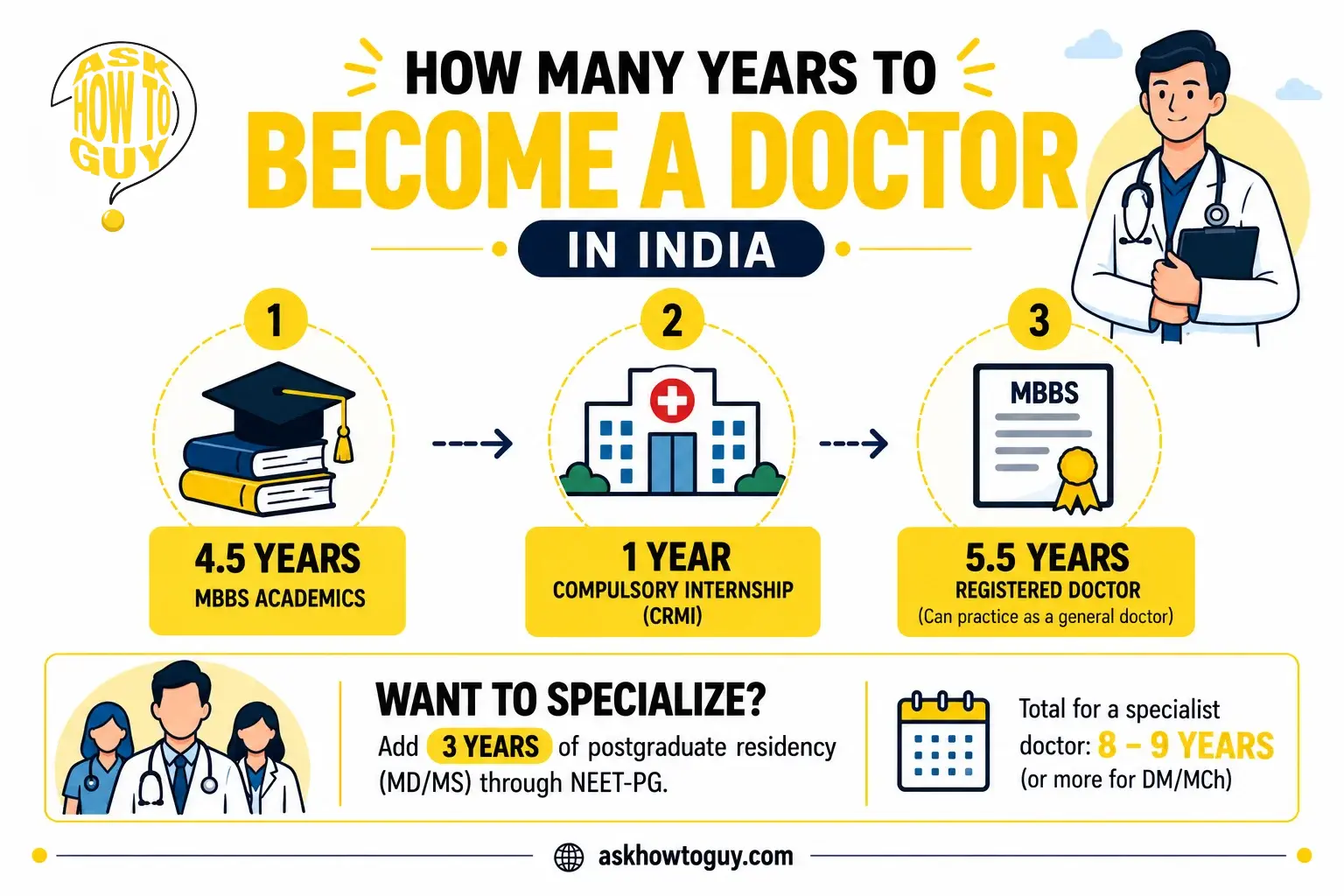
This is the number every aspirant and every worried parent wants straight: it takes a minimum of 5.5 years after Class 12 to become a registered doctor in India.
- 4.5 years (54 months) of MBBS academics – foundation course, pre-clinical, para-clinical and clinical phases
- 1 year of compulsory rotating medical internship (CRMI), done inside a recognized teaching hospital
That 5.5-year timeline gets you a license to practice as a general MBBS doctor. If you want to specialize – cardiology, surgery, dermatology, anything with “MD” or “MS” after your name – add another 3 years of postgraduate residency through NEET-PG. Realistically, a specialist doctor is looking at 8-9 years of training after school, sometimes more for super-specializations like DM or MCh.
A national licensing exam called NExT was meant to replace the current system, but as of 2026 the NMC has deferred its rollout by a few years – so NEET-PG remains the actual path to a postgraduate seat for now.
Government vs Private Medical Colleges: The Real Difference
This is where most families get stressed, and honestly, they’re right too. The gap is enormous.
Government medical colleges
Seats are allotted through the Medical Counselling Committee for the All-India Quota (15% of seats) or through your state’s own counselling body for the remaining 85%. Fees typically run from a few thousand rupees a year up to around ₹1-6 lakh for the entire course, depending on the college and state.
Private and deemed medical colleges
Fees swing from around ₹10 lakh a year at the more reasonable private colleges to well over ₹1 crore for the full course at the most expensive universities deemed to be. A handful of trust-run colleges – Christian Medical College, Vellore is the classic example – keep fees surprisingly close to government-college levels.
The honest advice: aim your NEET prep at a government seat first. It’s not just cheaper – the clinical exposure at busy government hospitals genuinely makes you a sharper doctor faster.
How Much Money Needed to Become a Doctor in India
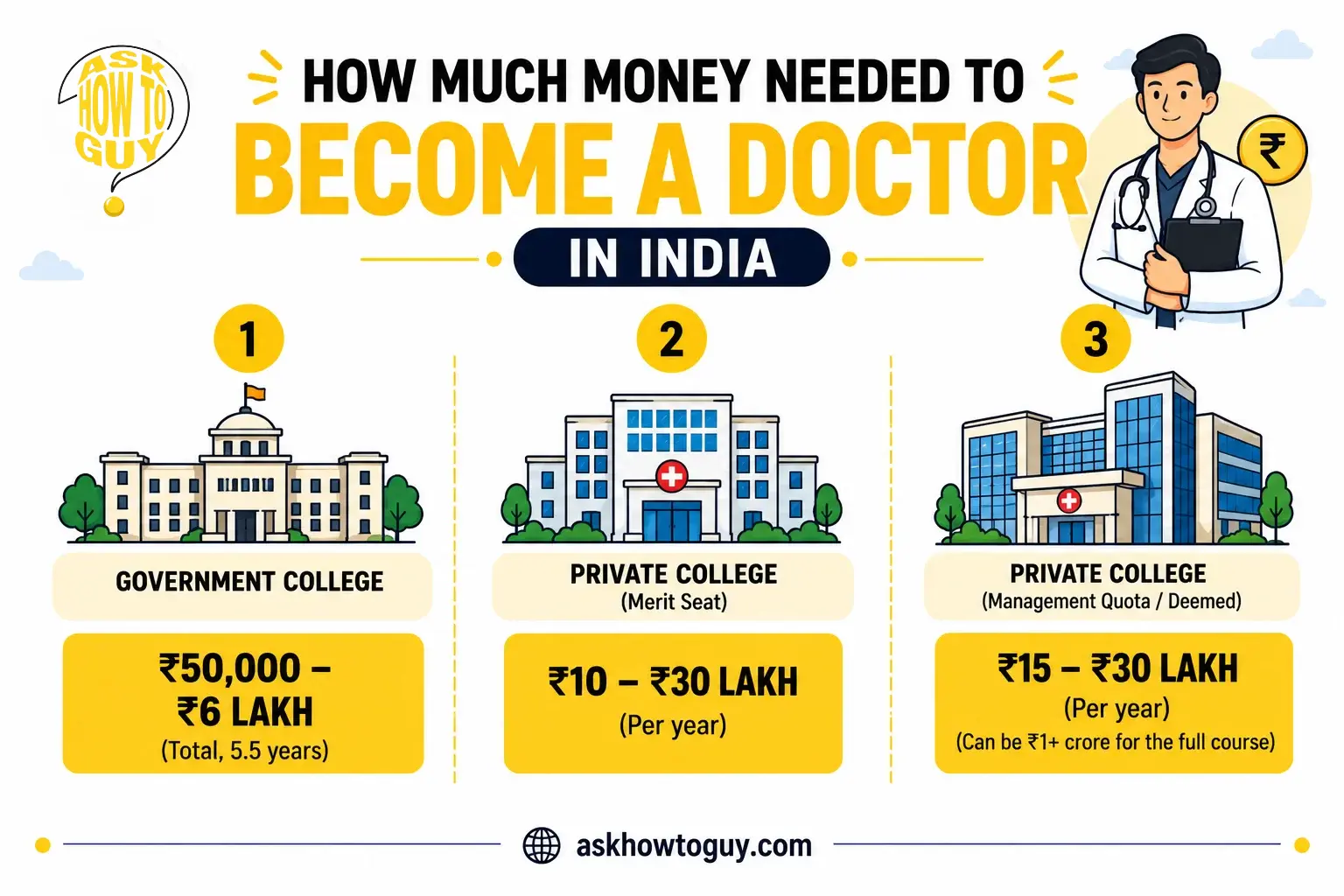
Numbers people actually search for, in one place.
- Government college, full 5.5-year course: roughly ₹50,000 to ₹6 lakh total, depending on the state and institute
- Private college (merit seat): roughly ₹10 lakh to ₹30 lakh a year
- Private college (management quota) or deemed university: roughly ₹15 lakh to ₹30 lakh a year, sometimes touching ₹1+ crore for the whole course
If a government seat doesn’t come through and private is the only option, most families lean on education loans from banks like SBI or Canara, which come with a moratorium period so repayment starts only after you graduate. Category-based scholarships can also chip away meaningfully at the total. If the MBBS cost feels out of reach, it’s worth comparing the investment against other long professional courses – becoming a Chartered Accountant is far cheaper, for instance, though the career itself looks very different.
Some states also attach a service bond to subsidized government seats – refuse the bond, and you may owe a penalty. Always check your state’s exact counselling and bond rules before choosing a college, not after.
Also Read: How to Become a CA
Life After MBBS: Internship, Registration, and NEET-PG
Getting the MBBS degree doesn’t make you a doctor yet – that happens after two more steps.
The CRMI internship
Your final year is spent rotating through departments – medicine, surgery, gynecology, pediatrics, emergency – under supervision, and government colleges typically pay a monthly stipend of around ₹17,000 to ₹30,000 during this period.
Medical registration
Once your internship is done, you register with your State Medical Council, and your name goes onto the National Medical Register. That’s the legal moment you become a licensed doctor in India.
NEET-PG, if you want to specialize
From here, most doctors either start practicing as an MBBS General Duty Medical Officer or sit NEET-PG to chase an MD or MS seat. A specialization reshapes your income, your working hours and your career ceiling – it’s the single biggest decision after MBBS.
How to Become a Surgeon in India
A lot of readers land on “how to become a doctor in India” with one specific picture in mind – scrubs, an operating table, a scalpel. Good news: the first half of the journey is identical to every other doctor. The surgery path only branches off after MBBS.
- Clear NEET UG and complete your 5.5-year MBBS, exactly like every other aspiring doctor
- Clear NEET-PG (or INI-CET for AIIMS, PGIMER and JIPMER) to win a seat in MS General Surgery
- Complete the 3-year MS General Surgery residency – this is where you actually start operating, first assisting, then performing procedures under supervision
- Optionally, go further with a 3-year MCh super-specialization in a field like neurosurgery, cardiothoracic surgery, urology or plastic surgery
Add it up and a general surgeon is looking at roughly 8.5 years of training after Class 12 – MBBS plus MS. A super-specialist surgeon, with an MCh on top, is closer to 11-12 years. It’s a longer road than general practice, but it’s also one of the more financially rewarding ones: entry-level general surgeons typically start around ₹10-14 lakh a year, climbing well past ₹30 lakh with experience and reputation.
Competition for MS General Surgery seats is fierce – seats are limited and demand is high – so a strong NEET-PG rank matters just as much as your original NEET UG score did.
Doctor Salary in India: What You’ll Actually Earn
This is the section every 12th-grader skips straight to, so here it is, without the sugar-coating.
- Fresh MBBS graduate (government): around ₹50,000 to ₹90,000 a month as a medical officer or junior resident
- Fresh MBBS graduate (private): around ₹30,000 to ₹70,000 a month, varying sharply by hospital and city
- MD/MS specialist (government): around ₹1.2 lakh to ₹3 lakh a month, once postgraduation is done
- MD/MS specialist (private, established): ₹2 lakh to ₹5 lakh a month is realistic in fields like radiology, surgery and anesthesia
- Super-specialists (DM/MCh) in high-demand fields: senior consultants in metro corporate hospitals can cross ₹10 lakh a month, though this sits at the very top of the range
The pattern is consistent everywhere: the real financial reward in medicine shows up years into your career, after specialization, not on day one. If money is the only reason you’re chasing this path, that patience requirement matters.
| 💬 The Guy’s Take Here’s what nobody tells you honestly enough: figuring out how to become a doctor in India isn’t really about being a genius. It’s about surviving a long, unglamorous grind – years of NEET coaching, a punishing MBBS curriculum, and an internship where you’ll be running on four hours of sleep more nights than you’d like. If that sounds exhausting rather than exciting, that’s worth sitting with before you commit your family’s savings to a private seat. But if the idea of a packed OPD, a tough diagnosis, or a 3 AM emergency call genuinely pulls you in – this is still one of the most respected, recession-proof careers this country has to offer. Start with your Class 11 PCB, build a real NEET study plan early, and don’t let one bad mock test convince you it’s over. Most doctors you admire failed a test or two on the way. |
Frequently Asked Questions
1. Can I Become a Doctor Without NEET?
No. NEET UG is mandatory for every MBBS, BDS or AYUSH seat in India – government, private, deemed university, or even NRI quota. There is no legitimate way around it, no matter what a college agent tells you.
2. Which Doctor Can Earn 5 Lakh per Month?
Established specialists and super-specialists in procedure-heavy fields – interventional cardiology, neurosurgery, cardiothoracic surgery, oncology and senior radiology consultants – are the ones most likely to cross ₹5 lakh a month, typically after 8-10+ years of training and practice in a metro city or reputed corporate hospital.
3. What Are the 7 Steps to Become a Doctor?
In short: pick PCB after Class 10, clear Class 12 with the required score, crack NEET UG, get through counselling into an MBBS seat, complete 4.5 years of academics, finish your 1-year CRMI internship, and register with the Medical Council to start practicing. That’s the full roadmap for how to become a doctor in India, from school to stethoscope.
4. Is 23 Too Late to Start MBBS?
Not even close. NEET UG has no upper age limit, so 23, 25 or even older aspirants can apply and compete on the same footing as anyone straight out of Class 12. What matters is your NEET score, not your date of birth.
Found this useful? Send it to whoever in your friend group is still deciding between NEET coaching and dropping a year but hasn’t picked a lane yet. Got a specific question about your NEET score, which college to pick, or whether that private seat is worth it? Drop it in the mail: hello@askhowtoguy.com!