
There’s always that one guy from your town – home twice a year, tanned from months at sea, and somehow driving a car nobody else your age can afford. Somebody mentions he’s “in the Merchant Navy,” and that’s usually the exact moment you start typing “how to become merchant navy officer” into Google at 1 AM.
Before anything else, clear this up: the Merchant Navy has nothing to do with the Indian Navy. No enlistment, no defence forces, no saluting anyone. Merchant Navy is the commercial shipping industry – cargo ships, oil tankers, container vessels – moving the world’s trade, crewed and captained by civilians, not soldiers. Confusing the two is the single most common mix-up in this entire search, so let’s not carry it forward.
Most people just type how to become merchant navy into the search bar, but what they actually mean is how to become merchant navy officer – the actual rank, salary, and career ladder, not just any job on a ship. This guide covers exactly that: the entrance exam, what to do right after 12th, the full path in India, and what it actually takes to work your way up to Captain.
Reality Check: Five Myths About Life in the Merchant Navy
| ❌ What People Think | ✅ What’s Actually True |
|---|---|
| Merchant Navy is basically the Indian Navy, just for cargo ships | Totally different worlds. Merchant Navy is commercial shipping – no enlistment, no defence forces, no military discipline. You work for a shipping company as a civilian officer, not the armed forces |
| It’s not a stable, permanent career | It’s a legitimate long-term career with a clear rank ladder – Cadet to Officer to Captain – you just work under contract-based sailing tours instead of one fixed office job |
| Any healthy person can join, the medical check is just a formality | DG Shipping’s medical standards are strict. Colour blindness, certain eyesight limits, and several health conditions can end this plan before training even starts |
| Seats are easy to get – ships always need crew | IMU CET alone pulls in over a lakh applicants for a limited number of seats. Getting in is genuinely competitive, and the training afterward isn’t a cakewalk either |
| Every officer is casually earning in dollars from day one | Pay climbs hard with rank and sea experience. A fresh Cadet’s stipend looks nothing like a Captain’s salary, even on the same ship |
Also Read: How to Become Customs Officer
| 🗺 VISUAL STEP MAP – How to Become Merchant Navy Officer | |
| Step 1 | Complete Class 12 with PCM Physics, Chemistry, Maths is compulsory, and most institutes want 60% aggregate, with English graded too. Get your eyes checked before you get emotionally invested – colour blindness or certain vision issues can end this path before it starts. |
| Step 2 | Clear IMU CET (or a college’s own entrance test) The common entrance exam run by Indian Maritime University – your gateway into every DG Shipping-approved maritime institute in the country. |
| Step 3 | Pick Deck or Engine and complete Pre-Sea Training Deck side means B.Sc Nautical Science or Diploma in Nautical Science (you navigate the ship); Engine side means Marine Engineering, B.Tech or Diploma (you run its machinery). Pick based on whether you’d rather be on the bridge or in the engine room. |
| Step 4 | Get your CDC (Continuous Discharge Certificate) Think of it as your seafarer’s ID. Without it, no ship signs you on – not even as a trainee. |
| Step 5 | Sail as a Cadet Mandatory sea time, usually 6 to 18 months depending on your course – actually working onboard and logging real sea service under supervision. |
| Step 6 | Clear your Certificate of Competency (COC) exams through DG Shipping This is the exam that upgrades you from Cadet to actual Officer – 3rd/2nd Officer on deck, or 4th/5th Engineer on the technical side. |
| Step 7 | Sign on as an Officer and start climbing From here it’s about logging sea time and clearing higher COC levels – which is also literally how to become captain in merchant navy or Chief Engineer, eventually. |
| ⏱ Total timeline: 4-6 years from Class 12 to becoming a certified Deck/Engine Officer (course length + mandatory sea time), depending on which course you pick. Reaching Captain or Chief Engineer realistically takes another 8-10+ years of sea experience and higher certificate exams on top of that. | |
How to Become Merchant Navy Officer in India
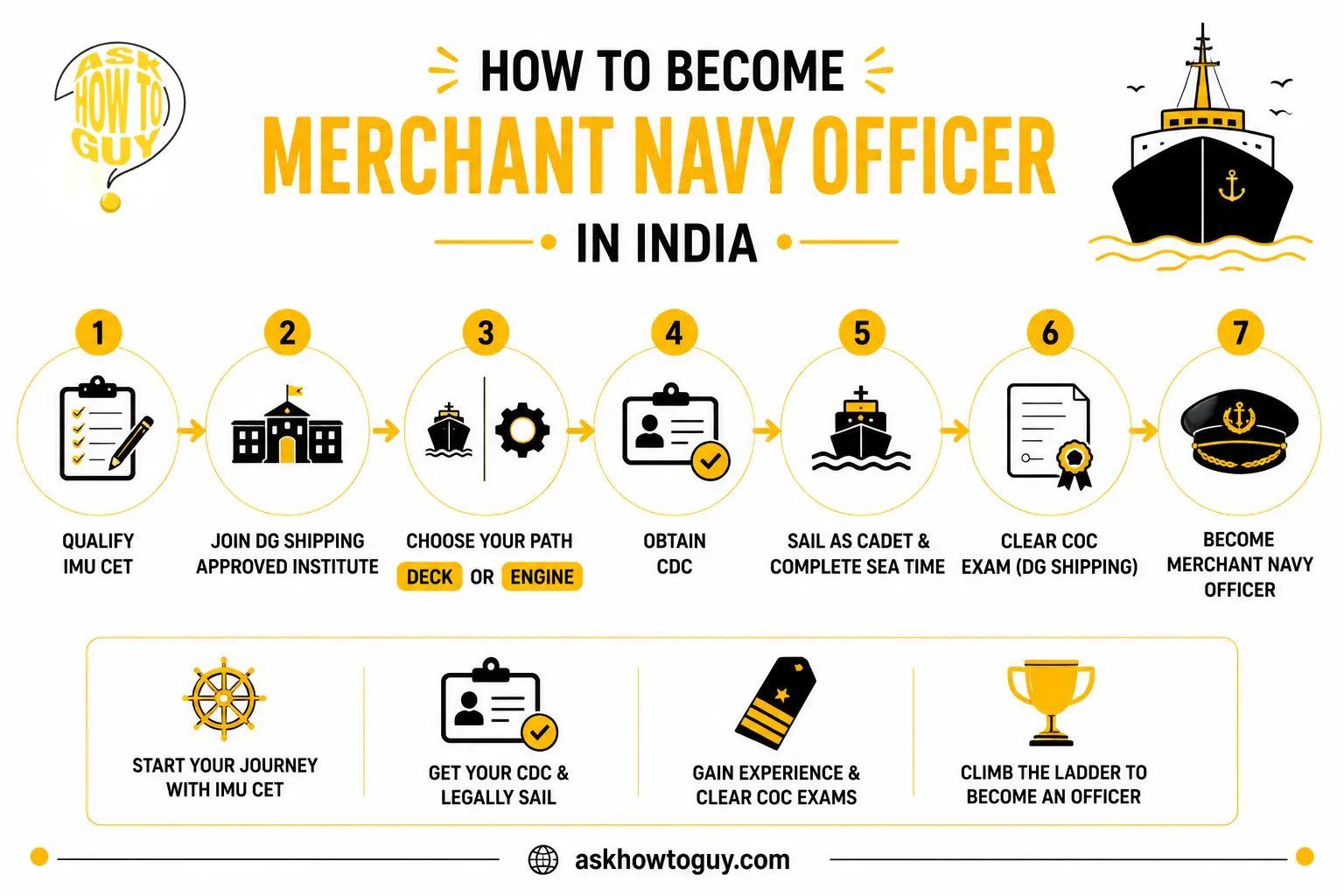
Here’s how to become merchant navy officer step by step, no skipping around. Everything starts with IMU CET, the Indian Maritime University’s Common Entrance Test – the exam that decides which DG Shipping-approved maritime institute you get into, and which course you’re eligible for. Some private institutes also run their own entrance tests, but IMU CET remains the most widely recognised route.
Once you’re in, you’ll pick a side: Deck or Engine. Deck cadets go through B.Sc Nautical Science (3 years) or the shorter Diploma in Nautical Science, and eventually navigate the ship. Engine cadets go through Marine Engineering – B.Tech or Diploma – and end up running the ship’s machinery. Neither is objectively “better”; they’re genuinely different day-to-day jobs, so pick based on what actually interests you, not which one your neighbour’s son chose.
Before you can sign onto a ship even as a trainee, you’ll need a CDC (Continuous Discharge Certificate) – your official seafarer’s identity document, issued once your medical fitness and training records clear DG Shipping’s standards. With that in hand, you sail as a Cadet, logging mandatory sea time under supervision – this is where classroom theory turns into actually knowing your way around a ship.
After enough sea time, you’ll sit for your Certificate of Competency (COC) exam through DG Shipping. Clearing it is what actually promotes you from Cadet to Officer – 3rd or 2nd Officer on deck, 4th or 5th Engineer on the technical side. From there, it’s a straightforward mix of experience and further exams. If the idea of working around ports and international trade appeals to you but you’d rather stay land-based and skip the months at sea, it’s worth also looking at how to become a customs officer – a very different exam route, but a career built around the same industry.
The Ministry of Ports, Shipping and Waterways oversees the entire sector, and DG Shipping enforces the actual certification standards – so every step here, from your CDC to your COC, ultimately runs through their approval.
How to Become Merchant Navy Officer After 12th
Still in Class 12 and trying to map this out? Here’s what actually matters: PCM – Physics, Chemistry, Maths – is non-negotiable, with most institutes asking for a 60% aggregate. English matters too, since a huge chunk of onboard communication and documentation happens in it.
Get a proper eye test done early, seriously, before you tell your whole family you’re joining the Merchant Navy. Colour blindness disqualifies you from the Deck side outright, and eyesight beyond a certain correctable range can rule out other roles too. Finding this out after a year of coaching is a genuinely common, genuinely avoidable heartbreak.
Once your 12th results are out, register for IMU CET the moment applications open – usually a few months before the exam, and yes, everyone in your batch will be talking about it non-stop by then. Decide Deck vs Engine before you apply if you can, since some institutes ask you to choose your stream at the application stage itself.
If PCM and NEET-style entrance exams aren’t your thing but you still want a career with genuine adventure and travel built in, plenty of students from the same stream also look at how to become a pilot – different skill set, different exam, but a similarly aspirational path.
Also Read: How to Become a Pilot
How to Become Captain in Merchant Navy
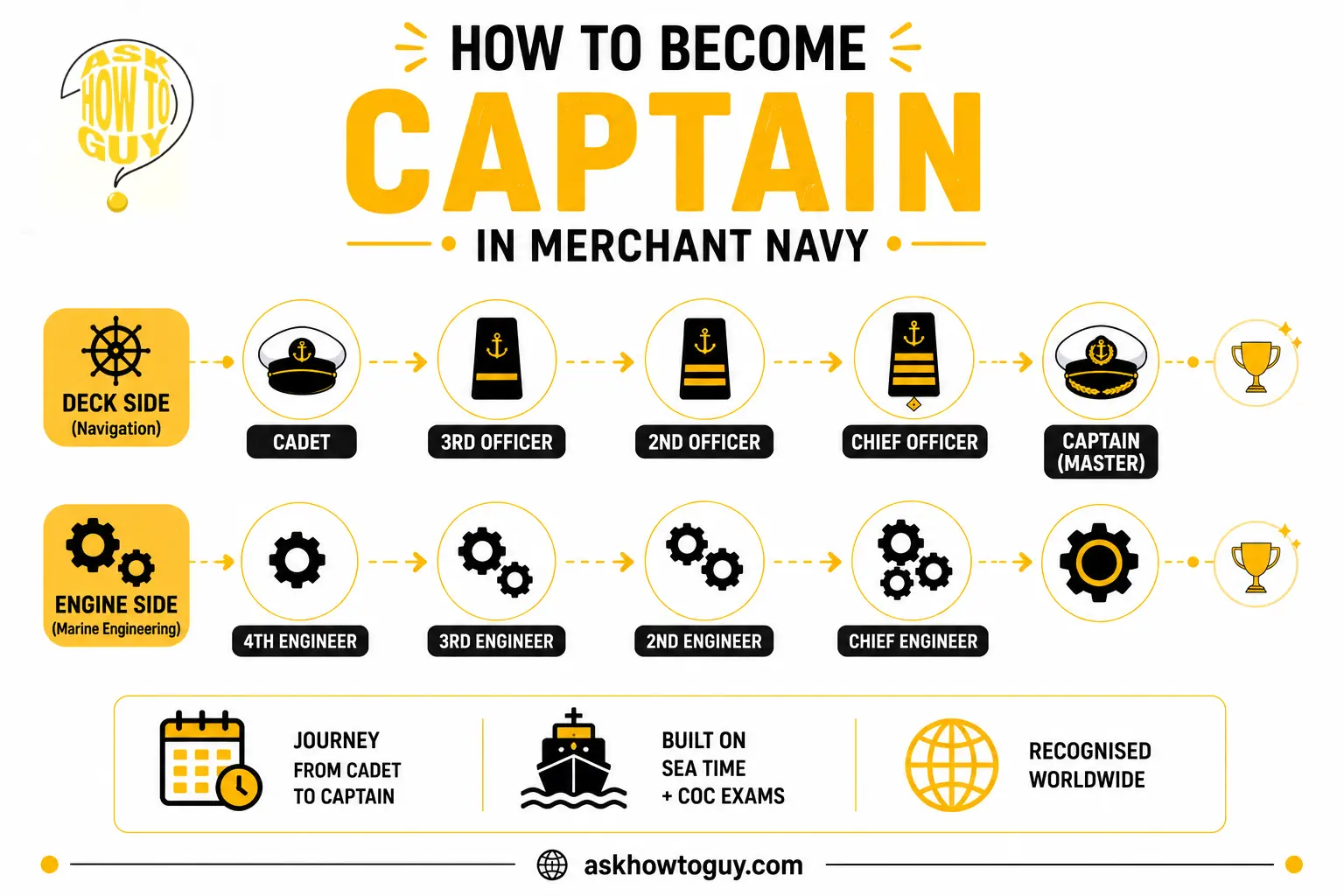
This is a genuinely different question from just getting in – Captain (technically called Master) is the top of the Deck hierarchy, and nobody starts there. The climb looks roughly like this: Cadet → 3rd Officer → 2nd Officer → Chief Officer → Captain, and each promotion needs both a minimum amount of logged sea time and clearing the next level of COC exam, right up to the Master’s certificate.
On the Engine side, the equivalent climb runs 4th Engineer → 3rd Engineer → 2nd Engineer → Chief Engineer. These certificate levels follow international standards set under the IMO’s STCW Convention, which DG Shipping enforces in India – so a Master’s certificate earned here is recognised on ships worldwide, not just Indian-flagged ones.
Realistically, going from Cadet to Captain takes somewhere around 10-15 years of accumulated sea experience, though it varies by company, how consistently you get sea time, and how quickly you clear each COC level. If you want to actually talk to people who’ve made that climb, the Company of Master Mariners of India is a professional body of working and retired Master Mariners that’s worth knowing about.
| 💬 The Guy’s Take Everyone who searches this has already met that one guy from their town driving a car he shouldn’t be able to afford yet – and nobody talks about the part where he’s missed two Diwalis in a row. That’s the trade-off nobody puts in the brochure: the salary is genuinely good, but you’re signing up for months away from home, patchy internet, and birthdays you’ll attend over video call. If that sounds fine to you, great, this is a solid career. If it doesn’t, figure that out before you burn a year prepping for IMU CET, not after. Also – actually decide between Deck and Engine based on what you enjoy, not because someone’s cousin said one pays more. Talk to an actual working officer if you can find one, even a random LinkedIn message. The people who last in this field aren’t the ones chasing the salary rumours; they’re the ones who genuinely didn’t mind the sea. |
Frequently Asked Questions
1. What Is the Qualification for Merchant Navy?
Class 12 with PCM (60%+ aggregate), a valid IMU CET score, admission to a DG Shipping-approved course (B.Sc Nautical Science, Marine Engineering, or a Diploma equivalent), a clean medical fitness certificate, and eventually a CDC and COC. That’s the full chain – there’s no shorter recognised route into an Officer’s rank.
2. What Is a Merchant Navy Salary?
It varies hugely by rank and company. A Cadet’s stipend during training is modest, but pay climbs sharply once you’re a certified Officer, and climbs again at Chief Officer/Chief Engineer and Captain level – often with tax advantages tied to time spent at sea. If a steadier, closer-to-home income matters more to you than a high but irregular one, it’s worth comparing this against something like how to become a bank manager, which trades a lower ceiling for a lot more stability and time at home.
3. Is Merchant Navy Easy to Get?
No – IMU CET alone draws well over a lakh applicants for a limited number of seats every year, and that’s before the medical fitness requirements and the actual training difficulty. It’s a genuinely competitive, genuinely demanding path, not a fallback option.
4.What to Do After 12th for Merchant Navy?
Short version: lock in PCM with a strong aggregate, get your eyes checked early, and register for IMU CET as soon as it opens. The full breakdown is in the After 12th section above.
5. Is Merchant Navy Permanent Job?
Yes, as a career it’s completely legitimate and long-term, with real promotion structure – but the day-to-day looks different from a typical permanent job. You work under contract-based sailing tours for a shipping company rather than clocking into one fixed office every day. If what you actually want is government-style permanence and staying in one city, careers like IAS officer run on a very different model worth comparing against.
6. Who Cannot Join the Merchant Navy?
Anyone who doesn’t clear DG Shipping’s medical fitness standards – colour blindness rules out Deck roles specifically, eyesight beyond a certain correctable range can disqualify you more broadly, and certain chronic health conditions are also grounds for rejection. The honest advice here is simple: get a proper medical check before you invest a year of coaching and money into this, not after.
Found this useful? Send it to that one cousin who’s been asking about ships since Class 10. Got a specific question about Deck vs Engine, or which institute is actually worth the fees? Drop it in the mail: hello@askhowtoguy.com!