
It’s probably 11pm and you’ve typed ‘how to become customs officer’ into Google for the fifth time this week. Maybe you’ve seen those airport seizure videos – someone’s bag gets pulled aside, gold bars come out, and you thought, “wait, that’s an actual job?”
Here’s the part most people get confused about: there’s no single “customs officer exam.” The role sits under the Central Board of Indirect Taxes and Customs (CBIC), and if you’re wondering how to join the customs department, there are two main routes – SSC CGL, which most people take, or UPSC Civil Services, which is tougher but lands you a higher rank from day one.
This guide breaks down both routes – how to become customs officer through SSC CGL, what it takes via UPSC, the airport posting question everyone asks, and what the salary actually looks like once you’re in uniform. If you’re wondering how to join custom department, understanding these recruitment routes is the first step toward planning your career in Indian Customs.
If UPSC is even slightly on your radar, our how to become an IAS officer guide covers that exam in depth – the Indian Revenue Service (Customs) is one of the services you can be allocated through it.
Reality Check: Let’s clear up the five things that confuse almost every first-time aspirant.
| ❌ What People Think | ✅ What’s Actually True |
|---|---|
| There’s one special “customs exam” | It’s SSC CGL (Group B/C) or UPSC CSE (Group A) – customs is a department you’re posted to, not a standalone test |
| You need a law or commerce degree | Any bachelor’s degree in any stream from a recognised university qualifies |
| Only Mumbai and Delhi airports have customs postings | Customs officers are posted at every major airport, seaport, and land border checkpoint across India |
| SSC CGL is just a desk job | Preventive Officers and Inspectors do real fieldwork – raids, baggage checks, anti-smuggling patrols |
| The pay is low for a government job | SSC CGL inspector roles start around ₹44,900 basic, with in-hand pay often ₹65,000-₹80,000 in metro postings |
Also Read: How to Become a Doctor in India
| 🗺 VISUAL STEP MAP – How to Become Customs Officer in India | |
| 📊 SSC CGL Route (Group B/C) | 🏛️ UPSC CSE Route (Group A – IRS Customs) |
| Step 1 Complete Class 12 in Any Stream – Science, Commerce, or Arts – no stream restriction for either exam. | |
| Step 2 Finish a Bachelor’s Degree – Any discipline from a recognized university. This unlocks both SSC CGL and UPSC eligibility. | |
| Step 3 Register for SSC CGL Notification on ssc.gov.in, usually mid-year. Age limit 18-30 (Gen) with category relaxations. | Step 3 Register for UPSC CSE Notification on upsc.gov.in in February. Age limit 21-32 (Gen), 6 attempts for General category. |
| Step 4 Clear Tier 1 & Tier 2 Tier 1 screens (GK, reasoning, quant, English); Tier 2 decides final merit and post allocation. | Step 4 Clear Prelims, Mains & Interview Prelims (filter), Mains (9 descriptive papers, main scoring), Interview (personality test). |
| Step 5 List CBIC / Customs Posts in Preferences Rank Preventive Officer, Inspector (Examiner) high – allocation follows rank + preference order. | Step 5 List IRS (Customs & IT) in Service Preferences Rank Indian Revenue Service (C&IT) in your preference form – allocation depends on rank + vacancy. |
| Step 6 Physical Endurance Test + Medical Preventive Officer & Inspector roles require a fitness/running test before final selection. | Step 6 Document Verification & Medical Standard post-selection checks – no separate physical endurance test for UPSC-route officers. |
| Step 7 Training at NACIN – Both routes require probationary training at the National Academy of Customs, Indirect Taxes and Narcotics before first posting. | |
| Step 8 First Posting – Airport, Seaport, or Land Border – CBIC decides posting based on vacancies and rank. Airport, seaport, or inland commissionerate – same process for both routes. | |
| ⏱ SSC CGL: 1-2 years of prep after graduation. | UPSC → IRS Customs: 4-6 years including attempts. | Both routes start with the same Class 12 + degree base. | |
The Two Real Routes – SSC CGL vs UPSC, Explained Simply
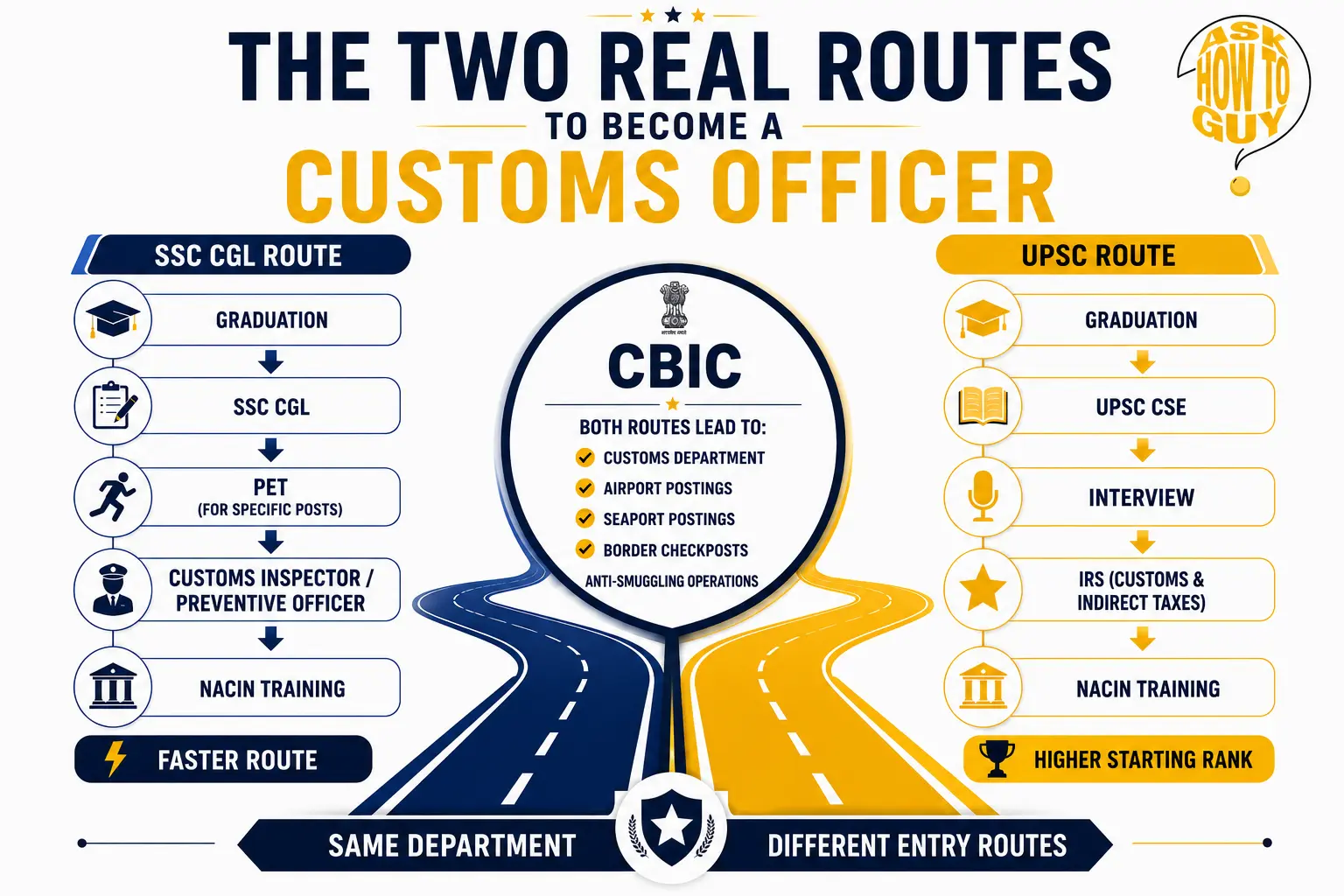
Route 1 : SSC CGL (Group B/C). This is the faster, more accessible path. After graduation, you sit for the SSC Combined Graduate Level exam – a two-tier test covering general knowledge, reasoning, quantitative aptitude, and English. A good rank gets you posts like Customs Inspector, Preventive Officer, or Examiner under CBIC. Preventive Officer and Inspector roles additionally require a Physical Endurance Test, since the job involves fieldwork – baggage checks, raids, and patrolling. Most candidates clear this in 1-2 attempts within a year or two of focused prep.
Route 2 : UPSC Civil Services (Group A). This is the harder but higher-ranked path. You sit for the same UPSC CSE that produces IAS and IPS officers – Prelims, Mains, and Interview – and list the Indian Revenue Service (Customs and Indirect Taxes) as one of your service preferences. Clear it with the right rank and preference, and you’re allocated as an Assistant Commissioner of Customs from day one, well above the entry rank of an SSC CGL recruit. The trade-off is difficulty and timeline – UPSC is widely considered one of India’s toughest exams, and most successful candidates take 4-6 years including 1-2 attempts. If UPSC is on your radar, our guides on how to become an IAS officer and how to become an IPS officer cover the same exam in depth — the prep is identical, only the service preference changes.
If you’re wondering how to join the customs department, there are two main routes as mentioned above: SSC CGL for posts such as Customs Inspector and Preventive Officer, or UPSC Civil Services for allocation to the Indian Revenue Service (Customs and Indirect Taxes). Both routes funnel into the same department – CBIC – and require training at NACIN (National Academy of Customs, Indirect Taxes and Narcotics) before your first posting. The difference is your starting rank, pay level, and how long it takes to get there.
How to Become a Customs Officer at Airport
This is probably the most-searched version of this question, and the honest answer is: the process is identical to becoming any other customs officer. There’s no separate “airport customs” exam or entry route.
What changes is your posting, not your qualification path. Once you clear SSC CGL (or UPSC and get allocated to IRS-Customs), your posting is decided by CBIC based on vacancies, your rank, and departmental requirements – which could be an international airport, a seaport, a land border checkpoint, or a city customs commissionerate.
Airports like Mumbai, Delhi, Bengaluru, and Chennai see heavy passenger and cargo traffic, so they typically have larger customs teams – more vacancies, in other words, not a separate exam. If working at an airport specifically matters to you, performing well enough to get a strong rank improves your odds of an early posting at a high-traffic location, but it’s never guaranteed on day one.
How to Become a Customs Officer in India – Eligibility at a Glance
Before applying through SSC CGL or UPSC, it’s important to understand the customs officer eligibility criteria and customs exam eligibility requirements. Whichever route you take, the baseline qualification is the same: a bachelor’s degree in any discipline from a recognized university – Engineering, Commerce, Arts, Science, all valid. Neither SSC CGL nor UPSC mandates a specific stream, and there’s no minimum percentage requirement at either level. Understanding these custom officer qualification requirements can help you check your eligibility before applying for the relevant recruitment examination.
The age limit for customs officer differ slightly by post and exam. SSC CGL posts linked to CBIC generally have an upper age limit of 30 years (with the usual SC/ST/OBC/PwBD relaxations), while UPSC CSE follows the standard 21–32 age window for General category candidates. Indian citizenship is mandatory for both.
Physical standards apply only to specific posts – mainly Preventive Officer and Inspector (Examiner) roles under SSC CGL, which involve fieldwork. If you’re aiming for a purely administrative customs role, the physical test typically doesn’t apply, but check the specific post notification since requirements can vary by recruitment cycle.
How to Crack the Customs Officer Exam – Preparation Strategy
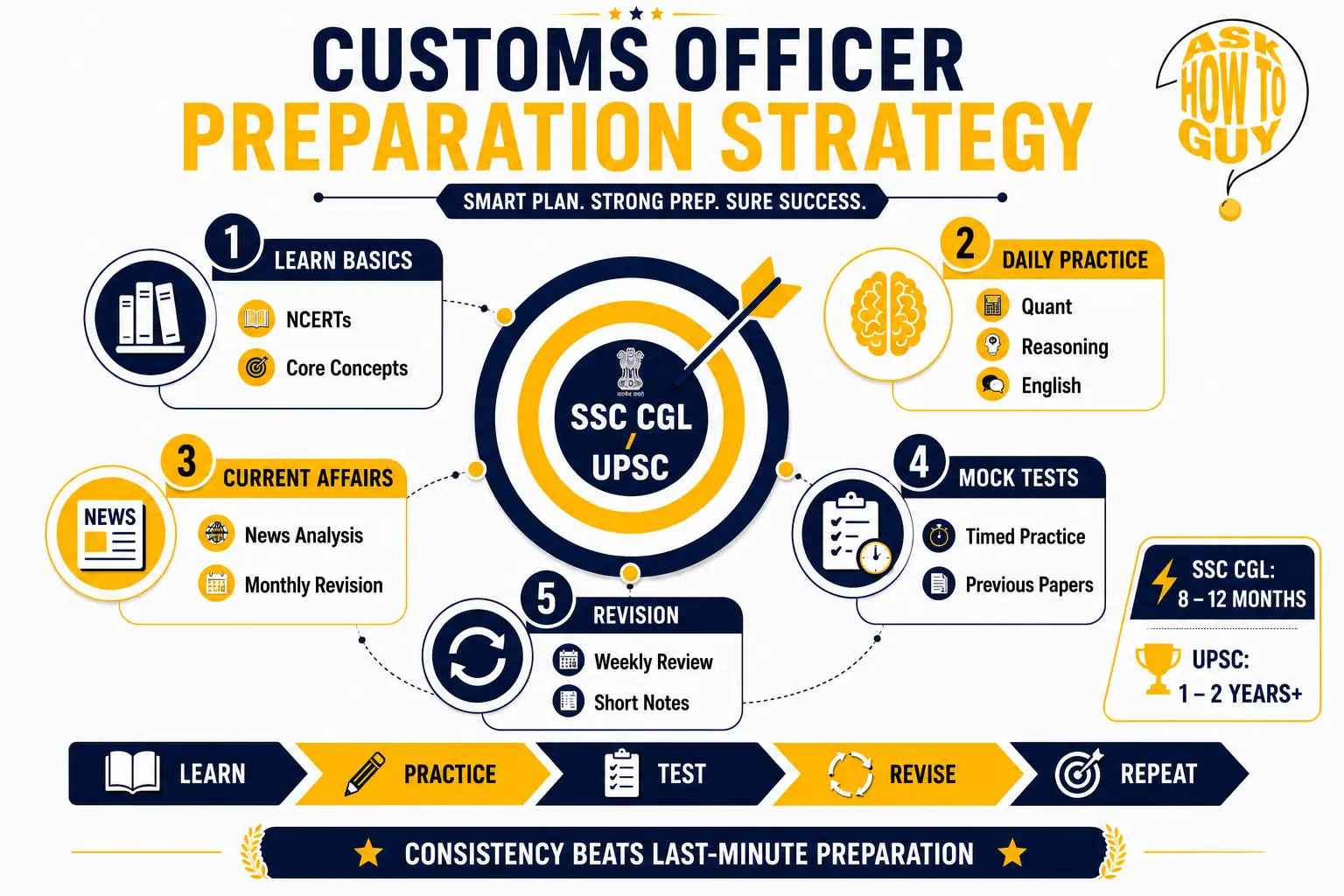
For the SSC CGL route, the syllabus across Tier 1 and Tier 2 covers General Awareness, Quantitative Aptitude, English Language, and Reasoning. Most successful candidates follow a fairly standard rhythm: NCERT-level basics for the first couple of months, followed by daily quant and reasoning practice, current affairs reading, and timed mock tests in the final stretch. Since the cutoffs for CBIC-linked posts tend to be competitive, consistency over 8-12 months usually outperforms last-minute cramming.
If you’re preparing for the UPSC route to IRS (Customs), the prep overlaps almost entirely with IAS and IPS preparation – General Studies papers, an optional subject, and current affairs. The only thing that changes at the end is your service preference list, where you’d rank Indian Revenue Service (Customs and Indirect Taxes) according to your priorities. Worth noting: SSC CGL also recruits Income Tax Inspectors through the same exam – if customs doesn’t come through in your first attempt, it’s a strong parallel path to consider.
Either way, don’t treat this as a side exam you can wing. Both SSC CGL and UPSC attract lakhs of applicants for a limited number of seats – a real study plan, not just “I’ll figure it out closer to the date,” is what separates people who clear it from people who attempt it for years.
Also Read: How to Become Merchant Navy Officer
Customs Officer Salary: What You Actually Earn
| Post / Route | Pay Level | Monthly (approx, with allowances) |
|---|---|---|
| SSC CGL Inspector / Preventive Officer | Pay Level 7 (₹44,900-₹1,42,400 basic) | ₹65,000-₹80,000 (metro posting) |
| SSC CGL entry (Pay Level 4-6 posts) | ₹25,500-₹1,12,400 basic | ₹35,000-₹65,000 |
| UPSC → Assistant Commissioner (IRS Customs) | Pay Level 10 | ₹56,100 basic + allowances, roughly ₹1,00,000-₹1,10,000 gross |
| Mid-career (10+ years, both routes) | Pay Level 11-12 | ₹1.2-1.5 lakh+ |
For most SSC CGL recruits, take-home pay in the first year lands between ₹65,000 and ₹80,000 in an X-tier (metro) posting, once Dearness Allowance, House Rent Allowance, and Transport Allowance are added to the basic pay. UPSC-route officers start at a higher pay level but with similar gross figures initially – the real gap in compensation and seniority opens up over the following decade as both tracks get promotions, with IRS officers typically moving up the ladder faster due to their starting grade.
| 💬 The Guy’s Take Everyone pictures the same scene when they think “customs officer” – someone in uniform at an airport, opening a suspicious suitcase. That job exists, but it’s one small slice of what CBIC actually does, and most people chasing this career don’t realize there’s a faster door in. SSC CGL is genuinely the practical route for most aspirants. It’s a one-to-two-year commitment, not a five-year one, and it lands you a real Group B government job with field postings, decent pay, and a clear promotion ladder. UPSC gets you a better starting rank, but it’s also UPSC – don’t sign up for that timeline unless you’re already prepping for IAS or IPS and customs is just one service on your preference list. If the goal is specifically “I want to work in customs, ideally at an airport, in a reasonable timeframe” – SSC CGL with Preventive Officer or Inspector as your target post is the straightest line there. Don’t overcomplicate it by chasing the harder exam for a job the easier one already gets you. |
Frequently Asked Questions
1. What is a custom officer’s salary?
It depends heavily on the entry route and post. SSC CGL Inspector and Preventive Officer roles fall under Pay Level 7 (₹44,900-₹1,42,400 basic), with in-hand pay typically ₹65,000-₹80,000 a month in metro postings once allowances are added. Officers who enter via UPSC and get allocated to the Indian Revenue Service (Customs) start at Pay Level 10, around ₹1,00,000-₹1,10,000 gross including allowances. Both tracks see steady increases with promotions over the years.
2. How to become airport customs officer in India?
The same way as any other customs officer – there’s no separate airport-specific exam. Clear SSC CGL (for Preventive Officer or Inspector roles) or UPSC CSE with IRS-Customs allocation, then your posting – airport, seaport, or land border – is decided by CBIC based on vacancies and your rank. Major international airports tend to have more customs vacancies simply because of higher passenger and cargo volume, which can make an airport posting more likely but never guaranteed from day one.
3. How to become customs officer at airport, specifically?
Same process as above – SSC CGL or UPSC, then a CBIC posting. If an airport posting matters to you specifically, focus on scoring a strong enough rank to have more say in your preference, since postings at high-traffic locations are allocated based on both rank and departmental need rather than personal request alone.
4. What is the age limit for customs officer?
The age limit for Customs Officer posts depends on the recruitment route and specific post. For SSC CGL posts such as Inspector (Examiner) and Inspector (Preventive Officer) under CBIC, the age limit is generally 18–30 years, with applicable age relaxations for eligible categories.
5. What qualifications do you need for customs?
The same baseline applies whether you’re asking how to become a custom officer or specifically how to become a customs officer in India through a particular route: a bachelor’s degree in any field, Indian citizenship, and clearing either SSC CGL or UPSC CSE. Some field-facing posts under SSC CGL additionally require meeting physical fitness standards and clearing a Physical Endurance Test.
6. Is a custom inspector a group B or C?
Customs Inspector and Preventive Officer posts recruited through SSC CGL are classified as Group B (non-gazette) positions, falling under Pay Level 7 of the 7th Pay Commission pay matrix. Some entry-level SSC CGL posts feeding into the broader CBIC ecosystem are Group C, but the customs-facing inspector and preventive roles specifically sit in Group B.
7. What is the salary for customs?
Across the department, salaries range widely by post and seniority – from roughly ₹35,000-₹65,000 in-hand for newer Group C/lower Pay Level recruits, to ₹65,000-₹80,000 for Group B Inspectors and Preventive Officers, up to ₹1 lakh+ for UPSC-route Assistant Commissioners and beyond as officers get promoted into mid and senior management over a 10-15 year career.
8. How to crack customs officer exam?
Treat it like any competitive government exam: pick your route (SSC CGL is faster and more common, UPSC is tougher but higher-ranked), get the syllabus early, and build a daily routine around quantitative aptitude, reasoning, English, and current affairs for SSC CGL – or the full General Studies and optional subject syllabus for UPSC. Mock tests in the last few months matter more than most people expect, since both exams are heavily time-pressured. Most successful candidates put in 8-12 months of consistent SSC CGL prep, or 1-2 years for UPSC.
Found this useful? Share it with someone weighing SSC CGL vs UPSC right now. Got a specific doubt about the Physical Endurance Test, post preferences, or NACIN training – drop it in the mail: hello@askhowtoguy.com!