
It’s probably 11pm and you’ve typed ‘how to become an IPS officer’ into Google for the fifth time this week. Maybe a cousin just cleared UPSC and now the whole family’s asking when you’re starting. Maybe you’ve watched one too many police dramas and thought, “wait, can I actually do that?”
Here’s what most articles skip: learning how to become an IPS officer isn’t really a separate exam from IAS. Before getting into the process, it’s worth knowing the IPS full form: Indian Police Service. It’s the same UPSC Civil Services Exam – same Prelims, same Mains, same interview. What decides whether you become an IPS officer or an IAS officer is your rank, your preference order, and a bit of timing.
This guide covers every angle of how to become an IPS officer in India – after 12th, after graduation, the qualification and age limit rules, what the salary actually looks like, and whether there’s any route that skips UPSC altogether.
Reality Check: Let’s clear up the five things that confuse almost every first-time aspirant
| ❌ What People Think | ✅ What’s Actually True |
|---|---|
| IPS has its own separate exam | Same UPSC CSE as IAS – one exam, multiple services, decided by rank and preference |
| You need a law or criminology degree | Any bachelor’s degree in any stream qualifies – Science, Arts, Commerce, Engineering, all valid |
| Only toppers get IPS | Good ranks help, but service allocation also depends on your preference order and category |
| There’s a shortcut that skIPS UPSC | Promotion from State Police Service exists, but it’s slow, rare, and not a real “shortcut” |
| IPS pay is just an average govt salary | Starts at ₹56,100/month and crosses ₹2,25,000/month at DGP level, plus housing and security |
Also Read: How to Become a Radiologist
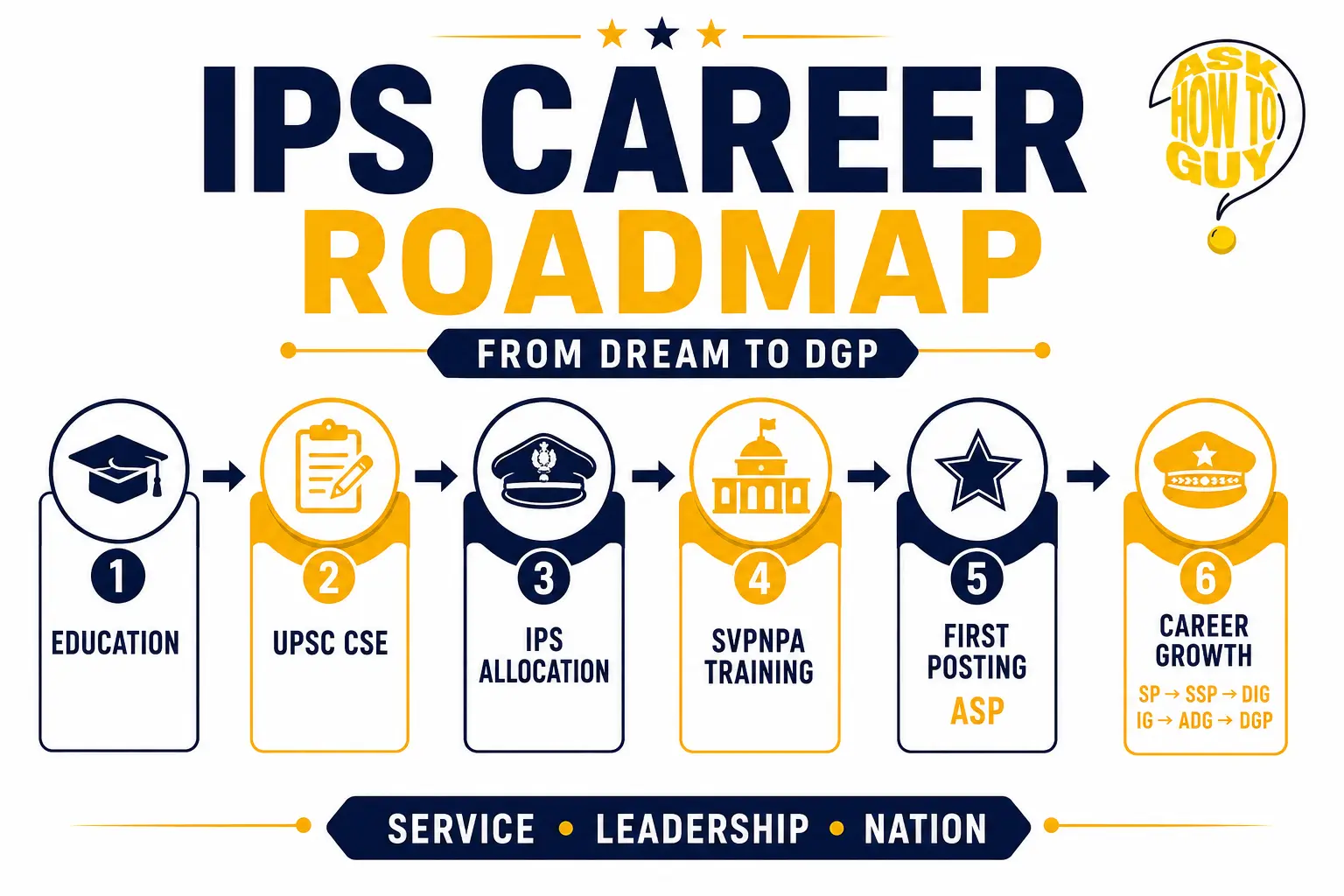
| 🗺 VISUAL STEP MAP – How to Become an IPS Officer | |
| Step 1 | Complete Class 12 in Any Stream No specific subjects required – Science, Commerce, or Arts all lead here. This is where how to become an IPS officer after 12th planning really starts. |
| Step 2 | Finish a Bachelor’s Degree Any recognised university, any stream. Final-year students can apply for Prelims while their results are pending. |
| Step 3 | Register for UPSC CSE Apply when the notification opens – usually February. Age window: 21-32 years for General category. |
| Step 4 | Clear Prelims (GS + CSAT) Objective papers – General Studies and CSAT. CSAT is qualifying only, but you still need 33% to clear it. |
| Step 5 | Clear Mains (9 Descriptive Papers) Essay, 4 GS papers, 2 optional papers, 2 language papers. This is where most of your final score comes from. |
| Step 6 | Clear the Personality Test (Interview) Board interview assessing your suitability for a service career – not just for IPS, but across all 24 services. |
| Step 7 | Service Allocation – IPS Cadre Your rank, category, and preference order decide allocation. Choose IPS as a high preference if it’s your goal. |
| Step 8 | Training at SVPNPA, Hyderabad Probationary training at the Sardar Vallabhbhai Patel National Police Academy, followed by your first field posting as ASP. |
| ⏱ Realistic timeline: 4-6 years from Class 12, including degree + 1-2 attempts. Some clear it on the first attempt right after graduation. | |
The 8 Stages to Become an IPS Officer – Explained Simply
The Step Map above gives you the full picture at a glance. Here’s what each stage actually means in plain language.
Stage 1 : Class 12, any stream. UPSC doesn’t check your 12th subjects at all. Pick whatever stream genuinely interests you – it won’t help or hurt your IPS chances later.
Stage 2 : Bachelor’s degree. Any 3-year (or 4-year) degree from a recognised university works. Engineering, B.Com, B.A. in History – UPSC genuinely doesn’t care which one. Final-year students can apply for Prelims, but must show proof of the degree before Mains.
Stage 3 : UPSC CSE registration. The notification drops around February each year on upsc.gov.in. Applications are submitted through upsconline.nic.in — register early, the window closes in about 3 weeks. You must be between 21 and 32 years old (General category) as of August 1st of that year, with relaxations for OBC (up to 35) and SC/ST (up to 37).
Stage 4 : Prelims. Two papers – General Studies (counts toward your score) and CSAT (qualifying, need 33%). This stage is purely a filter; thousands clear it but only a fraction make it to Mains.
Stage 5 : Mains. Nine papers: Essay, four General Studies papers, two papers in your chosen optional subject, and two qualifying language papers. This is where the real scoring battle happens – and where your optional subject choice matters a lot. . The full UPSC CSE syllabus is available on the UPSC website; check it before locking in your optional.
Stage 6 : Interview. A 20-30 minute conversation with a UPSC board, assessing personality, awareness, and decision-making – not just rote knowledge. It carries real weight in your final rank.
Stage 7 : Service allocation. Once your final rank is out, UPSC allocates services based on rank, category, and the preference list you submitted. List IPS high if it’s genuinely your first choice – allocation doesn’t reward hesitation.
Stage 8 : Training and first posting. IPS probationers train at the Sthe Sardar Vallabhbhai Patel National Police Academy (SVPNPA) in Hyderabad, then head to their allotted state cadre as Assistant Superintendent of Police (ASP) for field training before their first independent posting.
Start to finish, the journey runs roughly 4-6 years from Class 12 – degree, prep time, and one or two attempts at the exam. It’s a long road, but it’s the same road every IPS officer in India has walked.
Also Read: How to Become a Customs Officer
How to Become an IPS Officer After 12th
You can’t sit for UPSC CSE right after 12th – a bachelor’s degree is mandatory. But “after 12th” planning is exactly where the smart aspirants start.
If you’re thinking about how to become an IPS officer after 12th, the move is to pick a degree you can genuinely sustain for three years – because UPSC prep runs parallel to your final year of college for most successful candidates. Start reading the newspaper daily, build your English, and get comfortable with one or two subjects you might pick as your UPSC optional later.
Many toppers begin NCERT-level groundwork – history, polity, geography – during their first or second year of college, not after graduating. That two-year head start is often the difference between clearing UPSC at 22 versus 26.
How to Become an IPS Officer After Degree
Once your bachelor’s degree is done – in any stream – you’re eligible to apply for UPSC CSE the moment the notification opens. This is the most direct version of how to become an IPS officer after degree: register, prepare, attempt Prelims, and keep going.
Final-year students don’t need to wait either. UPSC allows you to appear for Prelims while your final results are pending, as long as you can produce proof of the degree before the Mains exam stage. This rule alone shaves a full year off many people’s timelines.
How to Become an IPS Officer After Graduation
This is the standard route, and most successful IPS officers follow it: graduate, register for UPSC CSE, and begin serious preparation. How to become an IPS officer after graduation really comes down to three things – a realistic study plan, a Mains optional subject you can sustain for months, and the discipline to attempt the exam even if the first try doesn’t go perfectly.
Most candidates need 1-2 attempts. The age window gives General category candidates until 32, which means even someone graduating at 22 has roughly a decade of eligible attempts – 6 for General, 9 for OBC, and unlimited (within the age limit) for SC/ST.
How to Become an IPS Officer Step by Step
If you want the absolute condensed version of how to become an IPS officer step by step, here it is: finish 12th in any stream, complete a bachelor’s degree, register for UPSC CSE between ages 21–32, clear Prelims, clear Mains, clear the Interview, list IPS as a high preference during the Detailed Application Form, and train at SVPNPA once allocated.
That’s the entire sequence – no separate IPS-only exam, no alternate entrance test, no shortcut hiding in plain sight. The Step Map earlier in this guide visualises exactly this sequence.
For a deeper breakdown of the Prelims-Mains-Interview structure and preparation strategy, our how to become an IAS officer guide walks through the exact same exam – the only thing that changes is the service you’re allocated at the end.
| 💬 The Guy’s Take Here’s the thing nobody tells you about IPS aspirants – most of them didn’t actually want IAS and “settle” for police work. A lot of people genuinely want this one specifically, and that’s a good sign, because the job is different in a way that matters. IAS is files, policy, and administration. IPS is operational – you’re out there, leading a force, making calls that affect law and order in real time, often within months of finishing training. If that sounds more exciting than intimidating, that’s useful information about yourself. The exam doesn’t care which service you want more – it’s the same syllabus either way. So prepare for the full UPSC CSE, not an “IPS version” of it, because there isn’t one. Just make sure IPS sits near the top of your preference list when the time comes, because rank decides a lot, but preference decides the rest. |
Frequently Asked Questions
1. How to become IPS officer without UPSC
Strictly speaking, you can’t – not as a direct entrant. The only alternate route is promotion from the State Police Service (SPS) into the IPS cadre, which exists under the IPS (Appointment by Promotion) Regulations, 1955. Roughly one-third of IPS vacancies in a state cadre can be filled this way, but it requires years of distinguished service as a DySP or equivalent, a clean record, and a vacancy actually being available in the promotion quota that year. It’s a real path, but it’s slow, competitive in its own right, and not something you can plan toward at 22. If IPS is the goal and you’re young, UPSC CSE remains the only direct, reliable route.
2. how to become an SP without UPSC?
It can be possible to reach an SP-level post without entering the IPS through UPSC. One alternative is to join the State Police Service through the relevant State Public Service Commission, usually as a DySP/DSP, and progress through the promotion system. However, the exact route and promotion rules vary between states.
3. Can I become IPS in 2 years?
Only if you’re already a graduate and clear UPSC on your first attempt. From 12th standard, becoming an IPS officer takes much longer because a bachelor’s degree is mandatory.
4. What is the qualification for an IPS officer?
A bachelor’s degree in any discipline from a UGC-recognized university – there’s no restriction on stream and no minimum percentage. You also need to be an Indian citizen and fall within the age window of 21-32 years (General category, with relaxations for reserved categories).
Beyond the academic side, IPS specifically adds a physical standards check after selection – minimum height (roughly 165 cm for men, 150 cm for women, with some state-level variation), a minimum chest measurement for male candidates, and an eyesight standard. These aren’t checked at the application stage – they come up during the medical exam once you’ve been allocated to IPS, so they don’t stop you from attempting UPSC, but they do matter for the final cadre confirmation.
5. What is the IPS salary in India?
An IPS officer starts at a basic pay of ₹56,100/month at the Junior Time Scale (Assistant Superintendent of Police), under the 7th Pay Commission pay matrix (Pay Level 10). With Dearness Allowance, House Rent Allowance, and Travel Allowance added, the gross monthly package at entry level typically works out to roughly ₹1,05,000-₹1,10,000. After about 10 years of service, officers usually reach the Superintendent of Police or Senior Superintendent of Police rank, with basic pay between ₹78,800 and ₹1,18,500, and total in-hand pay in the ₹1.35-1.55 lakh range. At the apex – Director General of Police – basic pay reaches ₹2,25,000/month, before allowances. On top of the salary, IPS officers receive government housing, an official vehicle, security personnel, and a defined pension.
6. Is it tough to become IPS?
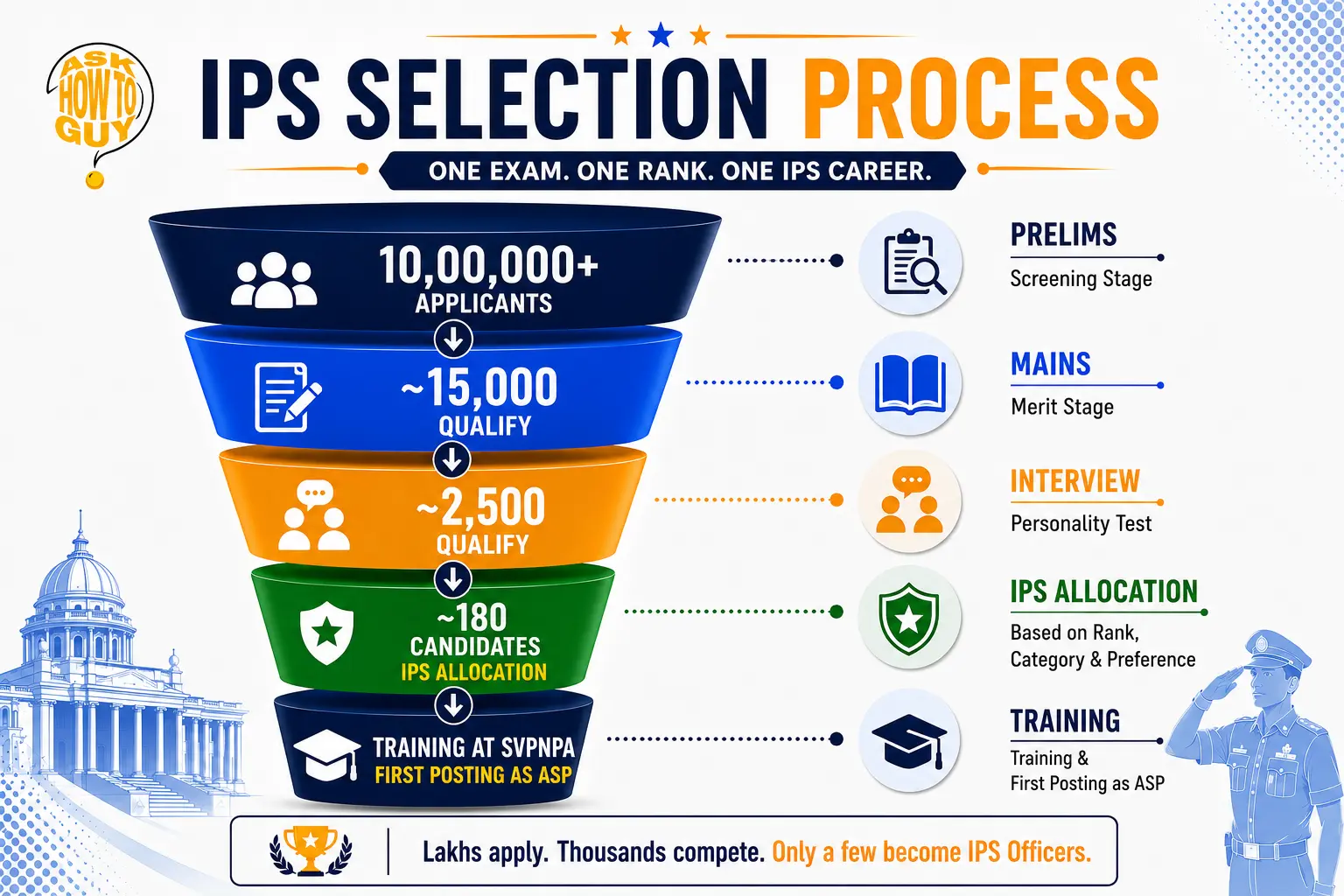
Yes – and it would be doing you a disservice to pretend otherwise. IPS comes through the same UPSC Civil Services Exam as IAS, which regularly sees over 10 lakh applicants competing for under 1,000 total civil service seats across all services combined.
7. Who is stronger, IPS or IAS?
This depends entirely on what “stronger” means to you — because IAS and IPS hold power in two genuinely different ways.
An IAS officer – say, a District Magistrate – holds administrative authority: policy implementation, government schemes, land records, disaster response, and overall coordination of every department in the district, including the police, in certain situations. An IPS officer – the Superintendent of Police – holds operational command over the police force itself: law and order, investigations, arrests, and field operations. The DM can direct the SP during a crisis like a riot or a VIP visit, which gives IAS a procedural edge on paper. But day-to-day, the SP runs the police independently – the DM doesn’t have operational control over individual cases or arrests.
Found this useful? Share it with someone weighing IAS vs IPS right now. Got a specific doubt about optional subjects, age relaxations, or the SVPNPA training – drop it in the mail: hello@askhowtoguy.com!