
Most people who Google ‘how to become a judge’ land on articles that list eligibility criteria and call it a day. That’s not helpful.
Here’s what those articles miss: there isn’t one single path. How to become a judge in India depends entirely on which court you’re aiming for. The district court route is a competitive exam. The High Court and Supreme Court are appointments – NO EXAM, EVER.
If you’re a law student, a fresh graduate, or someone who’s been going in circles on YouTube at midnight trying to figure this out – this guide is written for you. We’ll cover every route, every level, the real salary figures, and what nobody usually tells you about this career.
One more thing before we start. Knowing how to become a judge is only half the job. The other half is knowing which judge you want to be. That answer changes everything – your timeline, your preparation, your entire strategy.
Let’s kill the five myths that send most aspirants down the wrong path.
| ❌ What People Think | ✅ What’s Actually True |
|---|---|
| You need to be from NLU or a top law college | Any recognised LLB qualifies for the judiciary exam. College name doesn’t matter. |
| High Court and Supreme Court judges give exams | HC and SC judges are appointed by the collegium. There is no exam. Ever. |
| You need years of practice before applying | Many states allow direct entry right after LLB enrollment. No practice required. |
| The salary is average for a government job | District judges earn ₹1,44,840+/month. High Court judges earn ₹2,25,000/month fixed. |
| It takes 20+ years to reach the bench | You can become a Civil Judge in your mid-20s if you start planning from Class 12. |
India’s Court Hierarchy: Know This Before You Plan Anything
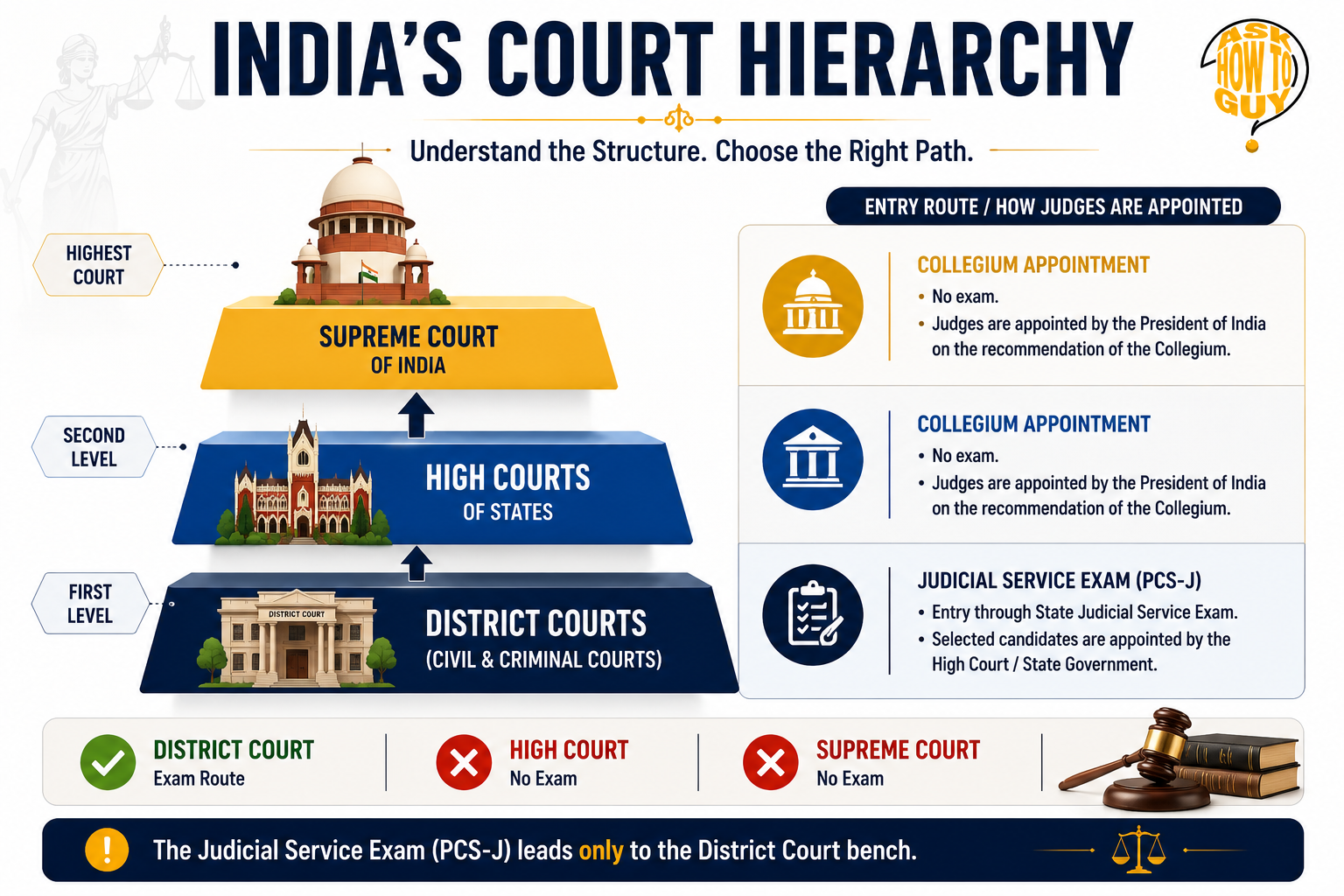
Here’s something most career guides skip. India’s judiciary is not one system with one entry point. It’s three separate tiers, each with a completely different entry route.
Get this wrong and you’ll spend a year preparing for the wrong thing.
| Court Level | Entry Route | Who Appoints |
|---|---|---|
| District Court (Civil Judge / Magistrate) | State Judicial Service Exam – PCS-J | High Court / State PSC |
| High Court | No exam – collegium recommendation only | President of India |
| Supreme Court | No exam – collegium recommendation only | President of India |
The exam route – the one you’re actually preparing for – only leads to the District Court. Everything above that is appointment-based. No coaching centre can prepare you for the High Court or Supreme Court. Time and a distinguished career do.
| 🗺 VISUAL STEP MAP – How to Become a Judge in India | |
| Step 1 | Complete Class 12 in Any Stream Science, Commerce, Arts – doesn’t matter. Most law colleges ask for 45-50% in Class 12. That’s it. |
| Step 2 | Get Your LLB – 5-Year or 3-Year After 12th: 5-year integrated BA LLB via CLAT. After graduation: 3-year LLB from any Bar Council of India-recognised college. |
| Step 3 | Enroll with a State Bar Council Non-negotiable step. Without this enrollment, you can’t appear in most state judiciary exams. Do this immediately after LLB. |
| Step 4 | Appear for the Judicial Service Exam (PCS-J) Your state’s High Court or PSC announces this exam every year. Check the notification, verify eligibility, apply the day it opens. |
| Step 5 | Clear Prelims → Mains → Viva Voce Objective Prelims, descriptive Mains on law subjects, and a viva conducted by sitting High Court judges. Three rounds, no shortcuts. |
| Step 6 | Training at State Judicial Academy After selection, you go through structured training before your first posting. Think of it as your onboarding to the bench. |
| Step 7 | First Posting – Civil Judge / Judicial Magistrate Your first posting is as a Civil Judge Junior Division or JMFC in a district court. This is where the real work begins. |
| ⏱ Realistic timeline: 7-10 years from Class 12. Shorter if you’re starting after graduation. | |
The 7 Steps to Become a Judge in India – Explained Simply
The Step Map above gives you the full picture at a glance. Here’s what each step actually means in plain language.
Step 1 – Complete Class 12 in any stream. Science, Commerce, Arts – the judiciary doesn’t care. Just clear Class 12 with at least 45-50% marks. That’s the only academic requirement at this stage.
Step 2 – Get your LLB. Either a 5-year integrated BA LLB right after Class 12 (via CLAT), or a 3-year LLB after any graduation. Both lead to the same place. The 5-year route is faster if you’re starting early.
Step 3 – Enroll with your State Bar Council. This is the step most people underestimate. Without this enrollment, you aren’t eligible to appear in the judiciary exam in most states. Do it the moment you finish your LLB.
Step 4 – Appear for the Judicial Service Exam (PCS-J). This is the competitive exam that leads to the district court bench. Every state holds it independently. Check your state High Court’s website for the notification – don’t miss the application window.
Step 5 – Clear all three rounds. Prelims is objective, covering law subjects. Mains is descriptive – think Civil Law, Criminal Law, Evidence Act, Constitutional Law. Then a Viva Voce in front of sitting High Court judges. All three need to be cleared in sequence.
Step 6 – Complete your judicial training. After selection, you go through a training programme at your State Judicial Academy. Duration and structure vary by state, but this is where you learn how the bench actually functions before you sit on it.
Step 7 – Your first posting. Civil Judge Junior Division or Judicial Magistrate First Class (JMFC) in a district court. This is it – you’re now a judge. From here, career progression runs on seniority, performance, and the High Court’s evaluation of your work.
The whole journey from Class 12 to first posting takes roughly 7-10 years. From graduation, it’s closer to 5-6. Hard? Yes. Impossible? Absolutely not – thousands of candidates crack PCS-J every year across states.
Also Read: How to Become a Lawyer
How to Become a Judge After 12th
This is actually the smartest route – and most people don’t take it because nobody explains it early enough.
If you want to become a judge after 12th, enroll in a 5-year integrated BA LLB or BBA LLB programme. You skip a separate graduation degree entirely. That’s 2 extra years you save.
Entry to the top NLUs is through CLAT (Common Law Admission Test). State universities have their own entrance exams. Most colleges ask for 45% in Class 12 – 40% for SC/ST. Finish at 22–23, enroll with the State Bar Council, start preparing for PCS-J. That means you could be sitting on the district court bench before your batchmates finish their MBA. That’s not a small thing.
How to Become a Judge After Graduation
Already done your graduation? You haven’t lost any advantage. You’ve actually gained one.
Enroll in a 3-year LLB programme from any Bar Council of India-recognised law college. Your stream doesn’t matter – Engineering, Commerce, Science, Arts – all fine.
After LLB, the path is identical for everyone: State Bar Council enrollment, then the Judicial Service Exam. The difference? You bring something the 5-year LLB students often don’t – a different way of thinking. An engineering grad who becomes a judge brings technical reasoning to the bench. A commerce graduate understands financial disputes differently. That background becomes an edge.
How to Become a Judge After LLB
LLB done. State Bar Council enrollment done. Now what?
The answer on how to become a judge after LLB is the Judicial Service Examination – also called PCS-J or HJS depending on your state. This is a state-level exam, not a central one. Every state runs it independently, on its own schedule, with its own eligibility rules.
That last part matters more than people realise. The minimum years of practice required, the upper age limit, the exam pattern – all of these vary significantly from state to state. Check your state’s specific notification before you build your prep plan.
| State | Conducted By / Key Notes |
| Uttar Pradesh | UPPSC – PCS-J exam. LLB enrollment needed. Senior posts require 3 years practice. |
| Maharashtra | MPSC – Maharashtra Judicial Service. LLB + 3 years enrollment for JMFC / Civil Judge posts. |
| Delhi | Delhi High Court recruits directly. LLB + Delhi Bar Council enrollment required. |
| Rajasthan | Rajasthan High Court – Direct recruitment. No minimum practice period for junior posts. |
| Karnataka | KPSC – Karnataka Judicial Service. LLB required. Enrollment period varies by post. |
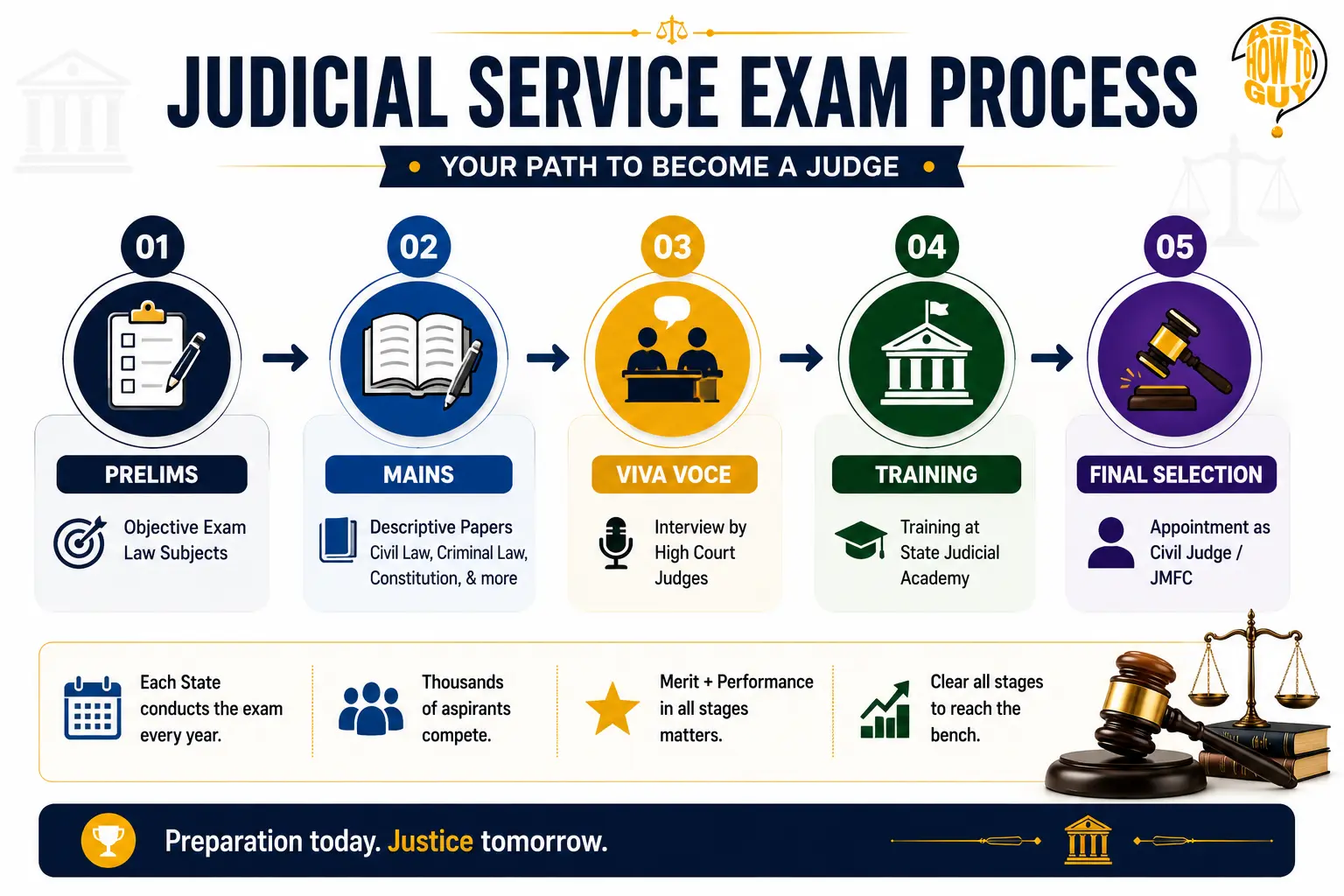
The exam itself has three rounds: Prelims (objective, MCQ – law subjects), Mains (descriptive – Civil Law, Criminal Law, Evidence, Constitution), and Viva Voce conducted by sitting High Court judges. Your preparation after LLB needs to be built around these three stages, not general legal knowledge.
How to Become a Judge in District Court
Let’s be specific about what this actually means.
If you want to know how to become a judge in district court, the answer is the State Judicial Service Exam. There are two levels: Junior Division (Civil Judge Junior Division / JMFC) and Senior Division (Civil Judge Senior Division / CJM). Junior Division is where everyone starts.
You need an LLB from a Bar Council of India-recognised institution and State Bar Council enrollment. Practice requirement varies by state – many states have zero minimum for junior posts. Age limit is typically 35 years for General category.
Once appointed, district court judges work entirely under the administrative control of the state’s High Court. Transfers, promotions, disciplinary matters – the High Court handles all of it. This is the career ladder you’re stepping onto.
How to Become a Judge in High Court
Stop looking for an exam. There isn’t one.
Becoming a judge in high court is an appointment – made by the President of India on the recommendation of the Supreme Court Collegium. The process is governed by Article 217 of the Constitution of India.
The eligibility: 10 years as an advocate in a High Court, or being recognised as a distinguished jurist. In practice, most HC judges are either long-serving district court judges who’ve been elevated, or senior advocates with decades of respected High Court practice.
There’s no application, no written test, no coaching centre that can help. The path to become a judge in high court runs through years of integrity, consistent legal work, and a reputation that the collegium takes notice of. That’s the honest answer.
How to Become a Supreme Court Judge
Same system, higher bar.
How to become a judge in supreme court is also a collegium appointment – no exam, no direct application. The process is governed by Article 124 of the Constitution. The President appoints on the recommendation of the Supreme Court Collegium, headed by the Chief Justice of India.
To become a supreme court judge you must either have been a High Court judge for at least 5 years, or have been an advocate in a High Court for at least 10 years. In reality, almost every appointment comes from the High Court bench – the advocate route is extremely rare.
The Supreme Court of India has 34 sanctioned positions including the Chief Justice. Vacancies open infrequently. This is not a career destination you plan toward at 25 – it’s what a 30-year distinguished judicial career can lead to.
Also Read: How to Become a Government Teacher
What Is a Judge’s Salary in India?
This is where most people are genuinely surprised. Judge salaries are governed by the recommendations of the Second National Judicial Pay Commission – not the standard civil service scale. The numbers are significantly better than most people expect.
| Post | Pay | Key Benefits |
|---|---|---|
| Civil Judge Junior Division / JMFC | ₹77,840/month | Govt housing, vehicle, medical, pension |
| Civil Judge Senior Division / CJM | ₹1,07,180/month | Official residence, staff, travel allowance |
| District Judge – Entry Level | ₹1,44,840/month | Bungalow, official vehicle, household staff |
| District Judge – Selection Grade | ₹1,65,480/month | Full official establishment |
| High Court Judge | ₹2,25,000/month (fixed) | Official residence, vehicle, security |
| Supreme Court Judge | ₹2,50,000/month (fixed) | Full official establishment, security detail |
| Chief Justice of India | ₹2,80,000/month (fixed) | 7, Lok Kalyan Marg, full establishment |
The in-hand amount is just the starting point. Add government housing in a good locality, an official vehicle, full family medical coverage, and a defined pension under the SNJPC recommendations. For a government career, the total package is genuinely hard to beat.
| 💬 The Guy’s Take Most people who ask how to become a judge in India are actually asking the wrong question. They should be asking: which court, and in what timeline? Because how to become a judge in district court – through a state PCS-J exam – is something you can realistically crack in your mid-20s if you start from Class 12. But how to become a supreme court judge or a judge in high court? That’s a 20–30 year journey, and nobody gets there by planning for it directly. They get there by being excellent at every step below it. Start with the district court. Be good. Be fair. Be consistent. The rest of the judiciary tends to notice. |
Frequently Asked Questions
1. How to become a judge after 10th
You can’t – not directly. An LLB degree is non-negotiable. But don’t wait either. Use Class 11 and 12 to start reading newspapers, build your English, and track how the Supreme Court thinks on current issues. Students who build this awareness before their LLB are typically better prepared than those who start from scratch in law college.
2. How to become a judge in Maharashtra
Appear for the Maharashtra Judicial Service Examination conducted by MPSC in coordination with the Bombay High Court. You need LLB from a recognised university + Maharashtra Bar Council enrollment + 3 years as an enrolled advocate. Three rounds: Prelims, Mains, and Interview. Posts include Civil Judge Junior Division and JMFC. Check mpsc.gov.in for the annual notification – don’t rely on coaching centres for the date.
3. How to become a judge of High Court
There is no exam. Appointment happens through the collegium system under Article 217 of the Constitution. You need 10 years as a High Court advocate or a distinguished reputation as a jurist. Most HC judges come either from the district court bench after years of service, or from senior advocate practice. Build your legal career first – the rest follows.
4. What is a judge’s salary in India?
As per the Second National Judicial Pay Commission: Civil Judge Junior Division – ₹77,840/month. District Judge (entry level) – ₹1,44,840/month. High Court Judge – ₹2,25,000/month fixed. Supreme Court Judge – ₹2,50,000/month fixed. Chief Justice of India – ₹2,80,000/month fixed. Government housing, vehicle, and medical benefits are additional.
5. How many years does it take to become a judge in India?
After Class 12: 5-year LLB + 1-2 years PCS-J prep = roughly 7-8 years to your first posting. After graduation: 3-year LLB + 1-2 years prep = 5-6 years. For High Court: 10-15 years of practice post-LLB before the collegium considers you. For Supreme Court: realistically 30+ years from LLB. The earlier you start, the more attempts you have.
Found this useful? Share it with someone stuck on this question. Got a specific doubt about a state’s PCS-J, CLAT prep, or the collegium process – drop it in the mail: hello@askhowtoguy.com!