
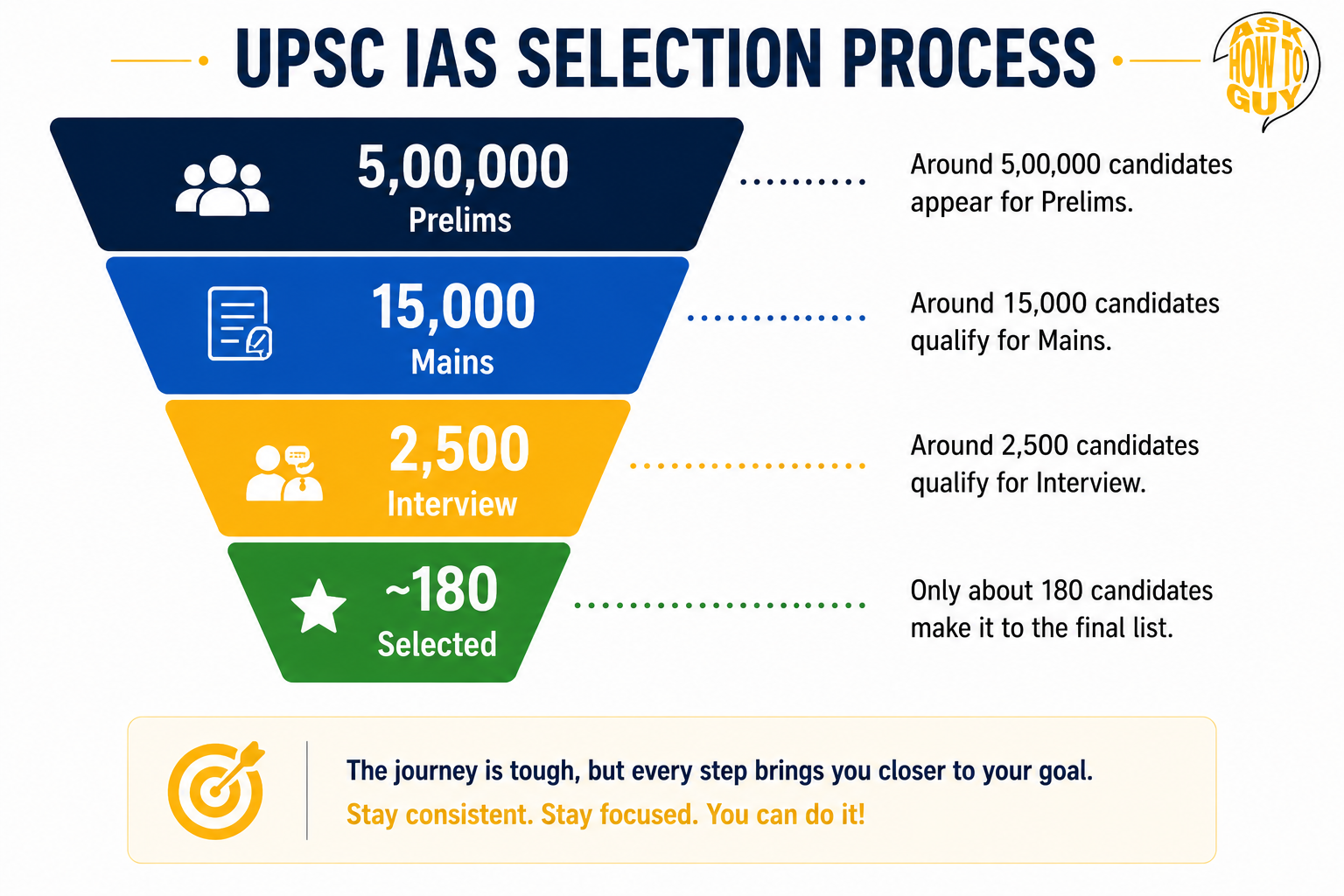
Every year, over 10 lakh students register hoping to become an IAS officer. Of those, roughly 180 actually make it. Not 180 thousand – 180 people.
That number isn’t here to scare you. It’s here to tell you something important: the ones who fail are not less intelligent. They’re less prepared, less consistent, or unclear on what the exam actually demands. If you’re reading this wondering how to become an IAS officer – whether you just finished Class 12, are in college, or are already on your second attempt – this guide gives you a clear, honest, no-jargon answer.
We cover everything: eligibility, age limit, the UPSC exam explained stage by stage, the best books to use, how to prepare for your first attempt, and what to do if things don’t go as planned. This is the step-by-step guide to becoming an IAS officer that most aspirants wish they had found earlier.
Before we get into the details, let’s clear up the five things most people get completely wrong about this journey.
| ❌ What People Think | ✅ What’s Actually True |
|---|---|
| You need to be from IIT or DU | Any recognised degree qualifies. Stream and college don’t matter. |
| Starting at 25 is too late | Most serious toppers begin between 24-27. Maturity matters here. |
| You need expensive coaching | Multiple AIR top-10 rankers cracked it using only free resources. |
| It takes a decade | With a clear plan, many people crack it in 2-3 attempts over 3-5 years. |
| You have to be a genius | The exam rewards consistency and clarity – not raw IQ. |
What Is an IAS Officer? (And Why This Career Is Different)
IAS stands for Indian Administrative Service – the most senior of India’s three All India Services, the other two being IPS (Police) and IFS (Foreign Service). When you hear “District Collector”, “DM”, or “District Magistrate”, that’s almost always an IAS officer. This is why many students searching for how to become a collector eventually find that the path begins with clearing the UPSC Civil Services Examination and getting selected for the IAS. They run districts, manage disaster relief, implement government schemes, and are typically the most powerful administrative authority in their region.
The career ladder looks like this: Sub-Divisional Magistrate → District Collector/DM → Divisional Commissioner → Secretary to State Government → and ultimately, positions like Cabinet Secretary of India – the highest-ranking civil servant in the country. That role is reserved for IAS officers.
It’s not a desk job. An IAS officer at 35 can be responsible for decisions that affect 30 lakh people – from flood relief operations to land acquisition disputes to public health infrastructure. That scale of impact is hard to find in any other career in India.
| 🗺 VISUAL STEP MAP – How to Become an IAS Officer Step by Step | |
| Step 1 | Complete Your Graduation Any stream, any recognised university. No minimum marks. Final-year students can also appear for Prelims. |
| Step 2 | Check Your Eligibility Age 21-32 for General category. Relaxations for OBC, SC/ST, PwBD. Each category has a fixed number of attempts. |
| Step 3 | Understand the UPSC Syllabus Download the official syllabus from upsc.gov.in. Around 60–70% of topics overlap. Don’t memorise it – understand it. |
| Step 4 | Choose Your Optional Subject Two Mains papers worth 500 marks total. Pick based on genuine interest and available study material – not just trends. |
| Step 5 | Build Your Foundation with NCERTs Class 6–12 NCERTs for History, Geography, Polity, Economics, and Science. Free at ncert.nic.in. Every topper starts here. |
| Step 6 | Appear in Prelims (Don’t Wait to Feel ‘Ready’) Real exam experience beats 100 mock tests. Your first attempt teaches you things no coaching institute can. |
| Step 7 | Clear Prelims → Shift to Mains Answer Writing Mains is 3-4 months after Prelims. Intensive answer writing practice is where your actual rank gets decided. |
| Step 8 | Clear Mains → Prepare for the Interview Fill your DAF carefully – the board uses it as their script for 45 minutes. Be a grounded person, not a walking encyclopaedia. |
| Step 9 | Cadre Allotment → LBSNAA Training → First Posting Two years of probationary training at the IAS Academy in Mussoorie before your first field posting. |
| ⏱ Realistic timeline from serious prep to first posting: 3-5 years. Most toppers wish someone had told them this upfront. | |
How to Become an IAS Officer: Age Limit and Number of Attempts
This is the first thing you need to check before anything else – because unlike other exams, UPSC has strict caps on both age and the number of times you can attempt.
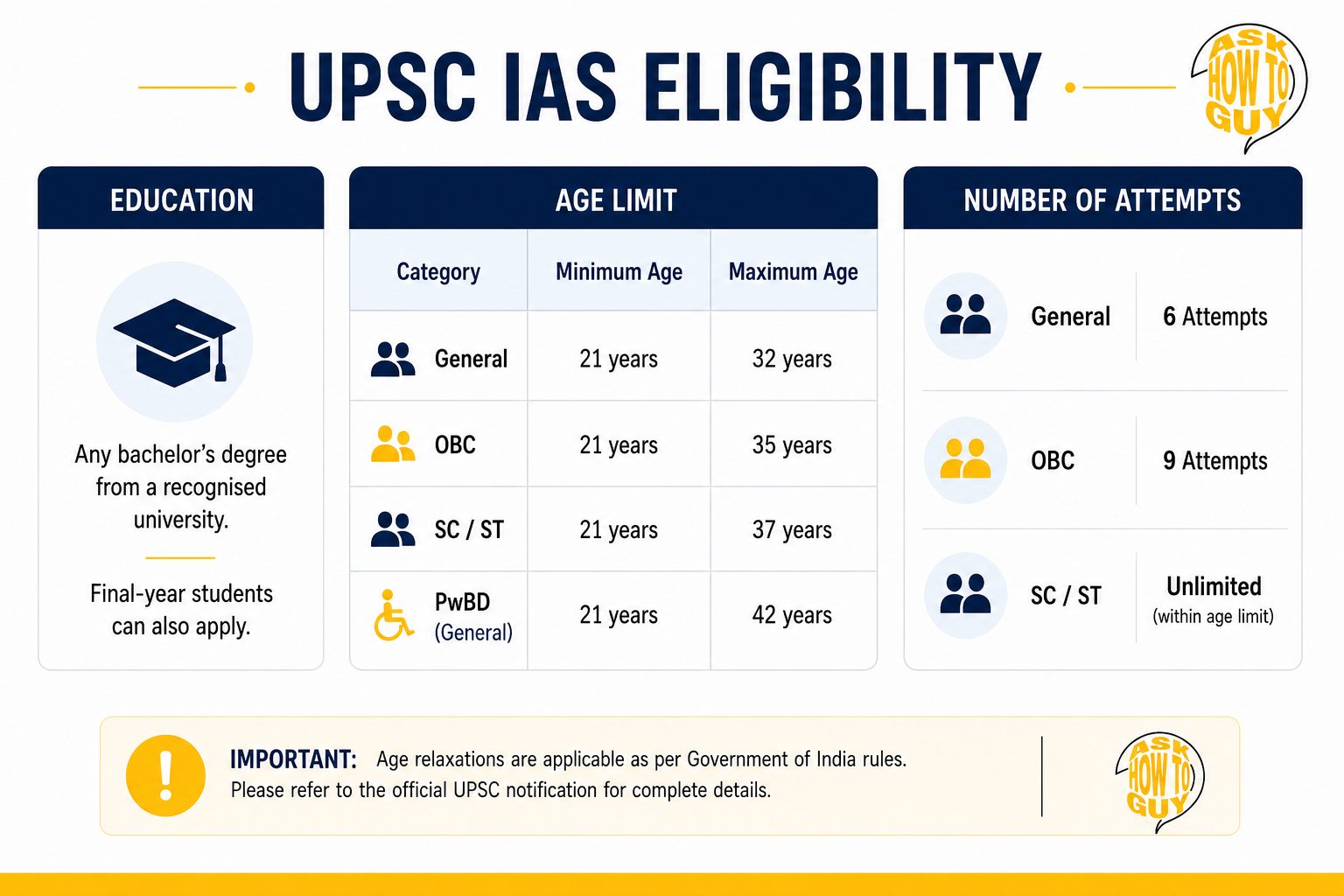
The minimum age is 21 for all categories. The maximum varies:
| Category | Maximum Age | Number of Attempts |
|---|---|---|
| General | 32 years | 6 attempts |
| OBC | 35 years | 9 attempts |
| SC / ST | 37 years | Unlimited (within age limit) |
| PwBD (General) | 42 years | 9 attempts |
| PwBD (OBC) | 45 years | 9 attempts |
| PwBD (SC/ST) | 47 years | Unlimited |
Source: UPSC Official Notification – Civil Services Examination
One question that comes up more than anything else: “Is 25 too late to start?” No – and this isn’t a motivational line. The 25-27 age range is actually when most serious toppers begin. The IAS exam rewards perspective, nuanced thinking, and the ability to form opinions on national issues. Those things tend to come with age, not despite it. What you should be careful about is burning through attempts when you’re not ready. If you’re 22 and just starting out, appearing once for “exam experience” is fine. But plan your attempts strategically – you have a finite number.
Also Read: How to become an IPS officer
How to Become an IAS Officer After 12th: What You Can (and Can’t) Do
A lot of aspirants ask this question – and the honest answer has two parts.
You cannot appear for the UPSC exam until you’ve completed graduation. That’s a hard eligibility rule. But if you’re in Class 12 or in your first year of college, you absolutely can – and should – start building your foundation right now.
Here’s what to do from Class 12 itself:
- Start reading a newspaper daily – The Hindu or Indian Express. Even 30 minutes a day builds an awareness foundation that will take years to develop otherwise.
- Go through NCERT textbooks for History (Class 6-12), Geography (Class 6-12), and Polity (Class 11-12). These are free at ncert.nic.in and are the starting point for every serious UPSC aspirant.
- Choose your graduation stream thoughtfully – not just based on what’s easy to pass. History, Political Science, Geography, Sociology, and Public Administration are all strong optional subject choices later. If you’re genuinely interested in one of these, aligning your graduation with your UPSC optional can save you significant preparation time.
- Follow UPSC trends – look at what topics appear repeatedly in previous year papers. You’ll start seeing patterns that most coaching students don’t notice until Year 2 of their preparation.
Students who begin this way before their graduation typically hit Prelims preparation running – and often crack it in their first serious attempt.
The UPSC Exam Has 3 Stages – Here’s What Each One Is Actually Testing
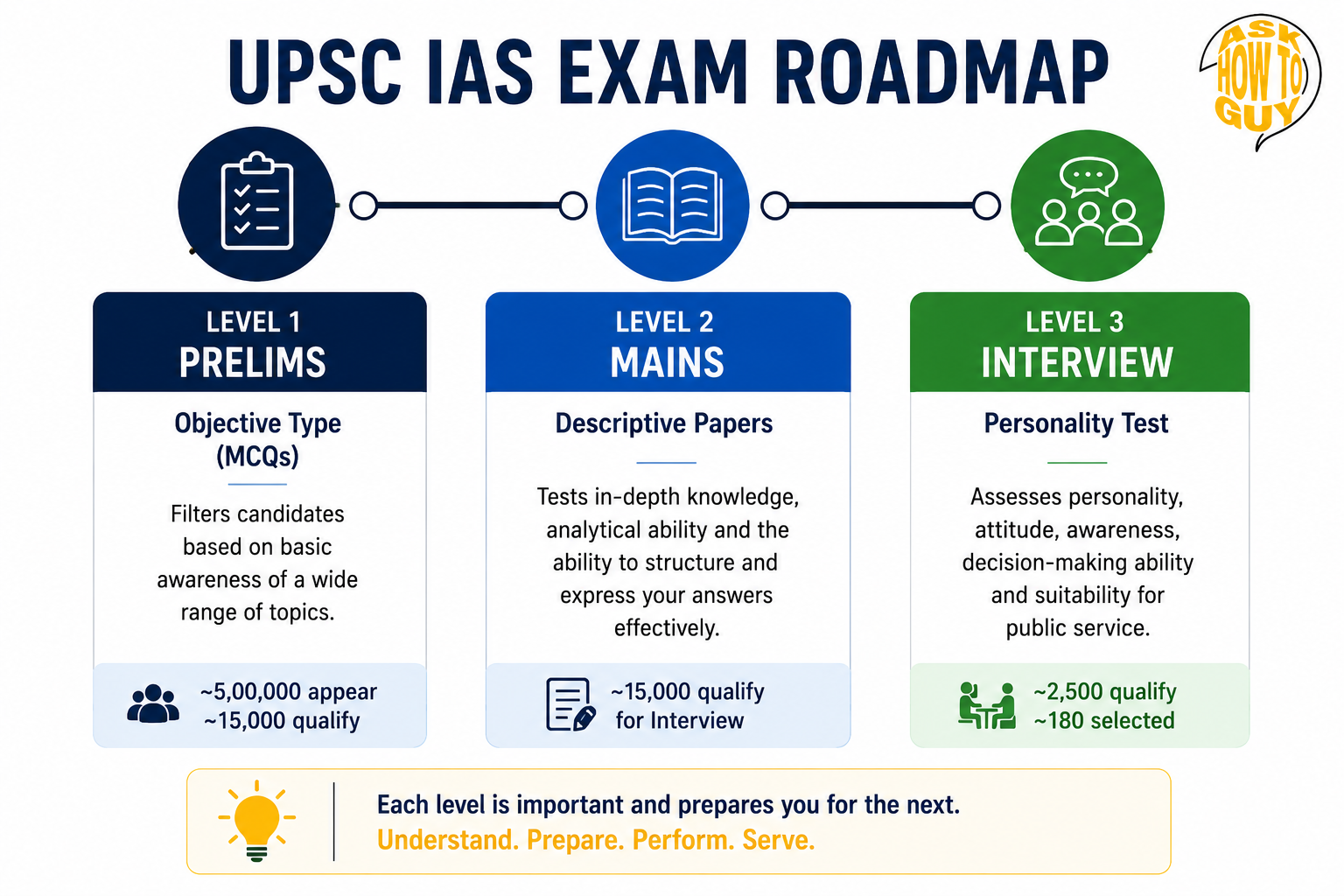
Most guides describe the format. What they don’t tell you is what each stage is designed to filter for. Understanding this changes how you prepare.
Stage 1: Prelims – The Breadth Filter
Prelims is one day, two papers. GS Paper 1 has 100 questions for 200 marks across history, geography, economy, polity, environment, and current affairs. CSAT Paper 2 has 80 questions for 200 marks – but it’s only qualifying; you just need 33%. Paper 2 marks don’t count toward your cutoff score.
Around 5 lakh people appear for Prelims every year. Roughly 15,000-20,000 clear it – about 3-4%. The exam is testing breadth of awareness, not depth. The single most effective preparation strategy: solve the last 10 years of UPSC Prelims papers. UPSC repeats topic patterns far more consistently than people realise. One thing most beginners underestimate: the -0.66 negative marking per wrong answer. Don’t guess blindly. If you’ve eliminated two of four options, attempt it. If you have no idea, skip.
Stage 2: Mains – Where Your Rank Is Actually Built
Mains is 9 descriptive papers spread over 5-7 days – one Essay paper, four General Studies papers, two Optional Subject papers, and two language papers (qualifying only). The marks that count toward your rank: 1750 from Mains and 275 from the Interview, totalling 2025.
Your optional subject is 500 of those 1750 marks – significant enough to shift your rank by 50-100 positions depending on how well you perform. Popular optionals include History, Geography, Political Science, Sociology, and Public Administration. Choose based on genuine interest and material availability, not just what’s trending on UPSC forums. The real separator in Mains is answer writing. The knowledge gap between candidates who qualify and those who don’t is smaller than you’d think. The writing gap – structured, balanced, time-pressured answers in 7-10 minutes – is where rank is truly decided. Most toppers spend at least 6 months doing nothing but answer writing practice.
Stage 3: The Interview – They’re Looking for a Person, Not a Bookshelf
The Personality Test is a 45-minute conversation with a five-member UPSC board. It carries 275 marks. The board uses your Detailed Application Form (DAF) – which you fill after clearing Mains – as their script.
The most common mistake candidates make is treating the interview like an oral exam. The board doesn’t want facts – they want to see how you think. Are you balanced? Do you hold a position under pressure without becoming defensive? Do you have self-awareness? Can you talk about your hometown, your graduation subject, or a current national issue like a real person and not a Wikipedia page?
Prepare your DAF thoroughly, have honest opinions ready on 3-4 major national issues, and remember: the board has seen thousands of candidates who’ve memorised answers. Stand out by being genuine.
How to Become an IAS Officer Step by Step: The Preparation Roadmap
Now that you understand what the exam is testing, here’s the actual preparation sequence – in order.
Step 1 – Read NCERTs Before Anything Else
Class 6 to 12 NCERT textbooks for History, Geography, Polity, Economics, and Science. Download them free at ncert.nic.in. Every serious UPSC aspirant – self-study or coaching – starts here. They build the conceptual foundation that makes all other reading faster and easier.
Step 2 – Move to Standard Reference Books
After NCERTs are done, these are the books that work. The key is to stick with them – don’t keep switching books chasing a “better” one:
- Polity: M. Laxmikanth – Indian Polity (read it at least twice)
- Modern History: Spectrum – A Brief History of Modern India
- Economy: Ramesh Singh – Indian Economy
- Art & Culture: Nitin Singhania – Indian Art & Culture
- Environment: Shankar IAS Environment (free PDF available online)
- Geography: NCERT + G.C. Leong for physical geography
Step 3 – Read a Newspaper Every Single Day
The Hindu or Indian Express – 45-60 minutes daily. Current affairs feed directly into Prelims GS, all four Mains GS papers, and the interview. After six months of this, you’ll start seeing the themes UPSC repeatedly examines. Keep a running notes file on important government schemes, Supreme Court judgments, environmental news, and India’s external relations. The Hindu ePaper is available free for students in some states.
Step 4 – Start Answer Writing by Month 4-5
Most beginners delay this until they feel “ready”. That’s the single biggest preparation mistake. Write one Mains-style answer per day starting no later than Month 5. Get it reviewed – by a mentor, a fellow aspirant, or platforms like Insights IAS or ForumIAS. You don’t need perfect answers early on. You need the habit of structured writing under time pressure, built gradually over months.
Step 5 – Appear in Prelims Every Year
Even if you don’t feel fully prepared. Real exam experience – the pressure, the timing, the question framing – teaches you things that no mock test can replicate. Your first attempt is often your best learning experience. Many candidates who eventually got top-100 ranks describe their first Prelims as the turning point that showed them exactly what was missing.
How to Become an IAS Officer: Books That Actually Work
There are hundreds of books marketed at UPSC aspirants. Most aren’t worth your time. The ones below have been consistently recommended by toppers across years and categories – they work because they’re thorough without being unnecessarily verbose.
| Subject | Book | Why It Works |
|---|---|---|
| Polity | Indian Polity – M. Laxmikanth | Covers everything UPSC asks on Constitution, Parliament, and governance. Non-negotiable. |
| Modern History | Spectrum – Brief History of Modern India | Concise, well-structured, covers the colonial period and independence movement in exam-ready depth. |
| Economy | Indian Economy – Ramesh Singh | Clear explanations of macro and micro concepts. Updated regularly. Aligns well with UPSC question patterns. |
| Art & Culture | Indian Art & Culture – Nitin Singhania | The only dedicated Art & Culture book that covers UPSC’s exact requirements. Hard to replace. |
| Environment | Shankar IAS Environment | Free PDF, comprehensive, and closely aligned with UPSC’s ecology and environment questions. |
| Current Affairs | Vision IAS Monthly Magazine | Free, reliable, well-organised. Covers national and international events through a UPSC lens. |
For UPSC previous year papers (free official source): upsc.gov.in – Previous Year Question Papers
Also Read: How to become customs officer
Coaching or Self-Study? Here’s the Honest Answer
Let’s be direct about this because coaching centres will never tell you the truth.
You don’t need coaching to become an IAS officer. That’s a fact, not a motivational line. Multiple AIR top-10 rankers in recent years – including rank holders from Tier 2 and Tier 3 cities – cracked UPSC entirely through self-study using free resources.
That said, coaching isn’t useless. It genuinely helps in two specific areas: structured test series with evaluation (mock Prelims and Mains with scored feedback) and interview preparation (mock interviews with experienced panellists). If you can afford coaching, use it for these two things. For foundation building – reading, notes, understanding concepts – you can do that entirely on your own.
Free resources that are genuinely excellent:
- NCERT books – free at ncert.nic.in
- UPSC previous papers – free at upsc.gov.in
- Mrunal.org – excellent for Economy and History, clear and no-nonsense
- Drishti IAS YouTube channel – strong for Hindi medium aspirants
- Insights IAS – answer writing platform with partial free access
- Vision IAS free monthly current affairs magazine
How to Become an IAS Officer at the First Attempt: What It Actually Takes
Cracking UPSC in the first serious attempt is rare – but not impossible. Around 15-20% of final selections in recent years were first-attempt qualifiers. What separates them isn’t intelligence. It’s the quality of their preparation strategy from Day 1.
Here’s what consistent first-attempt qualifiers typically do differently:
- They start with the UPSC syllabus and previous papers – not coaching material. They understand what the exam actually asks before deciding what to study.
- They choose their optional subject in the first two months – based on genuine interest, not what’s popular on forums – and stick with it.
- They begin answer writing by Month 4-5 at the latest, and get regular feedback. Not when they feel ready.
- They treat newspaper reading as non-negotiable – not something they’ll start “next month”.
- They solve 10 years of previous Prelims papers and analyse every wrong answer to understand UPSC’s exact questioning style.
According to UPSC’s annual report data, the average age of successful IAS candidates is approximately 26-27 years -which means most toppers have had one or two learning cycles before their final success. If you’re on your first attempt, aim to learn from it whether you clear it or not.
IAS Officer Salary and Career Progression
Starting base pay as an IAS probationer is around ₹56,100 per month (Level 10 of the 7th Pay Commission). But base pay alone dramatically underrepresents the actual compensation package.
The real value comes from what the pay slip doesn’t show:
- Government housing – Type V or Type VI bungalow in most postings, equivalent to ₹50,000-₹1.5 lakh/month in rent
- Official vehicle with driver, available 24 hours
- Household staff (orderlies)
- Full medical coverage for the officer and dependants
- Defined-benefit pension – guaranteed, not market-linked
- Travel allowances and official hospitality entitlements
Career progression:
| Career Stage | Typical Role | Years of Service |
|---|---|---|
| Early career | SDM, Joint Secretary (State) | 1-5 years |
| Mid career | District Collector / DM | 6-16 years |
| Senior | Divisional Commissioner, Secretary to Govt. | 17-25 years |
| Top | Principal Secretary, Chief Secretary | 26-35 years |
| Apex | Cabinet Secretary of India | 35-37 years |
What If I Fail? The Question Every Aspirant Thinks but Rarely Asks
Here’s the truth most guides skip: almost everyone fails at least once. Including people who eventually got AIR 1.
Roman Saini failed before becoming a doctor and then clearing UPSC. IFS topper Srushti Jayant Deshmukh has spoken openly about the uncertainty of the journey. The difference between those who eventually succeed and those who stop isn’t talent – it’s how specifically they analyse their failure.
If you didn’t clear Prelims: Look honestly at your newspaper reading habit, your previous paper practice, and your factual accuracy in GS Paper 1. Usually it comes down to 1-2 specific subject gaps. Fix those precisely – don’t overhaul your entire strategy.
If you didn’t clear Mains: Answer writing is almost always the issue. You might know the content but struggle to structure it under time pressure. The next cycle should be heavily focused on daily writing practice from Month 4 onwards.
If you’re running out of attempts: State PSC exams – Maharashtra PSC, UPPSC, Karnataka PSC – are genuinely impactful careers, not consolation prizes. SSC CGL opens positions in Income Tax, Customs, and Audit. The analytical depth and communication skills you’ve built through UPSC preparation are rare – and the corporate world has started recognising that seriously over the past five years.
You haven’t wasted years. You’ve built something genuinely uncommon.
| 💬 The Guy’s Take Here’s what I’d tell a younger sibling sitting down with this question: the exam is hard, but it isn’t mysterious. Most people who fail aren’t less smart – they studied without a clear plan, picked an optional they didn’t enjoy, or kept postponing answer writing until it was too late. If I had to give you one piece of advice, it would be this: start writing Mains-style answers from Month 4, even when they’re terrible. The improvement you’ll see in six months of daily writing practice will do more for your rank than any additional book. For everything else – NCERTs first, newspapers every day, previous papers religiously. That’s the whole formula. No secret, just consistency. |
FAQs
1. What are the steps to become an IAS officer?
Complete graduation from any recognised university, register for the UPSC Civil Services Exam, clear Prelims, clear Mains (nine descriptive papers), clear the Personality Test (interview), and receive an IAS cadre allotment based on your final merit rank. The journey from serious preparation to first posting typically takes 3–5 years.
2. Can I start preparing to become an IAS officer after 12th?
You cannot appear in the exam until graduation is complete, but you can build a serious foundation from Class 12: reading newspapers daily, going through NCERTs, and tracking UPSC trends. Students who do this consistently tend to crack the exam faster once they become eligible.
3. Is the IAS exam tough or easy?
It’s genuinely hard — the final selection rate is under 0.2% of all applicants. But the exam isn’t designed to stump geniuses; it’s designed to find people with breadth of awareness, depth of understanding, and mature judgment. All of those are buildable with consistent, structured preparation.
4. What is the IAS officer salary?
Starting base pay is approximately ₹56,100 per month under the 7th Pay Commission. Add government housing (equivalent to ₹50,000–1.5 lakh in monthly rent), an official vehicle, household staff, full medical coverage, and a defined-benefit pension. The total compensation package is significantly larger than the base figure.
5. Is 25 too late to become an IAS officer?
No. Most successful first-time qualifiers are in the 25–27 age range. The IAS exam rewards maturity and perspective, not just youthful energy. Check your attempt count carefully and plan strategically — but 25 is not too late by any measure.
6. What if I fail in the IAS exam?
Analyse what failed specifically – Prelims accuracy, Mains answer writing quality, or optional subject performance. Each has a targeted fix. If attempts are exhausted, State PSC exams and SSC CGL are respected, impactful careers. The preparation you’ve done has built real, transferable skills.
7. Who is the No. 1 IAS officer in India?
The Cabinet Secretary of India is the senior-most serving IAS officer in the country. UPSC publishes a merit list every year – AIR 1 (All India Rank 1) is the top qualifier. Recent notable AIR 1 rankers include Ishita Kishore (2022), Garima Lohia (2023), Shakti Dubey (2024), and Dr. Anuj Agnihotri (2025).
8. Who is the 21-year IAS officer?
Ansar Shaikh became one of the youngest IAS officers in India, clearing the exam at 21 years of age in 2016. He is from Shelgaon village in Maharashtra’s Jalna district and cleared UPSC in his very first attempt – widely cited as an example of what focused, self-study preparation can achieve regardless of background.
Sources & Further Reading
- 📎Official UPSC Exam Notification: UPSC Civil Services Examination – Official Notification
- 📎NCERT Books (Free): Download all NCERT textbooks – ncert.nic.in
- 📎Previous Year Papers: UPSC Previous Year Question Papers – Official Repository
- 📎UPSC Annual Report: UPSC Annual Report 2022–23 – Candidate Statistics
- 📎7th Pay Commission: 7th Central Pay Commission Report – Government of India
Found this useful? Share it with someone thinking about UPSC. Got a specific question – about optional subjects, cadre allotment, or how to restart after a gap year? Drop it in the mail and we’ll answer it: hello@askhowtoguy.com!