
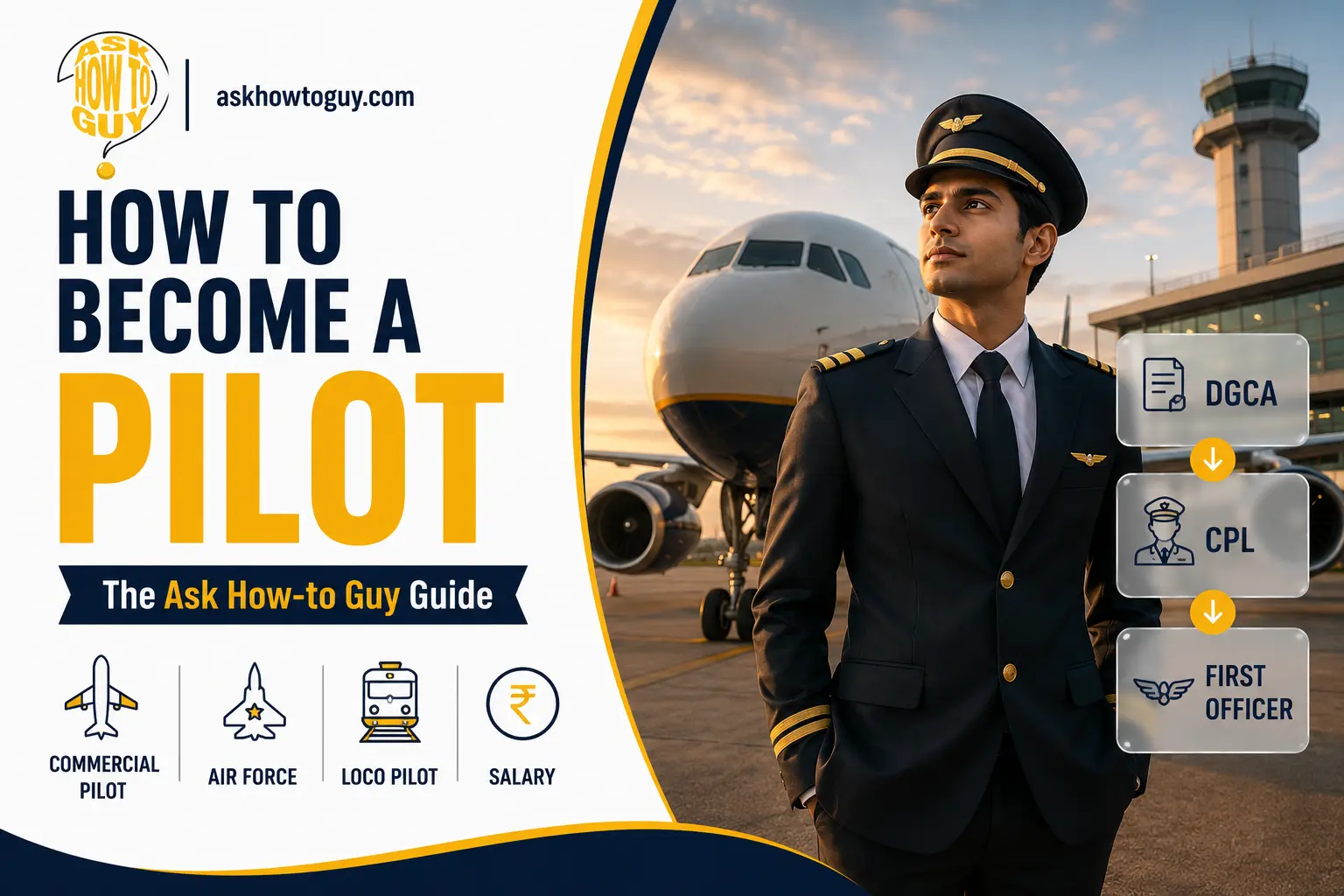
You’ve looked up at a plane more than once and thought, “that could be me up there.” Now you’re actually looking up “how to become a pilot” and the first thing you should know is that “pilot” means three very different things in India, and the path to each one is completely different.
Commercial pilots fly for IndiGo, Air India, Akasa, and other airlines. They earn ₹1.5-3 lakh a month as First Officers and can cross ₹12-25 lakh as senior captains. But the training costs ₹45-60 lakh and takes 18-36 months. Air Force pilots fly fighter jets and transport aircraft for the IAF. The training is free and you’re paid from day one – but entry is extremely competitive and the age window is narrow. Loco pilots drive trains for Indian Railways. It’s a stable government job with pension, accessible with a 10th pass + ITI, and the entry exam has 11,127 vacancies in 2026.
The table below tells you which route is yours based on what you want, what you’ve studied, and what you can invest. Read that first – the rest of this guide on how to become a pilot in India is structured so you can skip straight to the section that matters for your path.
| ✈️ Which Type of Pilot Are You Aiming To Become? | ||
| Commercial Pilot (Airline / CPL) | Air Force Pilot (IAF / NDA / AFCAT) | Loco Pilot (Indian Railways) |
| Entry Route | ||
| 12th with Physics & Maths → DGCA Class 2 Medical → DGCA-approved Flying School → CPL | NDA (after 12th) or AFCAT (after graduation) → Training at Air Force Academy | 10th + ITI/Diploma → RRB ALP exam → Training |
| Minimum Qualification | ||
| 12th with Physics & Maths. Commerce/Arts can qualify via NIOS bridge course. | NDA: 12th PCM. AFCAT: Graduation with 60%, Physics & Maths 50% at 12th. | 10th pass + ITI certificate in relevant trade (Mechanical/Electrical/Electronics) |
| Age Window | ||
| Min 16 (SPL), 17 (PPL), 18 (CPL). No upper age limit – but airlines prefer you finish training by mid-20s. | NDA: 16½-19½ years. AFCAT Flying Branch: 20-24 years (up to 26 with valid CPL). | 18-30 years (as of July 1, 2026). Relaxation for OBC/SC/ST. |
| Medical Standard | ||
| DGCA Class 2 first, then Class 1 before solo. Colour blindness typically disqualifying. | Very strict IAF medical: vision 6/6 correctable, height min 162.5 cm (Flying Branch). | Medically fit as per Railway Board standards. Less stringent than aviation. |
| Cost / Investment | ||
| ₹45-60 lakh (India FTO) to ₹80L-1 crore+ (cadet programme abroad + type rating) | No cost – government funded. You’re paid during training. | No cost – government recruiter, salaried from day one. |
| Starting Salary | ||
| Fresh CPL (no airline job yet): ₹30K-1L/mo. First Officer at airline: ₹1.5-3 lakh/mo. | Flying Officer: ₹56,100/month basic + allowances, in-hand ~₹1-1.1 lakh. | ALP: ₹19,900 basic, in-hand ₹28,000-35,000/month. |
| Peak Earning Potential | ||
| Captain (international routes): ₹12-25 lakh/month. Senior captain: ₹25 lakh+. | Air Commodore / Air Marshal: ₹1.5-2.5 lakh+ – plus perks, pension, housing. | Senior Loco Pilot / Loco Inspector: ₹70,000-1 lakh/month. Good pension. |
| Best For | ||
| High earning potential, global career, love of flying commercially | Prestige, patriotism, government service, funded training | Stable government job, Railways career, lower investment |
| 💡 The rest of this guide covers all three routes – find your column above and jump to the section that applies to you. | ||
Reality Check: Five things that need to be cleared up before you spend a single rupee on anything.
| ❌ What People Think | ✅ What’s Actually True |
|---|---|
| Pilot training costs ₹10-15 lakh | Commercial pilot training costs ₹45-60 lakh for CPL alone. Add ₹20-30 lakh for type rating to be airline-ready |
| You need a Science degree to become a pilot | 12th with Physics & Maths is enough. Commerce and Arts students can qualify via NIOS bridge course |
| DGCA medical is a formality | Colour blindness is permanently disqualifying. Class 1 medical failure can end a career before it starts – do this before investing in training |
| Air Force and commercial pilot are the same exam | Completely different paths: NDA/AFCAT for IAF (govt funded); DGCA CPL route for commercial airlines (you pay) |
| Loco pilot and aircraft pilot are the same career | Completely different jobs, different qualifications, different salaries, different exams. Both are called ‘pilot’ – nothing else in common |
Also Read: How to Become Customs Officer
| 🗺 VISUAL STEP MAP – How to Become a Commercial Pilot in India | |
| Step 1 | Clear Class 12 with Physics & Maths DGCA minimum: 10+2 with Physics and Maths. No minimum percentage specified by DGCA, but most FTOs expect 50%+ overall. Commerce/Arts: clear Physics & Maths via NIOS first. |
| Step 2 | Get DGCA Medical Clearance Class 2 medical first (for eGCA registration), then Class 1 before solo flying. Do this BEFORE investing in ground school. Colour blindness and cardiac conditions are typically disqualifying. |
| Step 3 | Register on eGCA Portal – Get DGCA Computer Number Your unique aviation ID for all future training, exams, and licensing. Required before you can register with any Flying Training Organisation (FTO). |
| Step 4 | Enrol in DGCA-Approved Flying School (FTO) Only DGCA-approved FTOs generate valid flying hours. Complete ground school + flying hours: SPL → PPL → CPL stages. Minimum 200 total flying hours mandated by DGCA. |
| Step 5 | Clear DGCA Theory Exams + RTR(A) 6 papers: Air Navigation, Meteorology, Air Regulations, Technical General, Technical Specific, and Radio Telephony (RTR-A). Passes required before CPL can be issued. |
| Step 6 | Obtain CPL + Get Type Rating → Apply to Airlines CPL issued by DGCA after 200 hours + exam clearance. Then get A320 or B737 type rating (₹20-30 lakh extra) before applying for First Officer roles at IndiGo, Air India, Akasa Air, etc. |
| ⏱ Timeline: 18-36 months from joining an FTO to CPL. Add 3-6 months for type rating. First airline job typically 2-3 years after CPL for most candidates. | |
How to Become a Pilot After 12th
After 12th is the best time to start, and the most direct version of how to become a pilot after 12th is the commercial CPL route – start with Step 1 above immediately after Class 12 board results.
Your stream determines your readiness, not your eligibility. Science with Physics and Maths students can register on the eGCA portal and book their Class 2 medical right after 12th results. Commerce and Arts students need to clear Physics and Maths first through NIOS (National Institute of Open Schooling) – that takes roughly 3-6 months and costs ₹15,000-40,000. After that, the path is identical.
One thing almost every article skips: get the DGCA medical done before you pay any flying school fees. The Class 2 medical costs a few thousand rupees and takes one day. If you fail it, you’ve saved yourself ₹45 lakh of regret. If you pass, your training begins with full confidence. This is the single most practical first step for any 12th-pass aspirant.
For the Air Force route after 12th: if you’re between 16½ and 19½ years old and have done 12th with Physics, Chemistry, and Maths, you can apply for the NDA (National Defence Academy) exam conducted by UPSC. NDA is the only route into the Air Force pilot stream directly after 12th – every other entry (AFCAT, CDS) requires graduation.
How to Become a Commercial Pilot in India
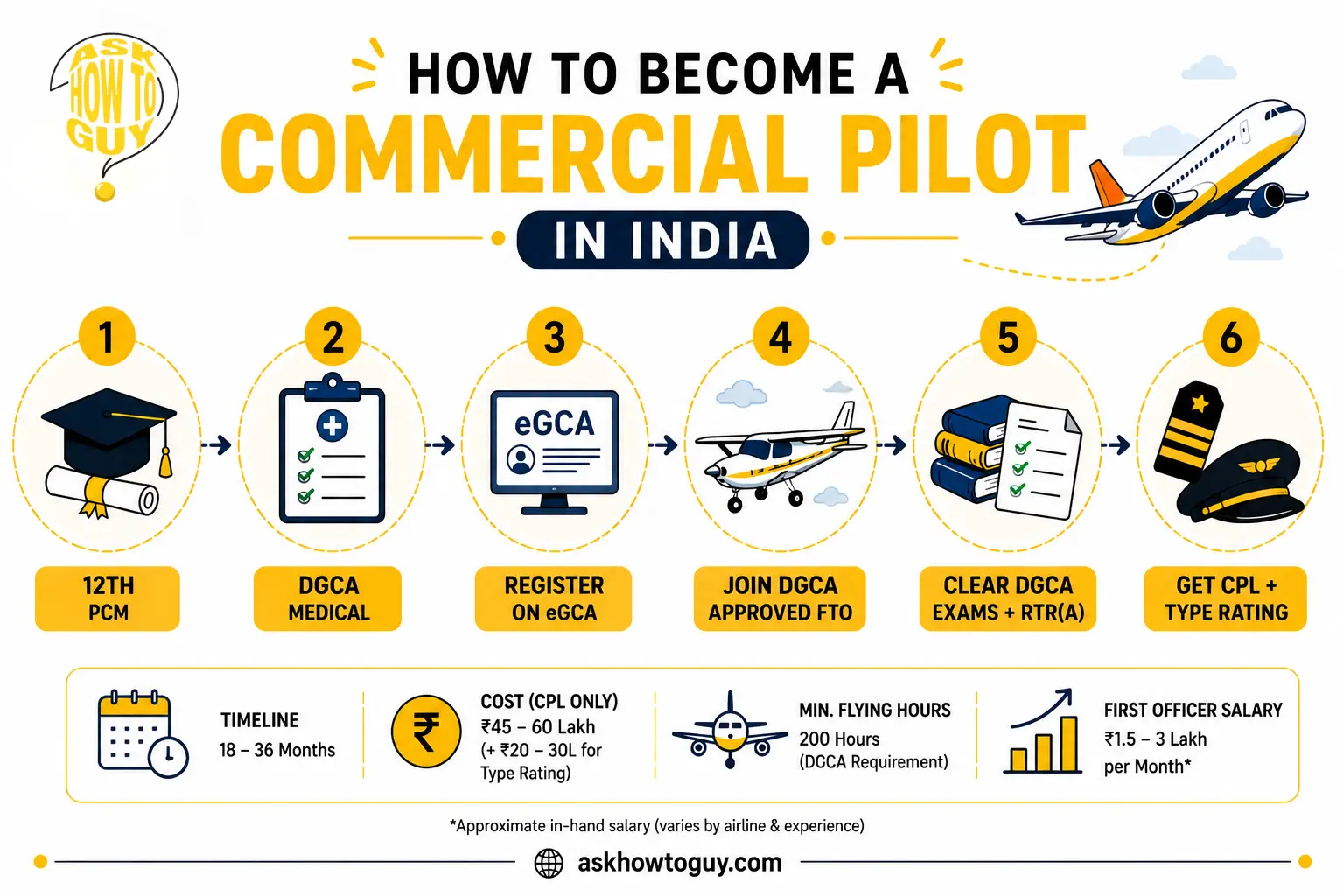
The full answer to how to become a pilot in india is in the Step Map above. Here’s what the key decision points look like in practice.
Choosing your Flying School (FTO) is the single most important financial decision of the entire journey. Only DGCA-approved Flying Training Organisations generate flying hours that count toward your CPL. Verify approval before signing anything. Key questions to ask any school: How many aircraft in the fleet? What’s the DGCA exam pass rate? How long do students typically take to log 200 hours? What’s the average wait time between flights?
India vs abroad: training at an FTO in India typically costs ₹45-60 lakh. Training in the USA or Philippines can be faster for hour-building (better weather, more aircraft availability), but add conversion costs (₹10-15 lakh extra for DGCA license conversion) and living expenses. Total abroad package can run ₹70 lakh to ₹1 crore. Many students find India-based training more practical once all-in costs are compared.
Cadet programmes: airlines like IndiGo (“Cadet Pilot Programme”), Air India, and Akasa (“SkyCadet”) run structured end-to-end programmes with a Letter of Intent (LOI) guaranteeing First Officer employment after completing training. Cost: ₹85 lakh to ₹1.1 crore. More expensive, but removes the uncertainty of the open-market job hunt after CPL.
How to Become a Pilot in the Air Force
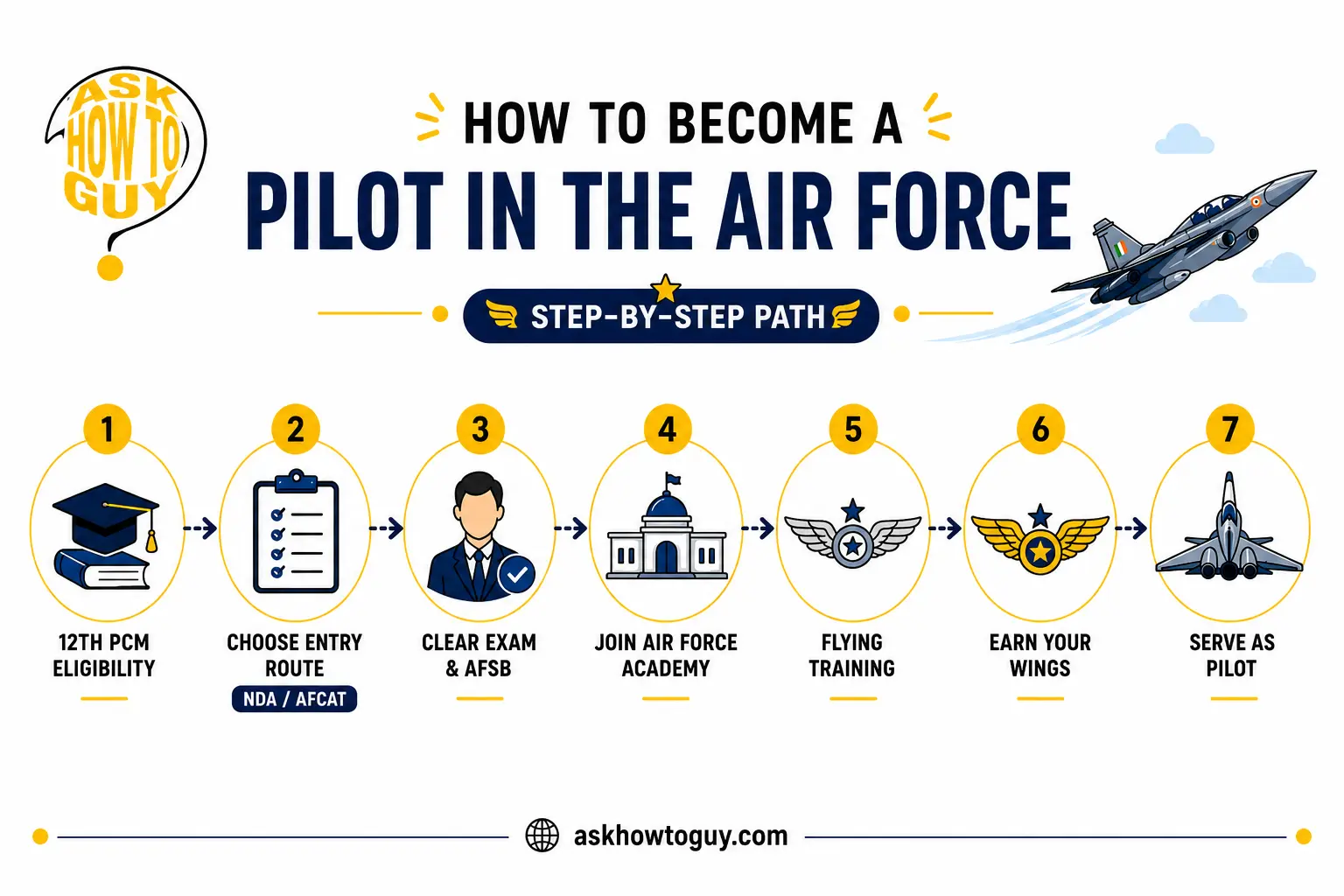
The IAF pilot path is the highest-prestige aviation career in India, fully government-funded, and one of the most selective. Understanding how to become a pilot in the air force means understanding there are three distinct entry routes, each with its own eligibility.
🌟 NDA Entry (after 12th): Age 16½-19½ years. 12th with Physics, Chemistry, Maths. Clear UPSC NDA exam (conducted twice a year), then SSB interview at Air Force Selection Board (AFSB). Successful candidates join the National Defence Academy in Pune for 3 years, then 1.5 years at Air Force Academy, Hyderabad. This is the youngest entry point into the IAF pilot stream.
🌟 AFCAT Entry (after graduation): Age 20-24 years for Flying Branch (up to 26 with valid DGCA CPL). Graduation in any discipline with minimum 60% marks; 50% each in Physics and Maths at 12th level. Apply for AFCAT (Air Force Common Admission Test), clear AFSB, and join Air Force Academy for flying training. AFCAT is conducted twice a year (typically February and August intake). Short Service Commission for 14 years, with no extension for Flying Branch.
🌟 CDS Entry (after graduation): Combined Defence Services exam conducted by UPSC. Another graduation-level route into the IAF, with similar eligibility to AFCAT. Both AFCAT and CDS lead to the same training and commission.
If a career in the armed forces appeals to you but the Air Force age window doesn’t line up, our guide on how to become an IPS officer covers another high-prestige defence-adjacent career through UPSC – different service, similar competitive intensity.
Physical standards for Flying Branch are strict: minimum height 162.5 cm for both men and women (no relaxation for this branch), leg length 99-120 cm, sitting height 81.5-96 cm. Vision must be 6/6 correctable. If you habitually wear glasses, IAF Flying Branch is not possible.
How to Become a Loco Pilot
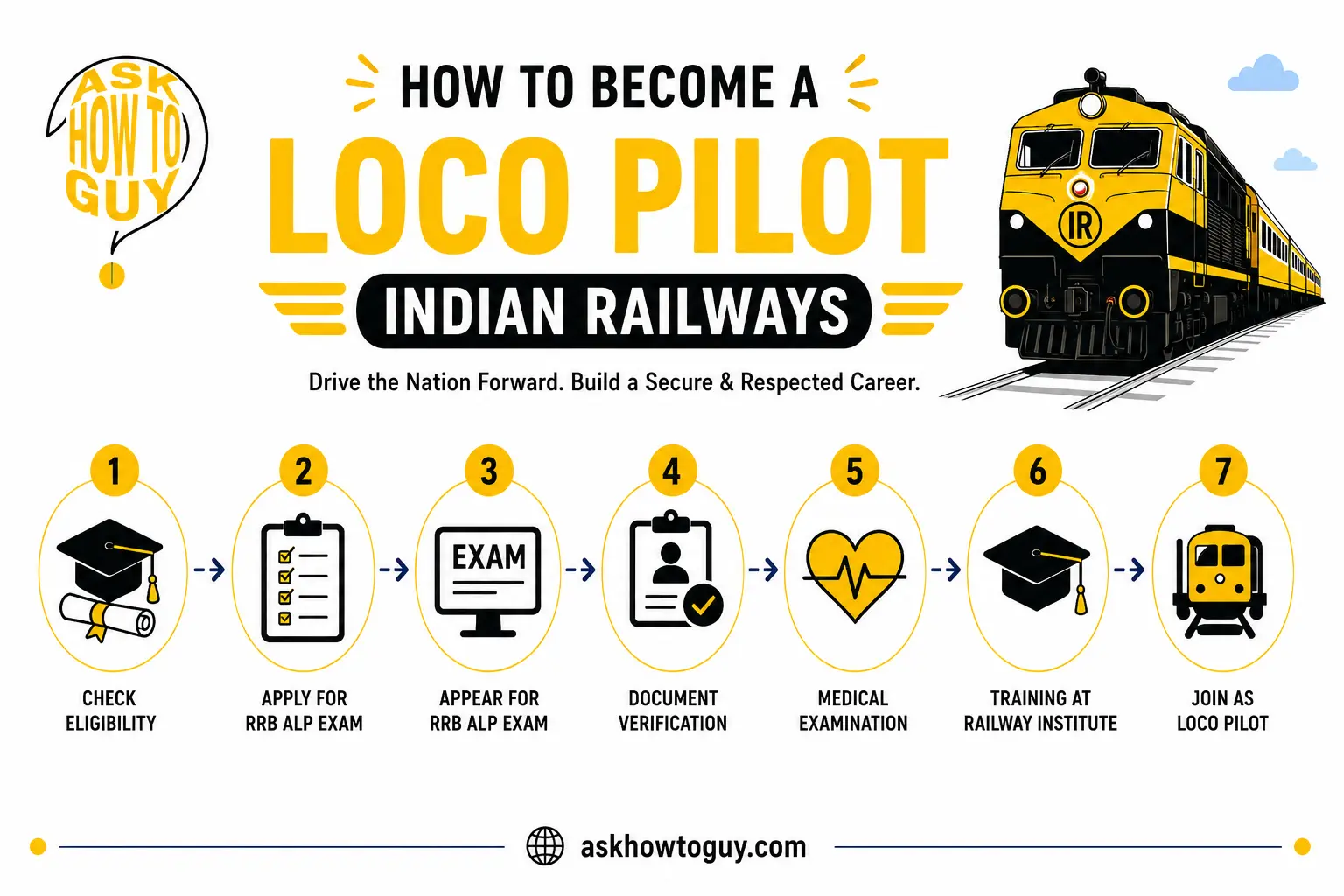
A loco pilot drives Indian Railways trains. It’s a completely different career from aviation, but it carries the word “pilot” and many searches conflate the two. Understanding how to become a loco pilot is straightforward: it’s a government job recruited through the Railway Recruitment Board (RRB) via the RRB ALP (Assistant Loco Pilot) exam.
Eligibility: minimum 10th pass + ITI certificate in a relevant trade (Mechanical, Electrical, Electronics, Automobile) from an NCVT or SCVT-recognised institute. Diploma in engineering or B.Tech in relevant disciplines also qualify. Age: 18-30 years as of July 1, 2026 (OBC: up to 33, SC/ST: up to 35). The 2026 recruitment cycle announced 11,127 vacancies under CEN 01/2026, with over 8.4 lakh applications received.
Selection process: CBT 1 (75 questions, 60 minutes – Maths, Science, General Awareness, Reasoning) → CBT 2 Part A (relevant trade syllabus) + Part B (basic science & engineering) → Computer-Based Aptitude Test (CBAT) → Document Verification → Medical Examination. You don’t start as a Loco Pilot directly – you join as an Assistant Loco Pilot (ALP) and get promoted after gaining experience and clearing internal tests.
Also Read: How to Become an IPS Officer
How to Become a Female Pilot After 12th
The answer is exactly the same as for any aspirant: Physics and Maths in 12th, DGCA medical, DGCA-approved FTO, 200 flying hours, CPL. India actually leads the world in female pilot representation – 15% of all commercial pilots in India are women, compared to roughly 5% globally. That’s not a small statistic.
For – how to become a female pilot after 12th – the only additional consideration is the DGCA Class 1 medical, which covers vision, cardiovascular health, and general fitness – same standards as male candidates. There are no gender-specific restrictions in the DGCA commercial pilot licensing framework.
For the Air Force: women can join the Flying Branch through AFCAT. Minimum height is 162.5 cm, same as men. Note that the IAF currently offers women Short Service Commission in the Flying Branch (14 years, no extension), not a permanent commission in that branch yet.
The most recent record holder for India’s youngest commercial pilot: Samaira Hullur from Vijayapura, Karnataka, who earned her CPL at 18 in 2025 after completing 200 flying hours and clearing all 6 DGCA exams. Before her, Sakshi Kochhar from Himachal Pradesh had received her CPL exactly on her 18th birthday. Both are proof that the timeline can be compressed for aspirants who start early and stay consistent.
| 💰 Cost to Become a Commercial Pilot in India (2026 CPL Breakdown) | ||
| Cost Component | Amount (approx 2026) | Notes |
| Ground School (DGCA theory) | ₹1.5-2.5 lakh | 6 papers: Air Navigation, Meteorology, Air Regulations, Tech General & Specific, RTR(A) |
| Flying Hours (200 hrs) | ₹30-40 lakh | Single-engine: ₹15K-20K/hr. Multi-engine adds ₹5-10 lakh |
| DGCA Medical (Class 1 & 2) | ₹20,000-60,000 | Class 1 required before solo. Annual renewals thereafter |
| DGCA Exam & License Fees | ₹50,000-1.5 lakh | Per attempt. Re-attempts add cost |
| Accommodation & Living | ₹3-8 lakh | Varies heavily by city and school location |
| Type Rating (A320/B737) | ₹20-30 lakh | Required for airline job – NOT included in CPL cost at most schools |
| TOTAL (CPL only, India FTO) | ₹45-60 lakh | CPL only. Add ₹20-30L for type rating = ₹65L-1 crore to be airline-ready |
| Cadet programmes (IndiGo, Akasa, Air India): ₹85L-1.1 crore but include guaranteed LOI. Education loans available from SBI, PNB up to ₹1.5 crore. Training abroad (USA, Philippines) may be cheaper on flying hours but adds conversion + living costs. | ||
How Long Does It Take to Become a Pilot
The answer depends entirely on which type of pilot and how consistently you can train:
Commercial CPL (India, FTO): 18-24 months from joining the FTO to receiving the CPL, assuming regular flying without major weather or aircraft downtime. Add 3-6 months for type rating. Most candidates take 2-3 years from 12th to being airline-job-ready.
Air Force (NDA route): 3 years at NDA + 1.5 years at Air Force Academy = roughly 4.5 years from joining NDA to getting wings as a commissioned Flying Officer.
Loco Pilot (ALP route): After qualifying the RRB ALP exam (prep time 6-12 months for most candidates), training is provided by Railways before your first posting. Total time from starting preparation to first posting: typically 1.5-2 years.
| 💰 Pilot Salary in India 2026 – Career Stages | |
| Role / Stage | Monthly In-hand (Approx 2026) |
| ✈️ Commercial Pilot (Airlines) | |
| Fresh CPL holder (no type rating yet) | ₹30,000-1,00,000 (freelance/FTO instructor) |
| First Officer – fresh with type rating | ₹1.5-3 lakh/month |
| First Officer (5-7 years experience) | ₹3.5-5 lakh/month |
| Captain (domestic routes, 8-12 yrs) | ₹6-12 lakh/month |
| Captain (international long-haul) | ₹12-25 lakh/month |
| ✨ Air Force Pilot (IAF) | |
| Flying Officer (entry) | ₹56,100 basic → ~₹1-1.1 lakh in-hand (+ perks) |
| Flight Lieutenant / Squadron Leader | ₹1.2-1.8 lakh (+ free housing, pension, ration) |
| 🚂 Loco Pilot (Indian Railways) | |
| Assistant Loco Pilot (ALP, entry) | ₹28,000-35,000/month in-hand |
| Loco Pilot (Mail/Express, senior) | ₹55,000-1,00,000+/month |
| IAF salary does not reflect the full compensation – free housing, ration, healthcare, pension, and ECHS make the real package substantially higher. Commercial pilot salaries depend heavily on hours flown and aircraft type. | |
| 💬 The Guy’s Take Commercial pilot training is one of the best-paying careers in India at the senior level. But it’s also one of the most financially risky paths you can choose at 18. You’re betting ₹50-60 lakh on getting a CPL, then spending another ₹20-30 lakh on type rating, then competing in an airline market that hires in cycles and fires in downturns. Aviation went through 2020 and you saw what happened to airlines globally. If you have the financial backing and a genuine passion for flying – not just for the uniform and the salary at captain level – this career is worth every rupee. The demand for pilots in India is at an all-time high in 2026 with IndiGo, Air India, Akasa, and new entrants all expanding. The next 10-15 years look genuinely strong for Indian aviation. If you want to fly but can’t put up ₹50 lakh: the Air Force is the better path if you can meet the medical and age window. Free training, government salary from day one, and you fly machines most commercial pilots will never get near. And if someone in your family told you the loco pilot path is ‘less prestigious’ than being an airline pilot – tell them 11,127 government vacancies, a pension, and ₹55,000-1 lakh/month at senior level sounds pretty good. Different word. Different world. Both valid. |
Frequently Asked Questions
1. How many years to become a pilot?
For a commercial CPL: 18-36 months from joining an FTO to getting the CPL, plus 3-6 months for type rating. So realistically 2-3 years after 12th to be airline-job-ready. For the Air Force (NDA route): roughly 4.5 years from NDA joining to getting wings. For Loco Pilot: 1.5-2 years from starting RRB ALP preparation to first posting.
2. How much does it cost to become a pilot?
For a commercial CPL at an Indian FTO: ₹45-60 lakh covering ground school, 200 flying hours, DGCA exam fees, and medical. This does not include the type rating (₹20-30 lakh extra) needed to actually fly for an airline. Fully airline-ready budget: ₹65 lakh to ₹1 crore. The cost breakdown table above has the full component-wise breakdown. For Air Force and Loco Pilot: zero – both are government-funded and you’re paid from day one.
3. How much money is required to become a pilot?
Same answer as above. Plan for a minimum of ₹60-65 lakh to safely cover CPL + type rating + living expenses at an Indian FTO, with a buffer for exam re-attempts and accommodation. Education loans up to ₹1.5 crore are available from SBI, PNB, and private lenders for DGCA-approved pilot training. If the financial commitment is a barrier, the Air Force (free, paid) or Loco Pilot (free, paid) paths are genuine alternatives worth considering.
4. Which is the best pilot training institute in India?
The best pilot training institute in India depends on your budget, location, training duration, and career goals. As of 2026, Avyanna Aviation is the only DGCA-ranked FTO in Category A, while IGRUA, FSTC Flying School, and National Flying Training Institute (NFTI) are among the Category B institutes.
For aspiring commercial pilots, it is important to compare DGCA ranking, aircraft availability, safety record, training duration, infrastructure, fees, and airline-placement support before choosing an institute.
5. What is the qualification to become a pilot?
For a commercial pilot (CPL): 12th pass with Physics and Maths from a recognised board (no minimum percentage from DGCA, but 50%+ expected by most FTOs). Class 2 DGCA medical, then Class 1 before solo flying. Minimum age 18 for CPL. For Air Force pilot (AFCAT): graduation with 60% + Physics and Maths with 50% at 12th, age 20-24. For Loco Pilot (RRB ALP): 10th pass + ITI in relevant trade, age 18-30.
6. What is the salary of a pilot?
It varies dramatically by type. A commercial airline First Officer earns ₹1.5-3 lakh/month, rising to ₹6-12 lakh as domestic captain and ₹12-25 lakh on international long-haul routes. An IAF Flying Officer starts at ₹56,100 basic (≈₹1-1.1 lakh in-hand), growing to ₹1.5-2 lakh+ at senior ranks with free housing, ration, and pension. A Loco Pilot (ALP) starts at ₹28,000-35,000 in-hand, rising to ₹55,000-1 lakh+ at the Loco Pilot (Mail/Express) level.
7. Is pilot harder than CA?
Different kind of hard. Becoming a CA requires clearing three levels of exams over 4.5-7 years, with low pass rates and no cash investment beyond education costs. Becoming a commercial pilot requires a ₹45-60 lakh financial investment, 200 flying hours, 6 DGCA theory papers, and a strict medical standard – the barrier is more financial than academic. UPSC-selected IAS officers and IAF pilots face similar levels of competitive difficulty. The CA exam rewards academic preparation; the CPL route rewards financial capacity and sustained physical fitness.
8. Is 25 too late to become a pilot?
For a commercial CPL: absolutely not. DGCA sets no upper age limit for pilot training. At 25, starting a CPL still gives you 40 years before the mandatory retirement age of 65. Airlines prefer candidates who complete training in their mid-twenties and younger, but a 25-27 year old starting now is well within the practical hiring window. For the Air Force: AFCAT Flying Branch closes at 24 (26 with a valid DGCA CPL) – so 25 without a CPL is outside the AFCAT window. For Loco Pilot: RRB ALP closes at 30 (33 for OBC, 35 for SC/ST) – 25 is well within range.
9. Can I be a pilot if I’m 5’1″?
For a commercial airline pilot (CPL): there is no official height requirement in DGCA regulations. Airlines and FTOs do not bar anyone on the basis of height, and 5’1” (about 155 cm) does not disqualify you from a CPL or airline employment. For the Air Force Flying Branch: minimum height is 162.5 cm (about 5’4”) with no relaxation. At 5’1”, IAF Flying Branch is not possible. For Loco Pilot: no specific height restriction in RRB ALP eligibility.
10. Who is the 18 year old pilot girl?
The most recent record holder is Samaira Hullur from Vijayapura (Bijapur), Karnataka, who earned her Commercial Pilot Licence at 18 in 2025 after completing 200+ flying hours and clearing all DGCA theory exams. Before her, Sakshi Kochhar from Parwanoo, Himachal Pradesh, received her CPL exactly on her 18th birthday in 2023, breaking the previous record held by Maitri Patel. India has consistently produced some of the world’s youngest licensed commercial pilots – male and female – because the DGCA allows CPL issuance from age 18 with no minimum gap after 12th.
11. Does it cost 1 crore to become a pilot?
For CPL only at an Indian FTO: no, typically ₹45-60 lakh. But to be airline-ready – CPL + type rating (A320 or B737) + associated costs – the total lands between ₹65 lakh and ₹1 crore depending on the school, location, and number of exam re-attempts. Cadet programmes (IndiGo, Akasa, Air India) that include a job guarantee cost ₹85 lakh to ₹1.1 crore. So “1 crore” is roughly accurate for a fully airline-ready package, not for a standalone CPL.
Found this useful? Share it with someone who’s been going back and forth on the aviation vs government career question. Got a specific doubt about DGCA medical standards, flying school selection, or AFCAT prep – drop it in the mail: hello@askhowtoguy.com !