
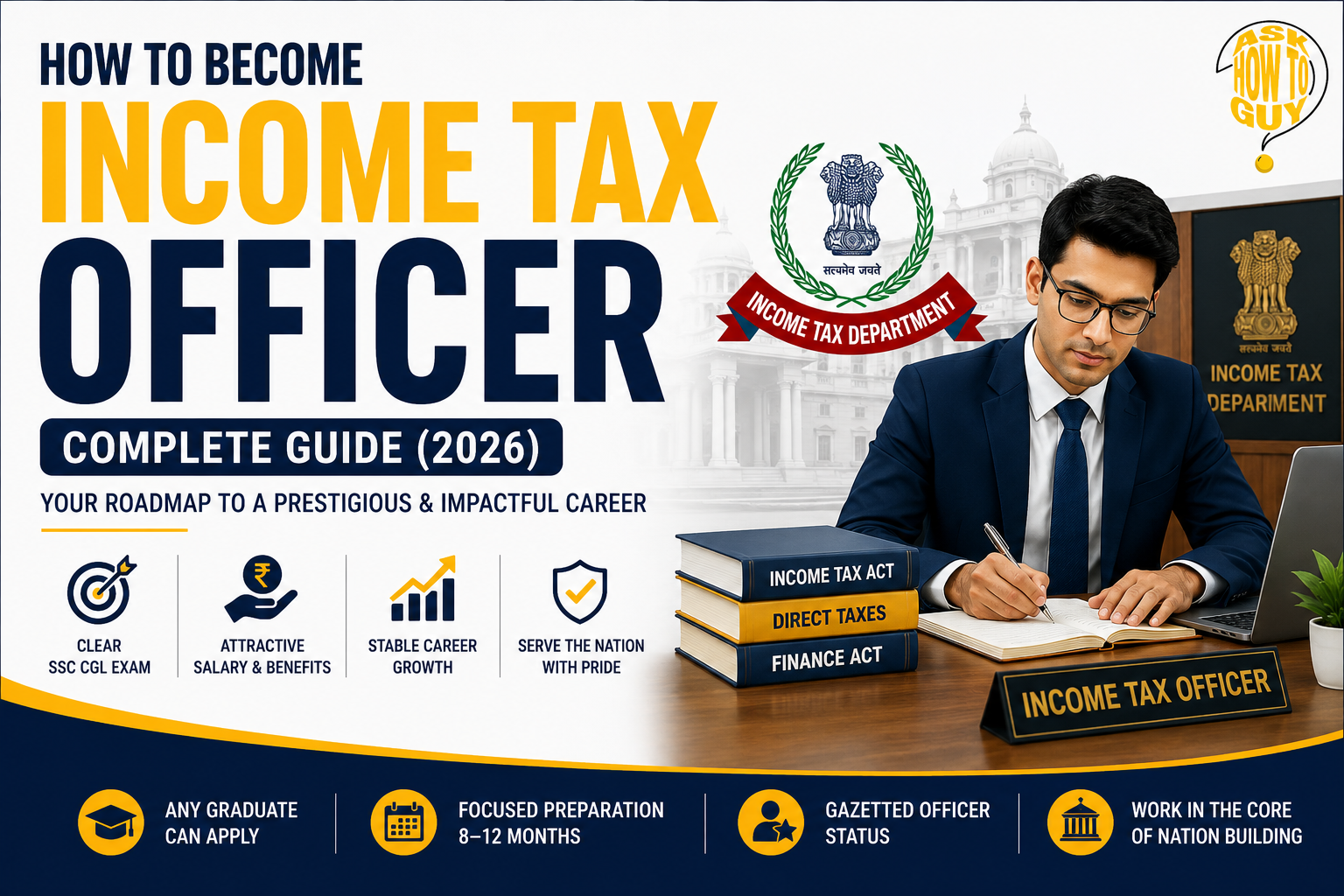
Every year, thousands of graduates in India type the same question into Google: how to become income tax officer. It’s one of the most searched government job queries in the country – and one of the most poorly answered. Most articles bury you in exam dates and syllabus PDFs without actually telling you what the path looks like from where you’re standing right now.
This guide answers the question of how to become income tax officer in India in plain language – covering the route through SSC CGL, eligibility from Class 12 and after graduation, the exact salary of income tax officer, and what the exam genuinely demands. Under 2000 words, no filler.
Before anything else – here’s what most people get completely wrong about this role.
| ❌ What People Think | ✅ What’s Actually True |
|---|---|
| You need a commerce or law degree | Any stream – Science, Arts, Engineering – qualifies for SSC CGL. |
| The exam tests tax law knowledge | SSC CGL tests Maths, Reasoning, English, and GK. Zero tax law required. |
| The salary is average for a govt job | Gross in-hand in a metro crosses ₹65,000-80,000/month from Day 1. |
| It takes 4-5 years like UPSC | A focused 8-12 months is enough for a serious first attempt. |
What Does an Income Tax Officer Actually Do?
An Income Tax Officer (ITO) works under the Income Tax Department of India, which reports to the Central Board of Direct Taxes (CBDT) under the Ministry of Finance. Their work includes assessing filed tax returns, conducting raids and surveys on suspected tax evaders, processing refunds, and recovering unpaid taxes.
The post carries Gazetted Officer status – meaning real administrative authority. An ITO can issue notices, conduct searches, seize documents, and attach assets. Career progression moves from Income Tax Inspector → Income Tax Officer → Assistant Commissioner of Income Tax → Deputy Commissioner → and higher.
| 🗺 VISUAL STEP MAP – How to Become Income Tax Officer | |
| Step 1 | Complete Your Graduation Any stream, any recognised university. No minimum percentage. Final-year students can also apply for SSC CGL. |
| Step 2 | Check SSC CGL Notification at ssc.gov.in Released once a year, typically April-June. Register immediately – the window is short and late registration is not allowed. |
| Step 3 | Clear Tier 1 – The Qualifying Round 100 questions, 60 minutes, online. Four sections: GK, Reasoning, Quantitative Aptitude, English. Negative marking of -0.50 per wrong answer. |
| Step 4 | Clear Tier 2 – Where Your Rank Is Decided Two papers: Paper 1 covers Maths (Module 1 & 2), Reasoning, and English. Paper 2 (Statistics) is only for JSO post – not needed for Income Tax Inspector. |
| Step 5 | Document Verification Submit originals of your degree certificate, identity proof, and caste or PwBD certificate if applicable. |
| Step 6 | Medical Examination Standard fitness test as per SSC norms. Visual standards and general health requirements apply. |
| Step 7 | Training at NADT, Nagpur All selected candidates undergo probationary training at the National Academy of Direct Taxes before their first posting. |
| ⏱ Realistic timeline: 1-2 years from serious prep to first posting, depending on SSC CGL attempt cycle. | |
What is the Qualification for Income Tax Officer?
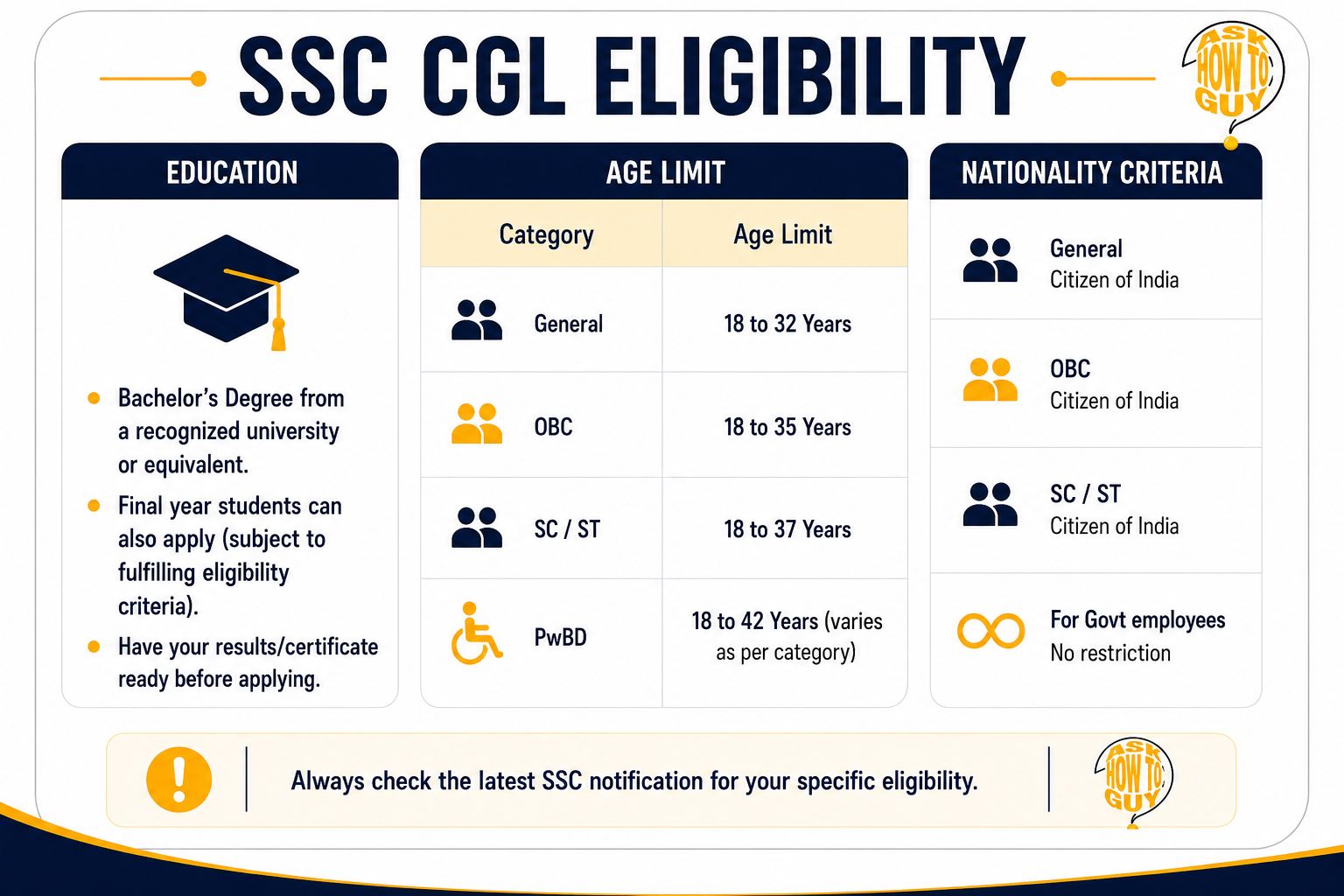
The minimum qualification to become income tax officer through SSC CGL is a bachelor’s degree from any recognized university – in any stream. Science, arts, commerce, engineering, law – all are valid. There is no minimum percentage requirement.
Age limit for the Income Tax Inspector post is 18-32 years for the General category. OBC candidates get a 3-year relaxation (up to 35 years). SC/ST candidates get 5 years (up to 37 years). PwBD candidates receive additional relaxation as applicable.
Indian nationality is required. You can verify the exact eligibility conditions in the official SSC CGL notification published annually at ssc.gov.in. Age limits and post-specific eligibility can vary slightly between cycles, so always check the current year’s notification before applying.
Also Read: How to Become a CA
How to Become Income Tax Officer After 12th
The most common question from school students: is there a way to become income tax officer after 12th directly? The straightforward answer is no – SSC CGL requires graduation as the minimum qualification. But there is a lot you can and should do from Class 12 itself.
Mathematics and English are the two pillars of SSC CGL. If you’re in Class 11-12, take Maths seriously regardless of your stream – it feeds directly into both Tier 1 and the harder Tier 2 papers. Build a daily English reading habit. Start tracking current affairs through a newspaper or a GK app.
Students who build this foundation in school and early college typically reach full SSC CGL exam-readiness within 6-8 months after graduation – instead of starting from scratch at 22 and needing 12-18 months. The groundwork you lay to become income tax officer after 12th directly shortens your prep timeline later.
How to Become Income Tax Officer After Graduation
This is the most common and most direct entry point. Once you’ve completed graduation, the path to become income tax officer after graduation is entirely through SSC CGL – there is no other central government route. The realistic preparation timeline for a focused first attempt is 8-12 months for most graduates.
Start by downloading the official SSC CGL syllabus from ssc.gov.in and mapping it against your current strengths. Tier 1 is broad but not deep – most graduates can handle it with 3-4 months of structured practice. Tier 2 is where a significant number of candidates drop, specifically the advanced Maths modules in Paper 1.
The single most effective preparation tool: SSC CGL previous year question papers. Solve the last 7-10 years of Tier 1 and Tier 2 papers before you open any coaching material. SSC recycles patterns consistently. Previous year papers are available free at the SSC official portal.
How to Become Income Tax Officer Through SSC CGL
SSC CGL is the only direct central government route to the Income Tax Inspector post under CBDT. There is no separate Income Tax Department recruitment exam. If someone is telling you otherwise, they’re wrong.
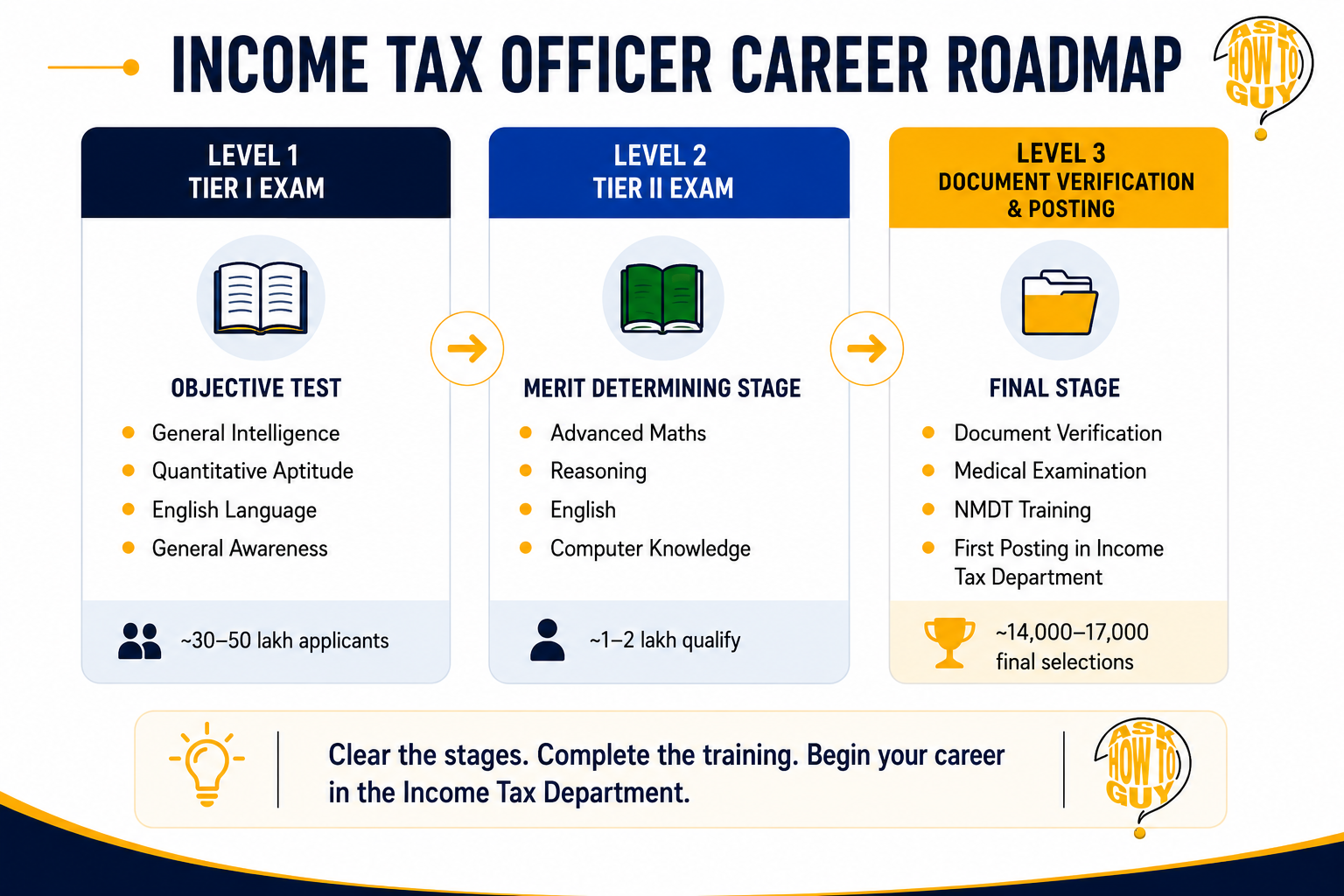
Here’s the full exam structure:
| Stage | Format | What It Tests |
|---|---|---|
| Tier 1 | 100 Qs | 60 mins | Online | -0.50 per wrong answer | GK, Reasoning, Quantitative Aptitude, English — 25 questions each section |
| Tier 2 | Online | Two Papers | Session-based | Paper 1: Maths (Modules 1 & 2) + Reasoning/English. Paper 2 (Statistics) not required for IT Inspector post. |
| Document Verification | Post-result, at regional SSC offices | Original degree, ID proof, caste/PwBD certificates if applicable |
| Medical Exam | Post-DV | Standard fitness and vision tests as per SSC norms |
The Income Tax Inspector post is allocated based on Tier 1 + Tier 2 combined merit rank and your post preference in the application form. It consistently ranks among the top 3 most preferred posts in SSC CGL – so competition for this specific post is tighter than the overall selection rate suggests. Scoring well in Tier 2 Maths is non-negotiable if Income Tax Inspector is your target post.
For official notification and exam calendar: SSC CGL Examinations – ssc.gov.in.
Also Read: How to Become Customs Officer
Salary of Income Tax Officer: The Full Picture
The salary of income tax officer is one of the most under-explained figures in government job discussions. The basic pay for an Income Tax Inspector (entry-level post) is ₹44,900/month at Pay Level 7 under the 7th Pay Commission. After promotion to Income Tax Officer, it moves to ₹47,600/month at Pay Level 8. Those numbers alone don’t tell the real story.
| Pay Component | Amount (Approx.) | Notes |
|---|---|---|
| Basic Pay (Inspector) | ₹44,900/month | 7th CPC Pay Level 7 |
| HRA – Metro City | ₹10,776 – ₹17,960 | 24-40% of basic, depends on posting city |
| Dearness Allowance (DA) | ₹20,000+ | ~45% of basic, revised twice a year |
| Transport Allowance | ₹3,600 – ₹7,200 | City-dependent |
| Gross In-Hand (Metro) | ₹65,000 – ₹80,000+ | Approximate, before standard deductions |
After promotion to ITO (typically 3-5 years of service), the total gross in a metro posting crosses ₹85,000-₹95,000/month. Add defined-benefit pension, full medical coverage for the officer and family, and Leave Travel Concession – and the salary of income tax officer is genuinely strong compared to most entry-level private sector roles at the same age. Source: 7th Pay Commission Pay Matrix – Department of Expenditure.
| 💬 The Guy’s Take Most people who look up how to become income tax officer in India don’t realise how underrated this path actually is. You skip the 5-year UPSC grind, the exam is genuinely crackable in under a year, and the salary of income tax officer – once you factor in HRA and DA in a metro city – is a package most private sector freshers can’t match. The one thing I’d tell anyone serious about this: don’t underestimate Tier 2 Maths. That’s where most people lose the post they want. Start solving previous year papers from Day 1, build your Maths accuracy week by week, and you’ll be in far better shape than 80% of the people appearing alongside you. |
Frequently Asked Questions
1. What is the qualification for income tax officer?
A bachelor’s degree from any recognised university in any stream – Science, Arts, Commerce, Engineering, or Law. No minimum percentage required. Age 18-30 years for General category, with relaxation for OBC (3 years), SC/ST (5 years), and PwBD. You apply through SSC CGL – there is no separate income tax department exam.
2. What is the salary of income tax officer exam?
There is no separate exam fee that reflects salary – but the salary of income tax officer starts at approximately ₹44,900/month basic pay for the Income Tax Inspector post (Pay Level 7). With HRA, Dearness Allowance, and transport allowance in a metro city, gross in-hand is typically ₹65,000-₹80,000/month from Day 1. After promotion to ITO, total gross crosses ₹85,000-₹95,000/month. Source: 7th Central Pay Commission Pay Matrix.
3. Is it hard to become an income tax officer?
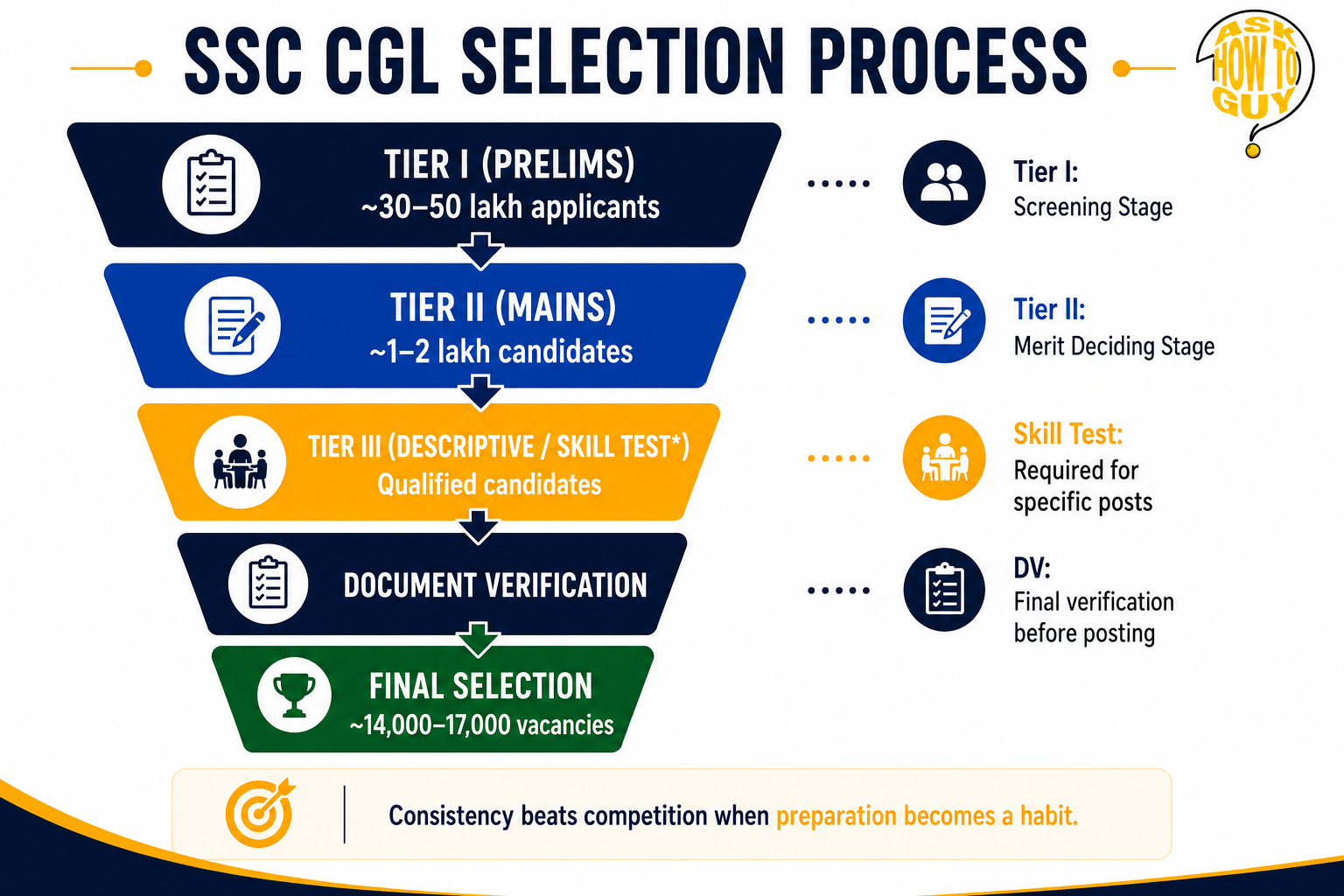
Harder than most people assume, significantly easier than UPSC. SSC CGL attracts 30-50 lakh applicants annually for roughly 14,000-17,000 total posts across all categories. The Income Tax Inspector post is one of the most competitive allocations because it’s consistently a top-3 preferred post. Tier 2 Maths is where most candidates fall short. A disciplined 8-12 months of preparation is enough for most graduates to crack it in one or two attempts.
4. Who is more powerful, CA or income tax officer?
They serve fundamentally different functions. A CA is a private professional working for clients. An Income Tax Officer is a government authority – one who can issue notices, conduct raids, seize documents, and attach assets. In terms of direct legal authority over taxpayers, an ITO holds power that a CA does not. In terms of earning ceiling, senior CAs in practice or employment can earn significantly more. The comparison comes down to what you value: administrative authority and stability, or income ceiling and entrepreneurial scope.
Sources & Further Reading
- 📎SSC CGL Official Notification: Staff Selection Commission – SSC CGL Examination Details
- 📎CBDT – Income Tax Department: Central Board of Direct Taxes, Ministry of Finance
- 📎7th Pay Commission Pay Matrix: Department of Expenditure – 7th CPC Pay Matrix
- 📎SSC Previous Year Papers: SSC Official Previous Year Question Papers Repository
- 📎NADT – National Academy of Direct Taxes: Training Academy for Income Tax Officers – nadt.gov.in
Found this useful? Share it with someone weighing their government job options. Questions about SSC CGL prep, post preferences, or training at NADT – drop them in the mails: hello@askhowtoguy.com!