
It’s probably 11pm and you’ve typed ‘how to become a CA’ into Google for the fifth time this week. Maybe your parents keep bringing it up at dinner. Maybe a friend just cracked Foundation and now everyone’s asking when you’re starting.
Here’s what those late-night searches usually miss: learning how to become a CA isn’t about one scary exam. It’s three levels, spread over years, with a long practical training phase stitched in between. Sounds heavy? It isn’t, once you know exactly what’s coming.
If you’ve just finished 12th, you’re a graduate, or you’re still in school trying to plan ahead – this guide is written for you. We’ll cover every route into how to become ca in india, the real timeline, and what a CA actually earns once the certificate is in hand.
One more thing before we start. If you’ve been asking how to become a CA step by step, the Step Map below gives you the entire journey in one shot – bookmark it.
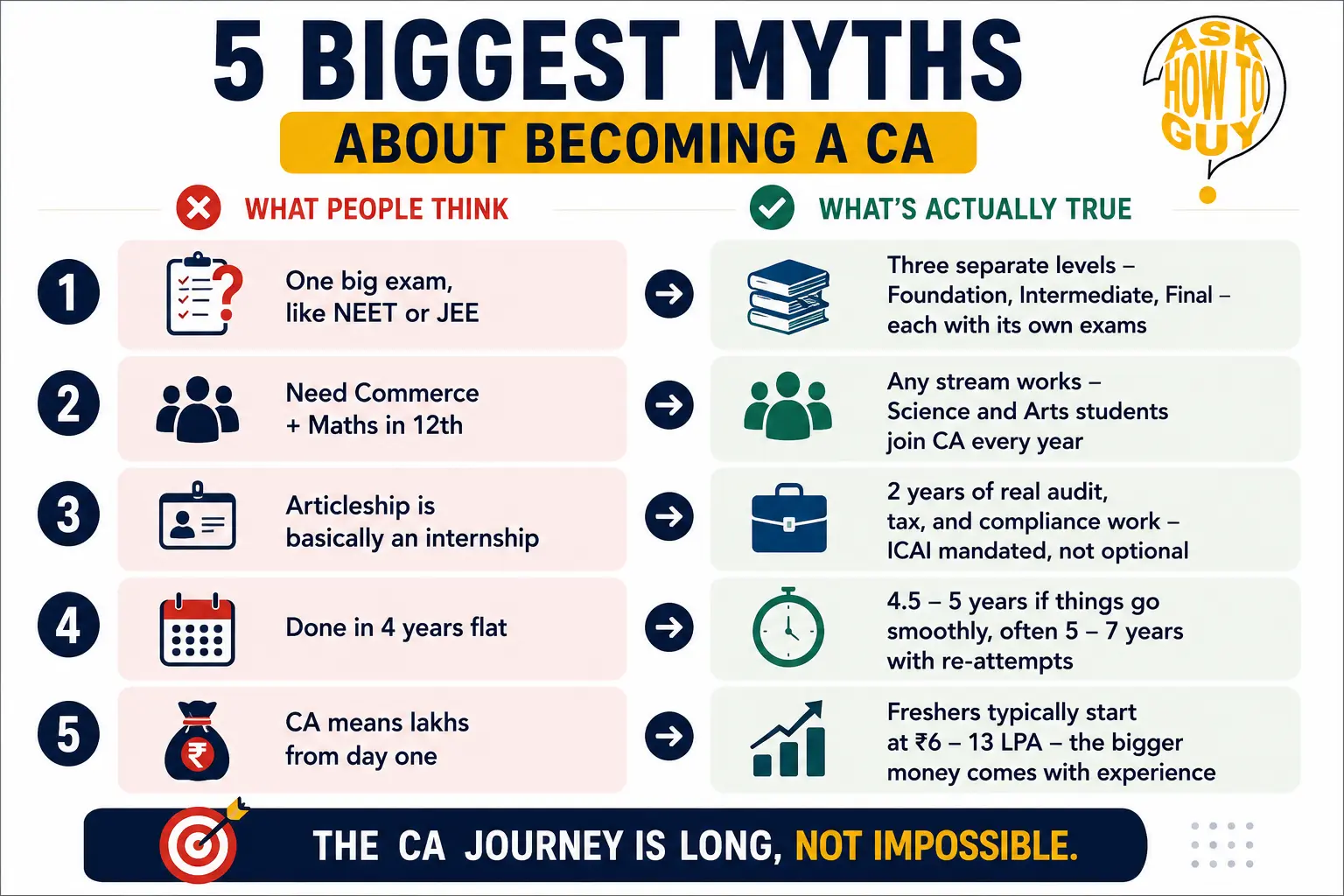
Reality Check: Let’s kill the five myths that send most aspirants down the wrong path
| ❌ What People Think | ✅ What’s Actually True |
|---|---|
| One big exam, like NEET or JEE | Three separate levels – Foundation, Intermediate, Final – each with its own exams |
| Done in 4 years flat | 4.5-5 years if things go smoothly, often 5-7 years with re-attempts |
| Need Commerce + Maths in 12th | Any stream works – Science and Arts students join CA every year |
| Articleship is basically an internship | 2 years of real audit, tax, and compliance work – ICAI mandated, not optional |
| CA means lakhs from day one | Freshers typically start at ₹6-13 LPA – the bigger money comes with experience |
| 🗺 VISUAL STEP MAP – How to Become a CA | |
| Step 1 | Complete Class 12 in Any Stream Commerce, Science, or Arts – ICAI doesn’t restrict entry by stream. This is also where how to become ca after 12th really begins. |
| Step 2 | Register & Clear CA Foundation 4-month study window, 4 papers: Accounting, Business Laws, Quantitative Aptitude, Business Economics. Study material for all four papers is available free on the ICAI BoS Knowledge Portal. |
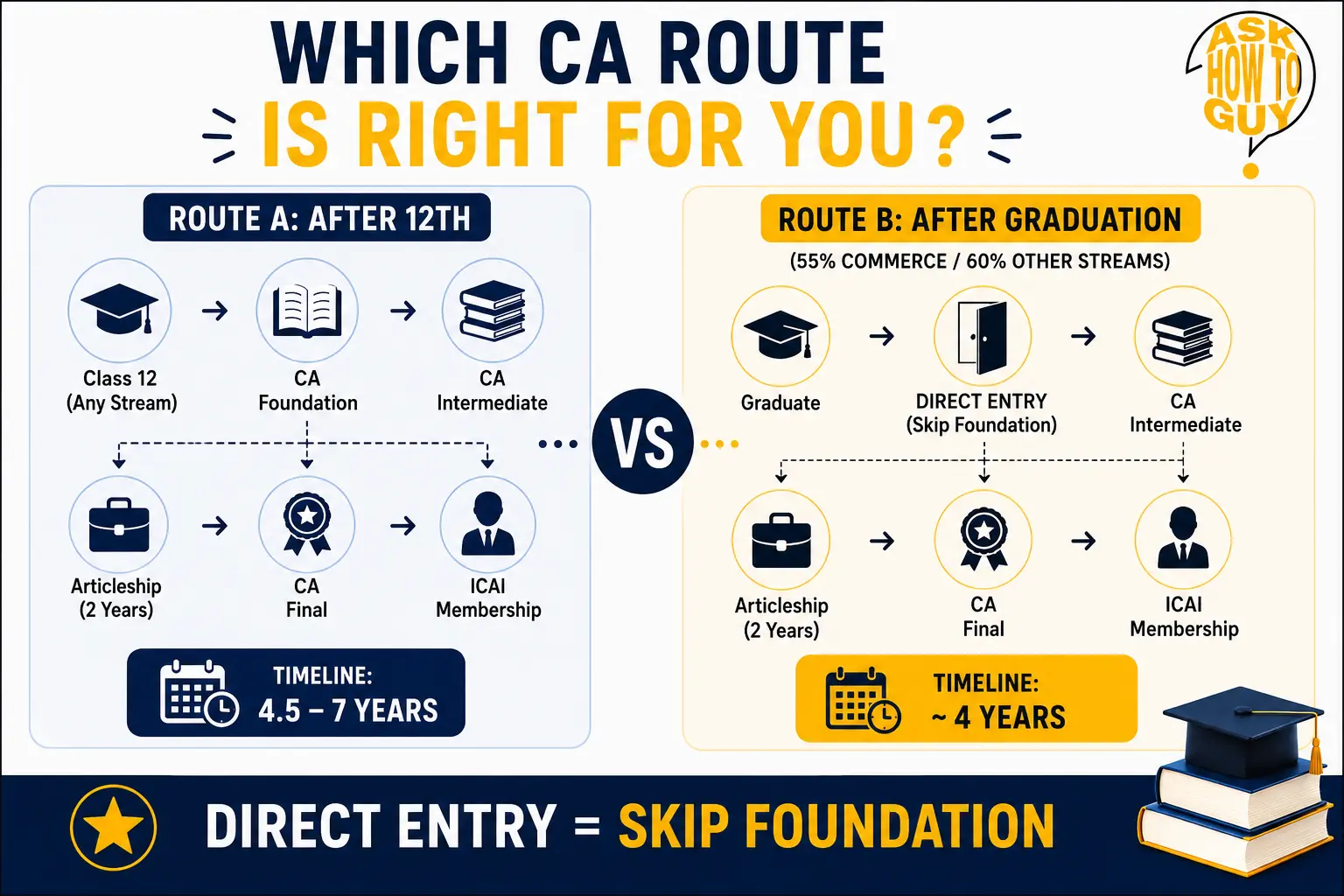
| Step 3 | Register for CA Intermediate Two groups, six papers. Graduates can skip straight here via Direct Entry – covers how to become ca after graduation. |
| Step 4 | Clear Both Groups of Intermediate Both groups need to be cleared before articleship can begin. Most students attempt this in stages. |
| Step 5 | Complete ICITSS Training Orientation + IT training mandated before you can start articleship, for both routes. |
| Step 6 | 2-Year Articleship + Self-Paced Modules Real audit, tax, and compliance work under a practicing CA, alongside 4 Self-Paced Online Modules. Registration happens through the same ICAI Self Service Portal – your principal CA needs to approve the deed from their end too. |
| Step 7 | Clear CA Final & Register with ICAI Both groups of Final, then apply for ICAI membership – you’re officially a Chartered Accountant. |
| ⏱ Realistic timeline: 4.5-7 years from Class 12. Around 4 years if you’re starting via Direct Entry after graduation. | |
The 7 Stages of How to Become CA in India – Explained Simply
The Step Map above gives you the full picture at a glance. Here’s what each stage actually means in plain language.
Stage 1 – Class 12, any stream. Commerce helps with the early accounting vocabulary, but Science and Arts students clear Foundation every attempt. ICAI doesn’t check your 12th stream at registration.
Stage 2 – CA Foundation. Register on the ICAI portal, get a 4-month prep window, then sit for 4 papers. This is the entry gate – once it’s cleared, the rest of the path opens up.
Stage 3 – CA Intermediate. Six papers across two groups. Either you arrive here from Foundation, or – if you’re a graduate – you walk in directly through Direct Entry, skipping Foundation entirely.
Stage 4 – Clear both groups. You can attempt the groups separately, but both need to be done before articleship starts. Most students take this in two sittings rather than one.
Stage 5 – ICITSS. A short orientation and IT training course – non-negotiable, and it has to happen before you’re allowed to register for articleship.
Stage 6 – Articleship. Two years of hands-on work at a CA firm, while also clearing 4 Self-Paced Online Modules on the side. This is the longest and toughest stretch of the entire journey.
Stage 7 – CA Final + ICAI registration. Clear both groups of Final – often while still finishing articleship – then apply for membership. The day ICAI approves it, you’re a Chartered Accountant.
The whole journey from Class 12 to qualifying takes roughly 4.5-7 years. From graduation via Direct Entry, it’s closer to 4. Long? Yes. Impossible? Not even close – lakhs of students are on this exact path right now.
Also Read: How to Become Income Tax Officer
How to Become CA After 12th
Stop waiting for “the right time.” If you’ve just finished 12th – any stream – you can register for CA Foundation right now.
The Board of Studies gives you a 4-month study window before your first attempt. Foundation has four papers: Accounting, Business Laws, Quantitative Aptitude, and Business Economics. Commerce students usually find Accounting and Economics familiar territory. Science and Arts students take a little longer to settle into the language of balance sheets, but plenty of them clear it on the first try.
If you’re searching ‘how to become ca after 12th commerce’ specifically – good news, you’re already a step ahead on the accounting basics. But don’t get complacent. Foundation tests how you apply concepts, not how well you memorised your 12th textbook.
Once you clear Foundation, you move straight to Intermediate. That’s the real story of how to become ca after 12th step by step – Foundation first, then Intermediate, then articleship, then Final. No shortcuts, but no detours either. In short, how to become ca step by step always follows this same sequence, regardless of which stage you’re starting from.
Register on the ICAI Self Service Portal once you’re ready – that’s where Foundation registration happens.
How to Become CA After 10th Step by Step
Here’s something a lot of 15-year-olds get wrong. You can’t actually register for CA Foundation right after 10th. ICAI requires you to clear Class 12 first.
So what should you do between 10th and 12th if CA is the goal? Pick a stream you’re genuinely comfortable with – Commerce gives you a head start, but it’s not compulsory. What matters more is building a habit of consistent daily study, because that habit is exactly what gets tested at every CA level.
If you’re researching ‘how to become CA after 10th’ this early, you’re already ahead of most of your batch. Use these two years to get comfortable with basic accounting concepts and English comprehension – both come up constantly in Foundation and beyond.
How to Become CA Without a Degree
Quick myth-bust: the standard CA route never required a degree in the first place.
Foundation → Intermediate → Articleship → Final is the default path, and it’s built entirely for 12th-pass students. No B.Com, no graduation, nothing. This is the answer for ‘how to become CA without a degree’ – it’s not a workaround, it’s the main road.
The confusion usually comes from the Direct Entry scheme, which is a separate path for graduates that skips Foundation. If you don’t have a degree, you simply don’t take that path – you go through Foundation like everyone else, and that’s completely normal.
How to Become CA After Graduation (Direct Entry)
Already finished your degree? You don’t need to start from Foundation.
Commerce graduates with at least 55% aggregate, and graduates from other streams with 60%, can register directly for CA Intermediate through the Direct Entry scheme. This shaves off the Foundation stage entirely.
If you’re a B.Com graduate wondering how to become ca after bcom, this is your fastest legal route – straight into Intermediate, then the same articleship and Final stages as everyone else. Before starting articleship, Direct Entry candidates also need to complete the ICITSS orientation and IT training that ICAI mandates.
Check eligibility details on the ICAI Direct Entry Scheme page before registering – the percentage cutoffs are checked strictly.
How Many Years Does It Take to Become a CA in India
This is the question everyone actually wants answered, and the honest answer has layers.
Under ICAI’s New Scheme, the articleship period has been cut from 3 years to 2, bringing the total course duration down to roughly 3.5-4 years on paper. So if someone asks how many years it takes to become a ca assuming zero re-attempts and a Direct Entry start, around 4 years is realistic.
For a 12th-pass student going through Foundation first, add the Foundation and Intermediate prep time – that pushes the total to about 4.5-5 years. This is the number you’ll see most often when people ask how many years does it take to become a ca starting fresh after Class 12.
Here’s the part nobody likes admitting: pass percentages at Intermediate and Final are low, and most students need at least one re-attempt at one of the groups. So when people ask how much time it takes to become a ca in the real world – not the brochure – the honest range is 5 to 7 years. That’s not a failure. That’s just the median.
Also Read: How to Become a Bank Manager
CA Salary: What You Actually Earn
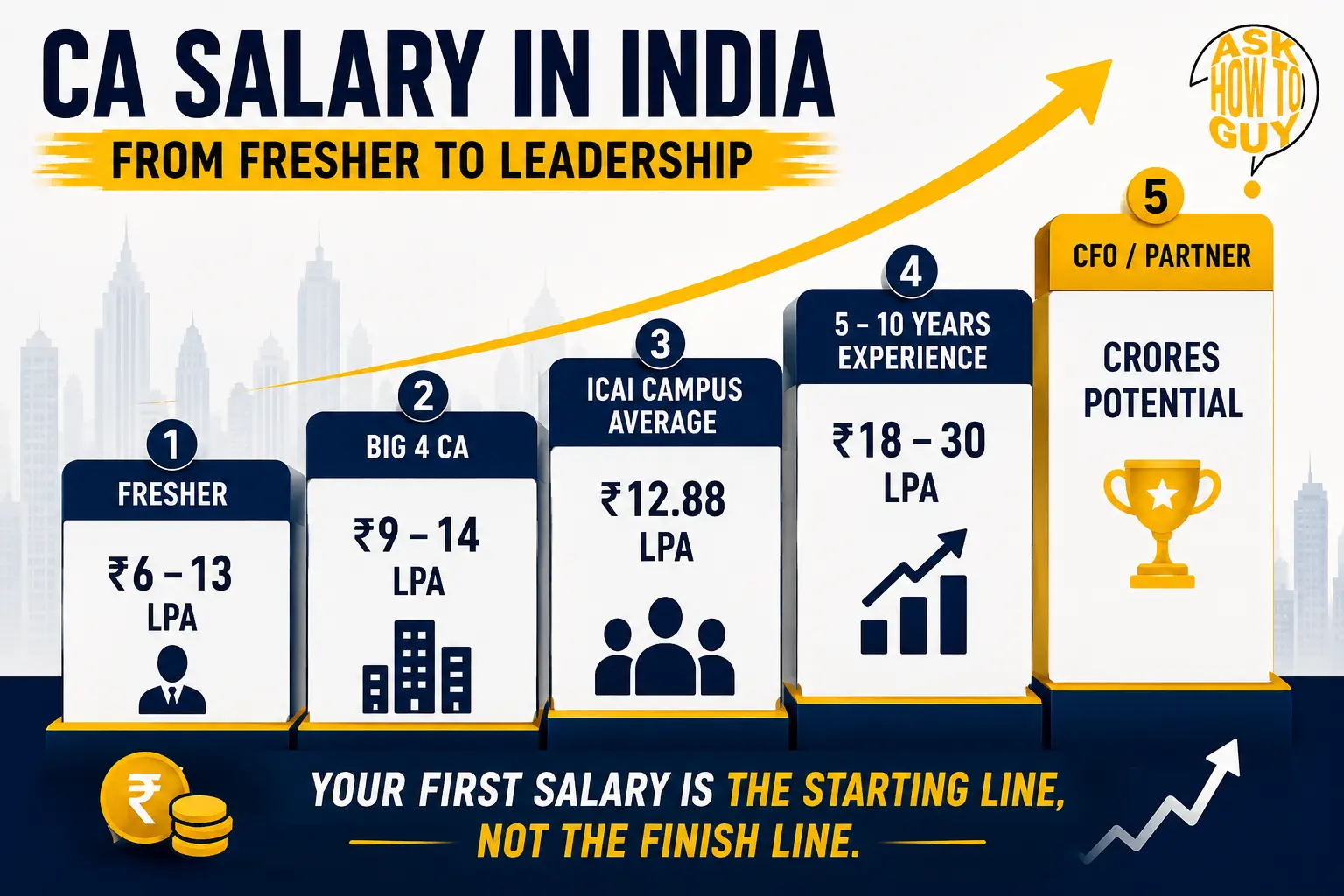
After everything – Foundation, Intermediate, two years of articleship, Final – what does the paycheck look like?
| Level | Annual Package | Monthly (approx) |
|---|---|---|
| Fresher (open market) | ₹6-13 LPA | ₹50,000-₹1,00,000 |
| Big 4 fresher (Deloitte, EY, PwC, KPMG) | ₹9-14 LPA | ₹75,000-₹1,15,000 |
| ICAI Campus Placement average | ₹12.88 LPA | – |
| Highest domestic offer (campus) | ₹26.70 LPA | – |
| Mid-level (5-10 yrs experience) | ₹18-30 LPA | ₹1.5-2 lakh |
Big 4 firms generally sit at the higher end of the fresher range, often ₹9-14 LPA depending on the role. Smaller firms and local practices tend to start lower but offer faster hands-on exposure, which some CAs value more in their first two years. The exact placement figures – including the offer ranges above — are published twice a year on the ICAI Placements portal, which runs the official Campus Placement Programme for newly qualified CAs.
The growth curve afterward is steep. Mid-level CAs with 5-10 years of experience commonly cross ₹1.5-2 lakh a month, and CFOs or Big 4 partners go well beyond that. The takeaway: the first salary isn’t the ceiling, it’s the starting line.
| 💬 The Guy’s Take Every commerce kid in India has thought about CA at least once, usually because someone’s uncle “did CA and now drives an Audi.” Here’s the unfiltered version. CA isn’t a hard exam. It’s a long one. The syllabus isn’t impossible – most of it is stuff you can genuinely learn if you sit down and do it consistently. What breaks people is the timeline. Two years of articleship while studying for Final is brutal, and a lot of smart people quit not because they couldn’t pass, but because they got tired of waiting. If you can handle a long game – not a sprint, a marathon with checkpoints every few months – this is one of the best returns on effort in Indian education right now. Do it because the work itself makes sense to you, not because of the Audi story. The ones who make it usually weren’t chasing the car. |
Frequently Asked Questions
1. What are the steps to become a CA?
Register for Foundation after 12th (or Intermediate directly via Direct Entry if you’re a graduate), clear Foundation, clear both groups of Intermediate, complete ICITSS, do 2 years of articleship alongside the Self-Paced Online Modules, then clear both groups of Final and register with ICAI.
2. Is CA harder than MBBS?
Different kind of hard. MBBS is a fixed-duration, seat-based course – once you’re in, the structure carries you through. CA has no seat limit, but every level is a fresh, open exam with notoriously low pass rates, so your progress depends entirely on clearing each stage, not on time served. Most people who’ve done both say CA demands more self-discipline since there’s no classroom forcing a routine on you.
3. What is a CA monthly salary?
For freshers, expect roughly ₹50,000-₹1,00,000 a month, translating to ₹6-13 LPA depending on the firm and your rank. This climbs steadily – experienced CAs in consulting or leadership roles can cross ₹1.5-2 lakh a month within 5-10 years.
4. Who is the 19 year old CA girl?
That’s Nandini Agarwal from Morena, Madhya Pradesh, who secured All India Rank 1 in the CA Final exam in 2021 at 19 years and 330 days old, making her the world’s youngest female chartered accountant by Guinness World Records. She’d completed her 10th boards at 13 and 12th at 15 after skipping two grades – proof that the “minimum years” on paper isn’t a hard ceiling for someone who moves fast and stays consistent.
5. Is CA a high paid job?
Yes, relative to most fresher roles in India. Starting packages of ₹6-13 LPA already beat the average graduate salary by a wide margin, and the long-term ceiling – Big 4 partner or CFO level – runs into crores. The catch is the 4.5-7 year runway before that first paycheck arrives.
6. Who earns more, CA or IAS?
In the early years, CA usually wins on pure take-home pay – a fresher CA can out-earn a junior IAS officer’s salary plus allowances, especially at Big 4 firms. IAS pulls ahead on long-term stability, pension, and the kind of authority and social standing that a government posting brings, which is a different kind of “earning” altogether. If the goal is purely the number in your bank account in your late 20s, CA tends to get there faster.
Found this useful? Share it with someone deciding between CA, B.Com, or other commerce careers right now. Got a specific doubt about Foundation prep, Direct Entry eligibility, or articleship – drop it in the mail : hello@askhowtoguy.com!