

Teaching in a government school is one of the most stable, well-paying, and genuinely meaningful careers in India – and one of the most misunderstood in terms of how to actually get there. If you’re wondering how to become a government teacher, the process is more structured than most people think. A lot of people give up before they start because the process seems complicated. It isn’t, once you understand the structure.
Here’s the one thing most articles skip: how to become a government teacher in India depends almost entirely on which level you want to teach. Primary (Classes 1-5), upper primary (6-10), or higher secondary (11-12) – each has a completely different qualification path, eligibility exam, and recruitment process. Before anything else, you need to answer that one question.
This guide breaks down how to become a government teacher step by step – how to become a government teacher after 12th, how to enter after graduation, what happens if you don’t have a B.Ed, how to become a high school government teacher, and what the salary actually looks like at every level.
Which Type of Government Teacher Are You Aiming For?
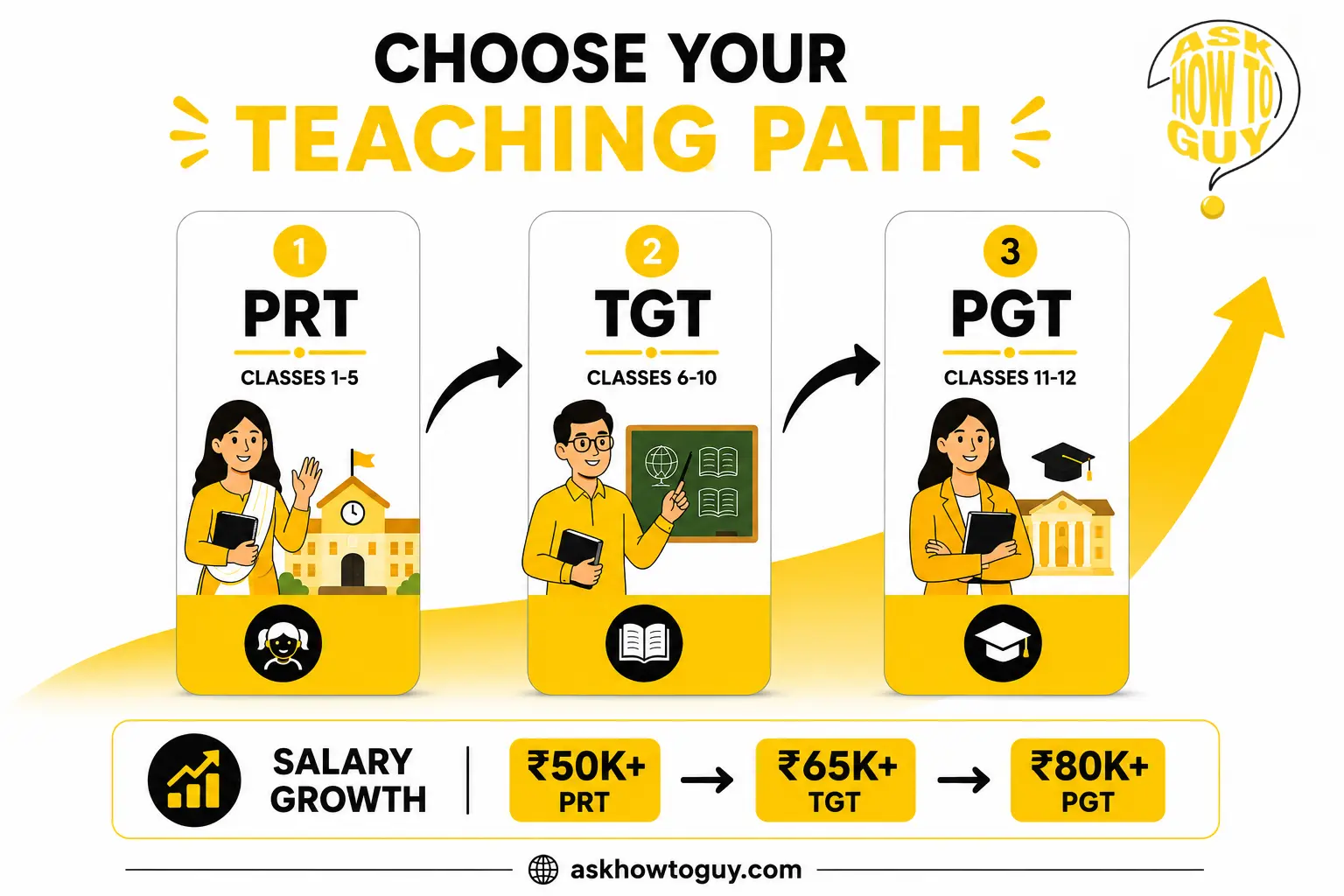
| 📌 Which Type of Government Teacher Are You Aiming For? | ||
| 🌟 PRT Primary Teacher (Classes 1-5) | 📚 TGT Trained Graduate Teacher (Classes 6-10) | 🏫 PGT Post Graduate Teacher (Classes 11-12) |
| Min. Qualification | Min. Qualification | Min. Qualification |
| 12th Pass + D.El.Ed / D.Ed (or 4-yr B.El.Ed / ITEP) | Graduation (50%) + B.Ed (NCTE recognised) | Post-Graduation (50%) + B.Ed (in the teaching subject) |
| Eligibility Exam | Eligibility Exam | Eligibility Exam |
| CTET Paper I or State TET | CTET Paper II or State TET | State TET / KVS / NVS recruitment (no CTET for PGT at some orgs) |
| Recruitment Exam | Recruitment Exam | Recruitment Exam |
| KVS / NVS / DSSSB / State PSC recruitment | KVS / NVS / DSSSB / State PSC recruitment | KVS / NVS / State PSC / State STET recruitment |
| In-hand Salary 2026 | In-hand Salary 2026 | In-hand Salary 2026 |
| ₹50,000-₹62,000/month (central school, metro) | ₹65,000-₹72,000/month (KVS/NVS, metro) | ₹70,000-₹80,000/month (KVS/NVS, metro) |
| 💡 The level you teach decides EVERYTHING: your qualification path, the exam you sit, and the salary you start at. Settle this question first before reading anything else. | ||
Reality Check: Five things that confuse most aspirants before they’ve even started.
| ❌ What People Think | ✅ What’s Actually True |
|---|---|
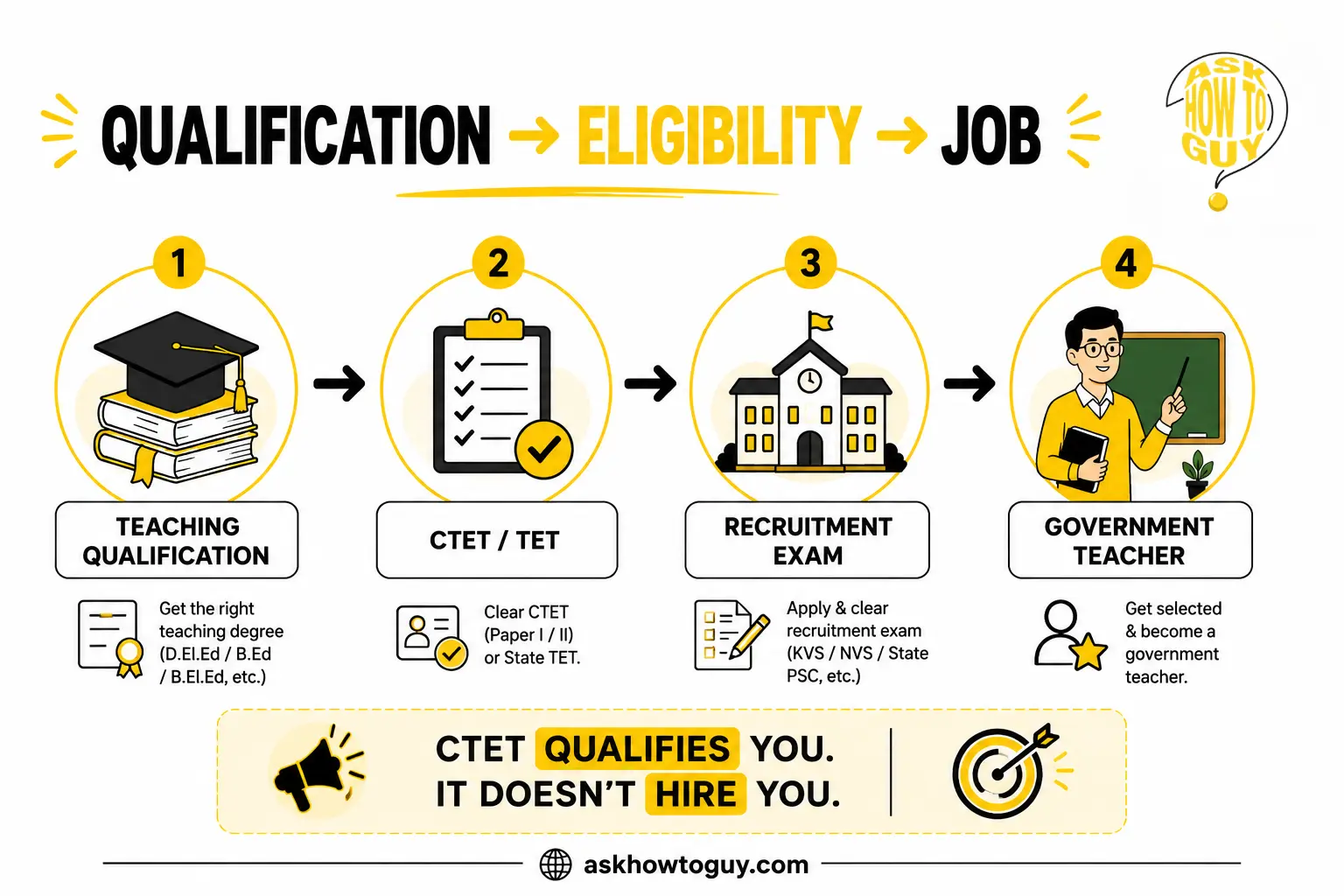
| CTET = a government teaching job | CTET is an eligibility test, not a recruitment exam – clearing it makes you eligible to apply, not appointed |
| B.Ed is compulsory for all levels | For PRT (Classes 1-5), D.El.Ed or D.Ed is sufficient – B.Ed is not mandatory at the primary level |
| One exam gets you the job | Three stages minimum: teaching qualification → CTET/TET → recruitment exam (KVS/NVS/State PSC) |
| CTET certificate expires | CTET certificate is now lifetime valid – CBSE made it permanent in 2021, pass once and it’s yours forever |
| State TET and CTET are interchangeable | CTET covers central schools (KVS, NVS); State TET covers state government schools – both valid but for different employers |
Also Read: How to Become a Pilot
| 🗺 VISUAL STEP MAP – How to Become a Government Teacher in India | |
| Step 1 | Decide Your Level: PRT, TGT, or PGT The single most important decision. See the routing card above – your level determines your qualification, exam, and timeline. |
| Step 2 | Get the Right Teaching Qualification PRT: 12th + D.El.Ed / D.Ed (or 4-yr B.El.Ed/ITEP). TGT: Graduation + B.Ed. PGT: Post-Graduation + B.Ed. Must be NCTE-approved. |
| Step 3 | Clear CTET or State TET CTET Paper I for PRT (Classes 1-5), Paper II for TGT (Classes 6-8). State TET for state schools. CTET for central schools (KVS, NVS). Certificate is now lifetime valid. |
| Step 4 | Apply for Recruitment Exams KVS / NVS conduct their own written exams + interview. State PSCs, DSSSB, BPSC TRE, and others run state-level recruitment drives. Watch official notifications. |
| Step 5 | Written Test + Demo Lesson + Interview Most recruitment bodies have a multi-stage selection: written exam (70% weightage in KVS), teaching demo (15%), and personal interview (15%). |
| Step 6 | Document Verification & Appointment Degree, TET certificate, caste documents if applicable, medical fitness. Appointment letter issued; probation period of 2 years typically follows. |
| ⏱ Timeline: 2-3 years after 12th for PRT. 4-5 years for TGT (including graduation + B.Ed). 5-6 years for PGT (post-graduation + B.Ed). Add 1-2 years for exam prep and recruitment cycles. | |
How to Become a Government Teacher After 12th
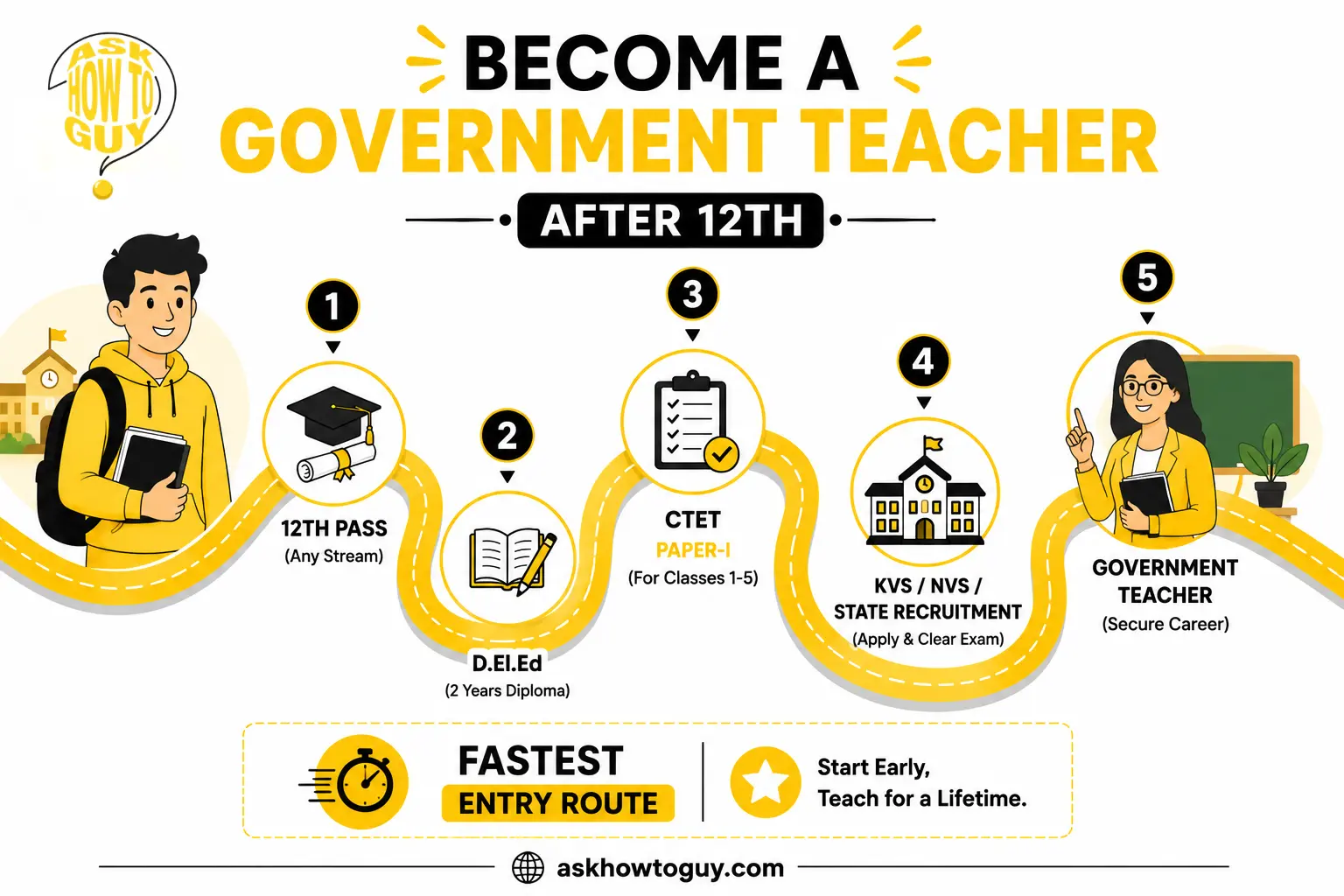
The direct route into government teaching after 12th is the PRT (Primary Teacher) path, which covers Classes 1 to 5. This is the fastest route into the profession and the most accessible – no graduation required.
After completing Class 12 in any stream with at least 50% marks (45% for SC/ST), you enrol in a D.El.Ed (Diploma in Elementary Education) or D.Ed (Diploma in Education) – a 2-year NCTE-recognized teacher training course. Alternatively, you can do a 4-year integrated B.El.Ed (Bachelor of Elementary Education) after 12th, which is the more comprehensive option and is highly preferred by central government schools. Under NEP 2020, a 4-year integrated ITEP (Integrated Teacher Education Programme) is also being introduced as a future standard.
Once your teaching qualification is done, the next step is clearing CTET Paper I (for Classes 1-5) or the equivalent State TET. After that, you apply for recruitment through KVS, NVS, DSSSB, or your state’s education service commission whenever they announce vacancies.
One thing many 12th-pass aspirants miss: you can start your D.El.Ed and simultaneously begin reading for CTET – both processes can run in parallel. Don’t wait until you finish the diploma before you start TET prep.
Also Read: How to Become a Radiologist
How to Become a Government Teacher After Graduation
Graduation opens the door to the TGT route – Trained Graduate Teacher, which covers Classes 6 to 10. This is the most popular path among graduates entering government teaching.
The qualification is a B.Ed (Bachelor of Education) from an NCTE-recognized university – a 2-year professional degree that covers pedagogy, teaching methods, and subject knowledge. Your graduation subject largely determines which subject you can apply to teach as a TGT – so a History graduate typically becomes a Social Studies TGT, a Maths graduate becomes a Maths TGT, and so on.
After your B.Ed, you need to clear CTET Paper II (or your state’s TET for Classes 6-8) before you’re eligible to apply for any government TGT vacancy. The CTET is conducted by CBSE and qualifies you for central government schools; state TETs qualify you for state board schools. You can hold both.
An important nuance for how to become a government teacher after graduation: some states offer integrated 4-year B.A. B.Ed or B.Sc. B.Ed programmes that combine graduation and B.Ed into one degree. If you’re still in graduation, switching to this integrated route saves you a full year of post-graduation teacher training.
How to Become a Government Teacher Without B.Ed
This question has a clear answer: it depends on which level you’re aiming for.
For PRT (Classes 1-5), B.Ed is not required. A D.El.Ed, D.Ed, or 4-year B.El.Ed is the recognised qualification – no B.Ed needed. This is the main route for how to become a government teacher without BEd that actually works in the current system.
For TGT and PGT positions, B.Ed is effectively mandatory for most recruitments – KVS, NVS, DSSSB, and state PSCs all require it for Classes 6 and above. There is a narrow exception: candidates with a 4-year integrated B.A. B.Ed or B.Sc. B.Ed are considered equivalent to separate Graduation + B.Ed, so technically they’re “without a standalone B.Ed” but still B.Ed qualified in the eyes of recruiters.
Bottom line: if avoiding B.Ed entirely is the constraint, PRT is your practical path. If you’re open to alternatives to the separate 2-year B.Ed, the integrated 4-year B.A. B.Ed route is worth considering.
How to Become a High School Government Teacher
High school here means Classes 11 and 12 – which falls under the PGT (Post Graduate Teacher) category. This is the most qualification-intensive route, and the one with the highest starting salary.
To how to become a high school government teacher, you need a post-graduate degree (M.A., M.Sc., M.Com., etc.) in your teaching subject with at least 50% marks, plus a B.Ed from an NCTE-recognized institution. So the full qualification path from Class 12 looks like this: 12th → Graduation (3 years) → Post-Graduation (2 years) → B.Ed (2 years) = 7 years minimum before you’re eligible.
PGT recruitment for KVS and NVS doesn’t always require CTET – these organizations conduct their own written exam, teaching demo, and interview. State-level PGT recruitment is handled by state PSCs and state STETs (Secondary Teacher Eligibility Tests), which vary by state. The written test for KVS PGT covers subject knowledge, reasoning, and pedagogy – and competition is high, since PGT posts carry the best salary in the school teaching hierarchy.
Which Recruitment Exam to Target: KVS, NVS, or State?
Once you’re TET/CTET qualified, the actual job comes through a recruitment exam. Here’s how the main options differ – because this is where a lot of aspirants lose time by preparing for the wrong exam.
1. KVS (Kendriya Vidyalaya Sangathan): Central government schools across India. Best pay, high competition. Written test + demo + interview. Vacancies are notified on kvsangathan.nic.in. CTET is mandatory for PRT and TGT posts.
2. NVS (Navodaya Vidyalaya Samiti): Residential schools (Jawahar Navodaya Vidyalayas). Computer-based test with negative marking. Good pay + government accommodation. Vacancies on navodaya.gov.in.
3. State PSC / Education Department: Each state recruits teachers through its own PSC or education board – BPSC TRE (Bihar), REET (Rajasthan), UPTET + UP TGT/PGT (UP), DSSSB (Delhi), MPTET (MP), etc. State TET qualifies you here, not CTET. This is often the more practical route for most aspirants since state-level competition is lower and postings are closer to home.
| 💰 Government Teacher Salary 2026 (7th Pay Commission) | |||
| Post | Basic Pay (Entry) | In-hand (Metro, 2026) | Pay Level |
| PRT (Classes 1-5) | ₹35,400/month | ₹50,000-₹62,000 | Pay Level 6 |
| TGT (Classes 6-10) | ₹44,900/month | ₹65,000-₹72,000 | Pay Level 7 |
| PGT (Classes 11-12) | ₹47,600/month | ₹70,000-₹80,000 | Pay Level 8 |
| DA: ~58-60% of basic (2026) • HRA: up to 27% (metro) • TA: ₹3,600/month • NPS deduction: 10% • Figures are for central schools (KVS/NVS); state school salaries vary. 8th Pay Commission expected to revise upward. | |||
If you’re exploring other respected public-sector careers, you may also want to read our guides on How to Become an IAS Officer, How to Become an Income Tax Officer, and How to Become a Lawyer, especially if you’re comparing government service, salary, and career progression options.
| 💬 The Guy’s Take Everyone respects a doctor or an engineer. Almost nobody talks about a government teacher until they’re in a moment of genuine need – an exam they failed, a concept they couldn’t understand, a student they couldn’t afford to send to a coaching center. That’s when the government school teacher matters more than anyone else in the room. The career isn’t easy to get into – but it’s far less complicated than people make it sound. The mistake most aspirants make is trying to understand everything at once. Don’t. Just answer one question first: which class do you want to teach? That answer alone cuts 80% of the confusion about qualifications, exams, and timelines. The job itself – once you’re in – gives you something most careers don’t: summers, evenings, and the ability to be fully present at home. That’s not a small thing. If teaching genuinely appeals to you, don’t let the process scare you off before you’ve even started. |
Frequently Asked Questions
1. What is the process of becoming a government teacher?
Step 1: Decide your level (PRT/TGT/PGT). Step 2: Get the teaching qualification – D.El.Ed for PRT, B.Ed for TGT and PGT, all from NCTE-recognised institutions. Step 3: Clear CTET (or your State TET) – Paper I for PRT, Paper II for TGT. Step 4: Apply for recruitment exams (KVS, NVS, DSSSB, or state PSC). Step 5: Clear written test + teaching demo + interview. Step 6: Document verification and appointment. CTET certificate is now lifetime valid, so step 3 only needs to happen once.
2. Which government job gives 50,000 salary per month?
Multiple government teaching posts cross ₹50,000 in-hand salary per month. A PRT in a central government school (KVS/NVS) in a metro city earns roughly ₹50,000-₹62,000 in-hand, TGT earns ₹65,000-₹72,000, and PGT earns ₹70,000-₹80,000 – all figures including DA, HRA, and TA under the 7th Pay Commission. Beyond teaching, government jobs that cross ₹50,000 in-hand include SSC CGL Group B posts (Inspector level), bank PO roles, and UPSC-allocated services – our guide on how to become an IAS officer covers the highest-paying government career path.
3. Which degree is best for a government teacher?
It depends on the level you want to teach. For PRT (Classes 1-5): a D.El.Ed or B.El.Ed is the right degree – B.Ed isn’t needed. For TGT (Classes 6-10): graduation in your subject + B.Ed from an NCTE-recognised university. For PGT (Classes 11-12): post-graduation in your subject + B.Ed. The integrated 4-year B.A. B.Ed or B.Sc. B.Ed (after Class 12) is increasingly preferred because it covers both graduation and teacher training in one programme, saving time. All qualifications must be from NCTE-approved institutions – verify before enrolling.
4. Is B. Ed. compulsory for teaching?
Not for all levels. For PRT (primary school, Classes 1-5), a D.El.Ed, D.Ed, or B.El.Ed is sufficient – B.Ed is not required. For TGT and PGT posts (Classes 6 and above), B.Ed is effectively mandatory at most central and state government schools. The 4-year integrated programmes (B.A. B.Ed / B.Sc. B.Ed) are accepted as equivalent to a separate B.Ed for TGT eligibility. Under NEP 2020, the ITEP (4-year Integrated Teacher Education Programme) is being rolled out as a future alternative to the separate D.El.Ed + B.Ed model.
5. Can only 12th pass apply for CTET?
For CTET Paper I (PRT/Classes 1-5): yes, candidates who have passed 12th with 50% marks AND are pursuing or have completed D.El.Ed or equivalent teacher training can appear. For CTET Paper II (TGT/Classes 6-8): graduation is required, so a 12th-pass-only candidate cannot appear for Paper II. In short, 12th pass is enough to apply for CTET Paper I only – and only if you also have the D.El.Ed qualification.
6. What are the 4 types of teachers?
In India’s government school system, teachers are classified as: (1) PRT – Primary Teacher, for Classes 1-5. (2) TGT – Trained Graduate Teacher, for Classes 6-10. (3) PGT – Post Graduate Teacher, for Classes 11-12. (4) Pre-Primary Teacher, for Nursery/KG, typically requiring a NTT (Nursery Teacher Training) diploma. Some frameworks also add a 5th category: Principal/Vice Principal, who is a teacher in a leadership role. The broader classification beyond school teaching includes college lecturers (NET/SET qualified) and university professors – different track, different eligibility entirely.
Found this useful? Share it with someone who’s been going back and forth on a teaching career. Got a question about which state’s TET to attempt, B.Ed options, or KVS vs NVS – drop it in the mail: hello@askhowtoguy.com !