

If you’ve typed “how to become a bank manager” into Google, there’s a good chance you’re imagining a job where you sit at the corner desk of a bank branch, approve loans, manage a team, and have a title that commands a bit of respect. That’s accurate. What’s less accurate is the assumption that there’s a direct “bank manager exam” you can take.
There isn’t. Nobody directly becomes a bank manager in India. You become a Probationary Officer (PO) in a government bank, or a management trainee or sales officer in a private bank – and then you earn the manager title through performance and time. The question isn’t “which exam gets you the manager job.” It’s “which entry route gets you into banking, and how quickly does it lead to the manager’s desk.”
This guide on how to become a bank manager in India answers both. It covers the government bank route (IBPS PO, SBI PO), the private bank route, the realistic timelines, the actual salaries, and what someone still in school or just finishing graduation should do right now.
| 📌 Which Route Are You Aiming For? Settle This First. | ||
| 🏦 Government Bank (SBI, PNB, BOB, Canara…) | 🏢 Private Bank (HDFC, ICICI, Axis, Kotak…) | |
| Entry Route | IBPS PO or SBI PO exam → Probationary Officer → Manager by promotion | Direct hire as Branch Manager or MBA fresher as Management Trainee |
| Minimum Qualification | Graduation in any stream (50% preferred, no minimum % for IBPS) | Graduation or MBA – private banks prefer MBA for fast-track manager roles |
| 12th Pass? | Not eligible directly. Graduation is mandatory for PO exams | Not eligible directly. Degree required at minimum |
| Exam Required? | Yes – IBPS PO or SBI PO (Prelims → Mains → Interview) | No standard exam. Each bank runs its own hiring or campus placement |
| Time to Become Manager | 5-8 years from PO joining (via internal promotion exams) | 2-5 years if MBA lateral hire; longer from clerk/sales executive entry |
| Starting Salary (PO level) | ₹70,000-₹85,000/month in-hand (SBI PO) | ₹40,000-₹70,000/month (varies widely by bank & role) |
| Branch Manager Salary | ₹72,000-₹85,000/month (SBI Scale III) | ₹1,00,000-₹1,50,000/month (HDFC/ICICI branch manager) |
| Job Security | High – PSB, pension, defined career ladder | Moderate – performance-linked, market-driven |
| Best For | Stability seekers, government job aspirants | Faster growth & higher pay seekers, MBA graduates |
| 💡 Nobody starts as a bank manager. You enter as a PO (government bank) or trainee/associate (private bank) and work your way up. The route you pick here determines every other section of this guide that’s relevant to you. | ||
Reality Check: Five things that need to be cleared up before anything else.
| ❌ What People Think | ✅ What’s Actually True |
|---|---|
| There’s a direct “bank manager” exam | No such exam exists – you enter as PO or management trainee and get promoted to manager over 3-8 years |
| 12th pass can become a bank manager directly | Graduation is mandatory for all PO and management trainee roles – 12th pass can only apply for clerk positions |
| IBPS PO and SBI PO are the same exam | Different conducting bodies, different banks, slightly different patterns – SBI PO is harder and considered more prestigious |
| Private bank = faster manager role always | Faster in some banks if you’re an MBA lateral hire; but without MBA, government PO route often has a clearer, steadier promotion track |
| Bank manager is a stressful, target-driven job | It genuinely is – loan targets, deposit growth, audits, staff management. The salary reflects it. Worth knowing upfront. |
Also Read: How to Become a Doctor in India
| 🗺 VISUAL STEP MAP – How to Become a Bank Manager | |
| Step 1 | Complete Graduation in Any Stream No minimum percentage for IBPS PO (degree from recognised university). SBI PO requires passing graduation. Final-year students can apply for PO exams provisionally. |
| Step 2 | Clear IBPS PO or SBI PO (Govt Bank) / Apply to Private Bank Govt route: IBPS PO Prelims → Mains → Interview. SBI PO: Prelims → Mains → Group Exercise + Interview. Private route: campus placement, direct application, or management trainee programme. |
| Step 3 | Join as Probationary Officer / Management Trainee Govt bank: 2-year probation at Scale I. Private bank: 6-12 month training programme, then confirmed in a role (sales officer, relationship manager, etc.). |
| Step 4 | Build Experience – Credit, Ops, Retail Banking Rotate across departments. Credit appraisal, loan processing, customer relations, branch operations. This is where the real banking education happens. |
| Step 5 | Clear Internal Promotion Exams Public sector banks run internal exams (JAIIB, CAIIB – Indian Institute of Banking) that are de-facto prerequisites for promotion from Scale I to Scale II and beyond. |
| Step 6 | Promoted to Manager (Scale II / Branch Manager, small branch) Typically 3-5 years after PO joining. In private banks, Manager title can come sooner for high performers, but Branch Manager with full P&L ownership takes longer. |
| ⏱ Realistic timeline: 5-8 years from graduation to Branch Manager (government bank). 3-6 years in a private bank with MBA or strong performance record. | |
How to Become a Bank Manager in Government Bank
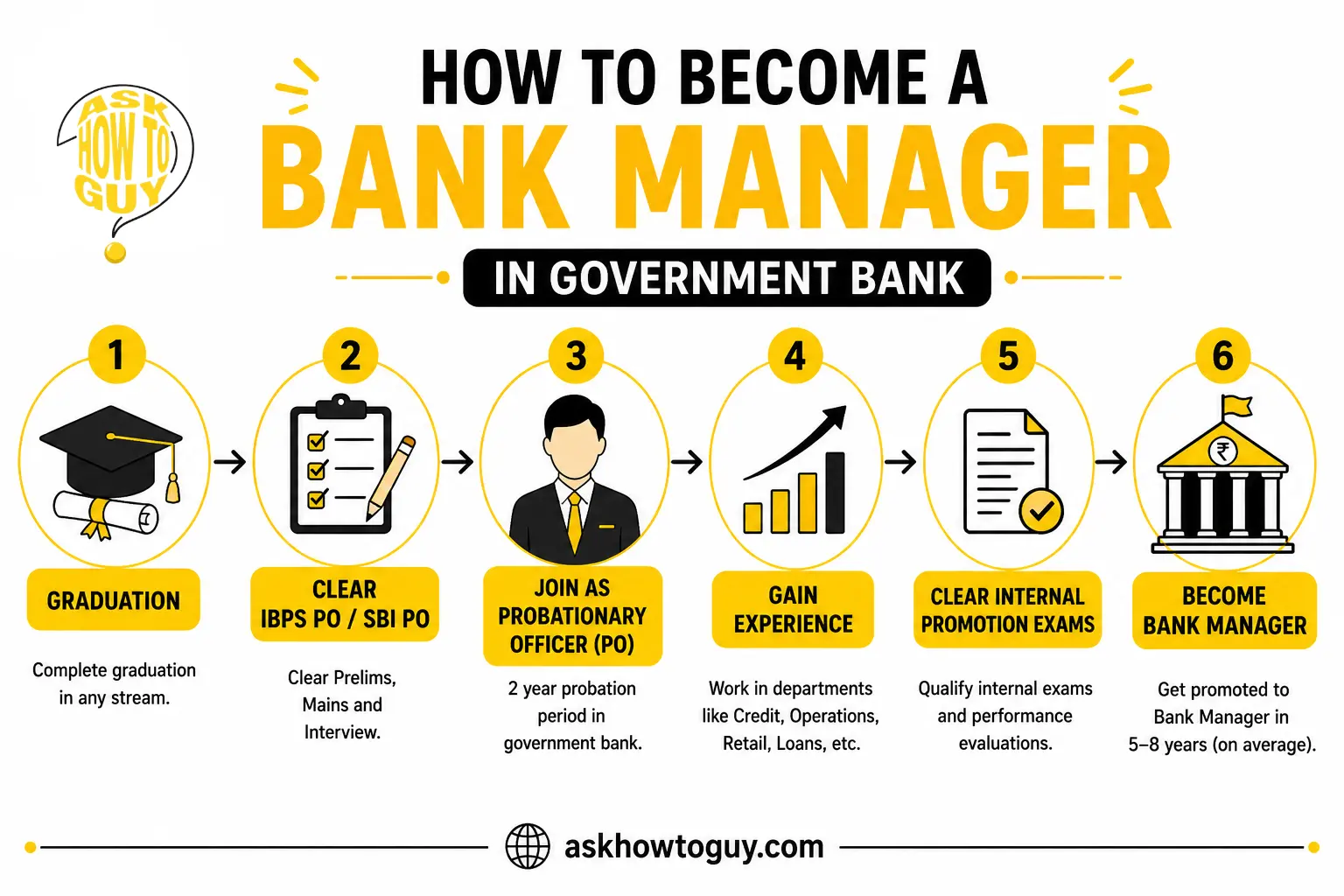
The government bank route is the most structured path, and the one most people searching how to become a bank manager in government bank are actually looking for. It works like this: clear a PO exam, join as Probationary Officer, get promoted through internal exams and appraisals.
There are two main entry exams. IBPS PO – run by the Institute of Banking Personnel Selection – recruits POs across 11 public sector banks including PNB, Bank of Baroda, Canara Bank, and Union Bank. The 2026 cycle has announced 6,715 vacancies for PO/MT posts (CRP PO/MT-XVI), with applications open until 21 July 2026. SBI PO – run by the State Bank of India – is a separate exam for SBI’s own 1,500 vacancies in 2026. SBI PO is considered slightly tougher (it has a Group Exercise and Psychometric Test stage) but is also more prestigious and pays a notch higher.
Both exams follow the same broad format: Prelims (objective, screening) → Mains (objective + descriptive) → Interview. Eligibility: graduation in any discipline, age 20-30 years (General), with the usual reserved category relaxations. No minimum percentage for IBPS PO; SBI PO requires passing graduation from a recognised university.
After joining as PO, the promotion ladder (see infographic below) moves through Scale II (Manager) → Scale III (Senior Manager / Branch Manager for medium branches) → and upward. Most POs reach branch manager level in 5-8 years with consistent performance and by clearing the JAIIB and CAIIB exams conducted by the Indian Institute of Banking and Finance, which are practically essential for promotion in PSBs.
| 📈 Career Ladder in Public Sector Banks (after IBPS/SBI PO) | ||
| Scale | Designation | Typical Timeline |
| Scale I | Probationary Officer (PO) / Junior Manager | Entry level – 2-year probation |
| Scale II | Manager (Branch Manager, small branches) | 3-5 years after PO joining |
| Scale III | Senior Manager (Branch Manager, medium branches) | 6-9 years of service |
| Scale IV | Chief Manager | 10-13 years |
| Scale V | Assistant General Manager (AGM) | 14-18 years |
| Scale VI | Deputy General Manager (DGM) | 18-22 years |
| Scale VII | General Manager (GM) / MD / Chairman | 22+ years |
| Promotion is through internal exams + performance appraisals. Timelines above are approximate – high performers often move faster. Private bank ladders are less standardised but typically faster to Branch Manager. | ||
Also Read: How to Become an Income Tax Officer
How to Become a Bank Manager in Private Bank
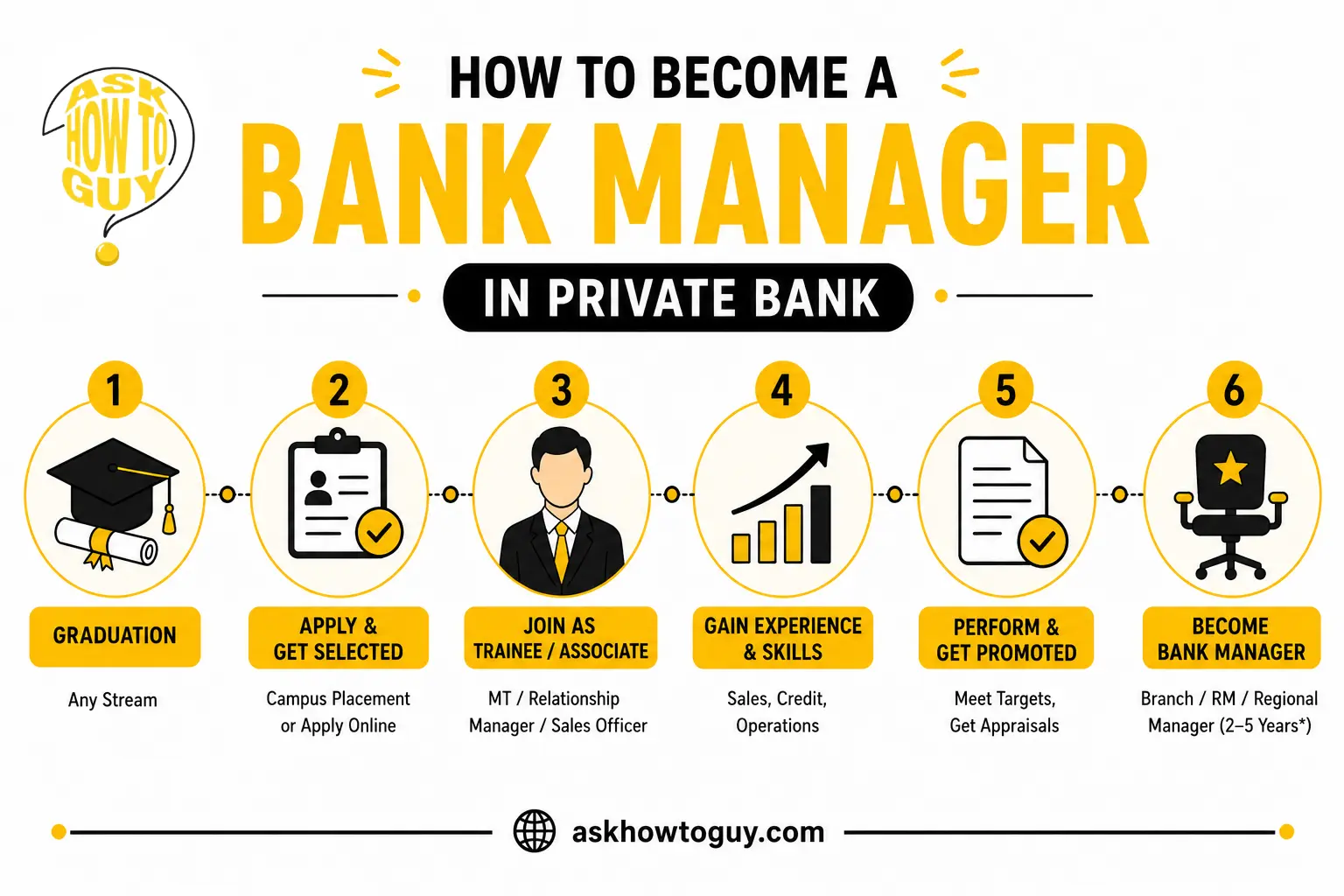
The private bank route to how to become a bank manager in private bank is less standardized but often faster, especially if you hold an MBA. There’s no single entrance exam – each bank runs its own hiring.
The three main entry points are:
(1) MBA campus placement – banks like HDFC, ICICI, Axis, and Kotak actively recruit management graduates as Management Trainees or Future Leaders Programme participants, and fast-track them to assistant manager or manager roles within 2-3 years.
(2) Direct application – applying for roles like Relationship Manager, Retail Banking Officer, or Branch Operations Executive and working up from there; typically slower to Branch Manager designation.
(3) Lateral hire from govt banks – experienced public sector bank officers are actively poached by private banks at higher pay scales, especially those with credit or large-account management experience.
If you’re weighing other central government exam paths, our guide on how to become an income tax officer covers SSC CGL and UPSC routes into the Income Tax department – a comparable government career that many IBPS aspirants also consider.
Private bank salaries at Branch Manager level are typically higher than government bank equivalents – ₹1,00,000-₹1,50,000/month at HDFC or ICICI versus ₹80,000-₹95,000 at SBI. The trade-off is higher targets, more performance pressure, and no defined pension. The salary card below lays this out side by side.
| 💰 Bank Manager Salary in India 2026 – Govt vs Private | ||
| Level / Role | 🏦 Govt Bank (SBI / IBPS) | 🏢 Private Bank (HDFC / ICICI) |
| PO / Entry Officer (Scale I) | ₹70,000-₹85,000/month in-hand | ₹40,000-₹70,000/month (varies) |
| Manager (Scale II / Asst Mgr) | ₹75,000-₹90,000/month | ₹70,000-₹1,00,000/month |
| Branch Manager (Scale III) | ₹80,000-₹95,000/month (SBI ~₹78K avg) | ₹1,00,000-₹1,50,000/month |
| Senior / Regional Manager | ₹1,00,000-₹1,30,000/month | ₹1,20,000-₹2,00,000/month |
| Govt bank figures include DA, HRA & allowances. Private bank figures are total CTC – in-hand may be 15-20% lower. SBI PO package is ~₹21.97 LPA CTC at metro posting (2026). | ||
How to Become a Bank Manager After 12th
Short answer: you can’t – not directly. Graduation is the minimum qualification for both IBPS PO and SBI PO, and for any management trainee programme at private banks. How to become a bank manager after 12th is really a question about what to do now so that the path to manager opens up in 4-6 years.
The practical steps: finish 12th, then choose your degree thoughtfully. A B.Com, BBA, B.Sc. (Economics), or any graduation works for PO exams. An MBA after graduation is the fastest route to manager-level entry in private banks. Commerce graduates who want an alternative to the banking path often look at how to become a CA – a qualification that opens doors in audit, tax, and corporate finance with comparable long-term earnings. During your degree, start reading for bank exams in your final year – IBPS PO syllabus (Quant, Reasoning, English, General Awareness) runs parallel to most graduation preparation and doesn’t need a separate 2-year coaching slog.
One thing you can do right after 12th: apply for IBPS Clerk after graduation, which is an entry-level position in the same public sector banks. Some clerks get promoted to officer scale over time through an internal promotion route. It’s a longer path to manager, but it’s a legitimate one if you want to start working in a bank sooner rather than later.
| 💬 The Guy’s Take Everyone who asks about becoming a bank manager is really asking one of two things: “how do I get a stable, respectable government job” or “how do I build a career in finance that pays well and grows.” Both are valid, but they lead to different routes. If it’s stability you want, the IBPS PO or SBI PO path is one of the best deals in Indian employment right now – decent starting pay, structured growth, pension, and the kind of job security that very few private sector roles can match. The trade-off is that you’ll be a PO for 3-5 years before the manager title arrives, and you’ll spend some of that time posting at branches far from home. If it’s financial growth and faster advancement you’re after, the private bank route with an MBA gets you to Branch Manager faster and at higher pay – but with real targets and real pressure attached. The ₹1.5 lakh/month figure isn’t a given; it comes with performance. Either way, start with the routing card at the top of this guide. The path you pick there determines everything else – which exam to study for, which degree to prioritise, and how long the realistic journey actually takes. |
Frequently Asked Questions
1. What is the basic salary of a bank manager?
In a government bank, a Branch Manager at Scale III earns a basic pay of roughly ₹48,170-₹63,840/month, with Dearness Allowance, HRA, and other allowances pushing total in-hand to ₹80,000-₹95,000/month in a metro posting. SBI Branch Managers average around ₹78,000/month in-hand based on 2026 data. In private banks like HDFC or ICICI, a Branch Manager typically earns ₹1,00,000-₹1,50,000/month total CTC, with a significant variable pay component tied to branch performance.
2. Is there any exam for bank manager?
There is no direct “bank manager exam.” You enter banking through the IBPS PO exam or SBI PO exam as a Probationary Officer, and then get promoted to manager through internal promotion exams (mainly JAIIB and CAIIB) and performance appraisals. IBPS PO is an annual exam; SBI PO is conducted separately by SBI. The manager designation comes after 3-8 years of service, not from clearing any single exam.
3. Is it hard to become a bank manager?
The entry exam (IBPS PO or SBI PO) is genuinely competitive – lakhs of graduates compete for a few thousand seats. The syllabus covers Quant, Reasoning, English, and General Awareness, and most serious candidates prepare for 6-12 months. After joining, getting promoted from PO to Branch Manager requires consistent performance, clearing JAIIB/CAIIB, and typically 5-8 years of service. So: moderately hard to get in, and a long game to reach the branch manager desk. Not impossible – but not a shortcut either. If you’re comparing this with other competitive government career paths, our guide on how to become an IPS officer is worth reading alongside this – some aspirants run IBPS PO and UPSC preparation in parallel.
4. Can a 12th pass apply for a bank manager?
No – not for any officer-level role. Both IBPS PO and SBI PO, and private bank management trainee programmes, require at minimum a graduation degree. A 12th pass student can apply for IBPS Clerk (which also requires graduation in most states) or wait to apply once they complete their degree. There is no direct 12th-pass route to becoming a bank manager.
5. Is a bank manager a stressful job?
Yes, and it would be dishonest to say otherwise. A Branch Manager is accountable for branch revenue, deposit growth, loan disbursement targets, customer complaints, staff management, and regulatory compliance – all simultaneously. Private bank managers particularly face high performance pressure with variable pay linked to branch metrics. Government bank managers have slightly less variable pressure but deal with heavier bureaucratic compliance load. The salary, perks, and authority reflect this. People who thrive in this role are typically comfortable with targets and enjoy managing teams – not everyone does, and that’s worth being honest about before you commit to the path.
6. Is SBI PO salary 1 lakh per month?
Not quite at the PO (entry) level, but close once you account for everything. SBI PO’s CTC is officially around ₹21.97 lakh per annum at a metro posting – that works out to roughly ₹1.83 lakh/month CTC. However, in-hand take-home after NPS deduction and other deductions is typically ₹70,000-₹85,000/month at entry level. The ₹1 lakh figure is total CTC including DA, HRA, medical, and other allowances, not a direct bank transfer. As you get promoted from PO to Scale II and Scale III, in-hand pay crosses ₹1 lakh. For a broader picture of how government pay scales compare across services, see our guide on how to become an IAS officer – IAS officers start at a similar pay level but with a very different career trajectory.
Found this useful? Share it with someone weighing banking versus other government exam paths. Got a question about IBPS vs SBI PO, MBA route, or internal promotions – drop it in the mail : hello@askhowtoguy.com !