
Someone in your family gets an MRI done, and the first thing everyone does is stare at the radiologist’s report trying to decode words like “hyperintense” and “no acute abnormality.” Somewhere in that moment, you’ve probably wondered what it takes to be the person who actually reads those scans for a living -and that’s how you’ve landed on “how to become a radiologist.”
Before anything else, let’s clear up the confusion this search always runs into: a radiologist is a full MBBS doctor with a postgraduate specialisation in reading and interpreting scans. A radiology technician (also called a radiographer) is a separate, diploma or B.Sc-level role that operates the imaging machines. Same department, very different qualifications and very different jobs -and mixing the two up early on can send your planning in the wrong direction.
This guide walks through everything you need to know about how to become a radiologist – how long it actually takes, how to become a radiologist in india step by step, how to start planning right after 12th, and what your income realistically looks like once you’re qualified. No fluff, just the roadmap.
Reality Check: Five Myths That Confuse Every Radiologist Aspirant
| ❌ What People Think | ✅ What’s Actually True |
|---|---|
| A radiologist just reads X-rays | Radiologists interpret X-rays, CT, MRI, ultrasound and mammograms – and many also perform image-guided procedures like biopsies and drainages |
| You can become a radiologist without an MBBS | MBBS is compulsory. A radiologist is a full doctor with a postgraduate specialisation, not a diploma-level job |
| Radiologist and radiology technician are the same job | The technician (or radiographer) operates the scanning machine after a diploma or B.Sc; the radiologist is the MBBS + MD/DNB doctor who reads the scan and writes the report |
| It’s a quick way into a medical career | Realistically it takes 9-10 years from Class 12 to become a fully qualified, independently practising radiologist |
| Every radiologist earns ₹10 lakh a month | That kind of income is possible for senior consultants or diagnostic-centre owners in big cities after 10+ years -it’s not the entry-level reality |
Also Read: How to Become a Doctor in India
| 🗺 VISUAL STEP MAP – How to Become a Radiologist | |
| Step 1 | Complete Class 12 with PCB Physics, Chemistry, Biology is compulsory -not Commerce or Arts. Most colleges ask for 50% aggregate (40% for reserved categories) to sit for NEET UG. This is where how to become a radiologist after 12th planning really begins. |
| Step 2 | Clear NEET UG The single entrance exam for every MBBS seat in India, conducted by the NTA. Your rank decides which college and state quota you can get into. |
| Step 3 | Complete MBBS (5.5 years) 4.5 years of academics plus a mandatory 1-year rotating internship. You’re a licensed doctor at the end of this, but not yet a specialist. |
| Step 4 | Clear NEET PG A separate, tougher exam after MBBS that decides your postgraduate seat -this is what actually gets you into radiology. |
| Step 5 | MD in Radiodiagnosis or DNB Radiodiagnosis (3 years) MD is through a medical college; DNB is the equivalent hospital-based route run by the National Board. Both make you a qualified radiologist. |
| Step 6 | Optional fellowship or super-specialization 1-2 extra years in interventional radiology, neuroradiology, or another niche – not compulsory, but it raises your ceiling considerably. |
| Step 7 | Register with the State Medical Council/NMC and start practice Only after registration can you legally sign off on reports -in a hospital, a diagnostic chain, or your own practice. |
| ⏱ Total timeline: 9.5-10 years from Class 12 (5.5 years MBBS + 3 years MD/DNB, plus the gap most students take to prepare for NEET PG). Add 1-2 more years if you go for a fellowship. | |
How to Become a Radiologist in India
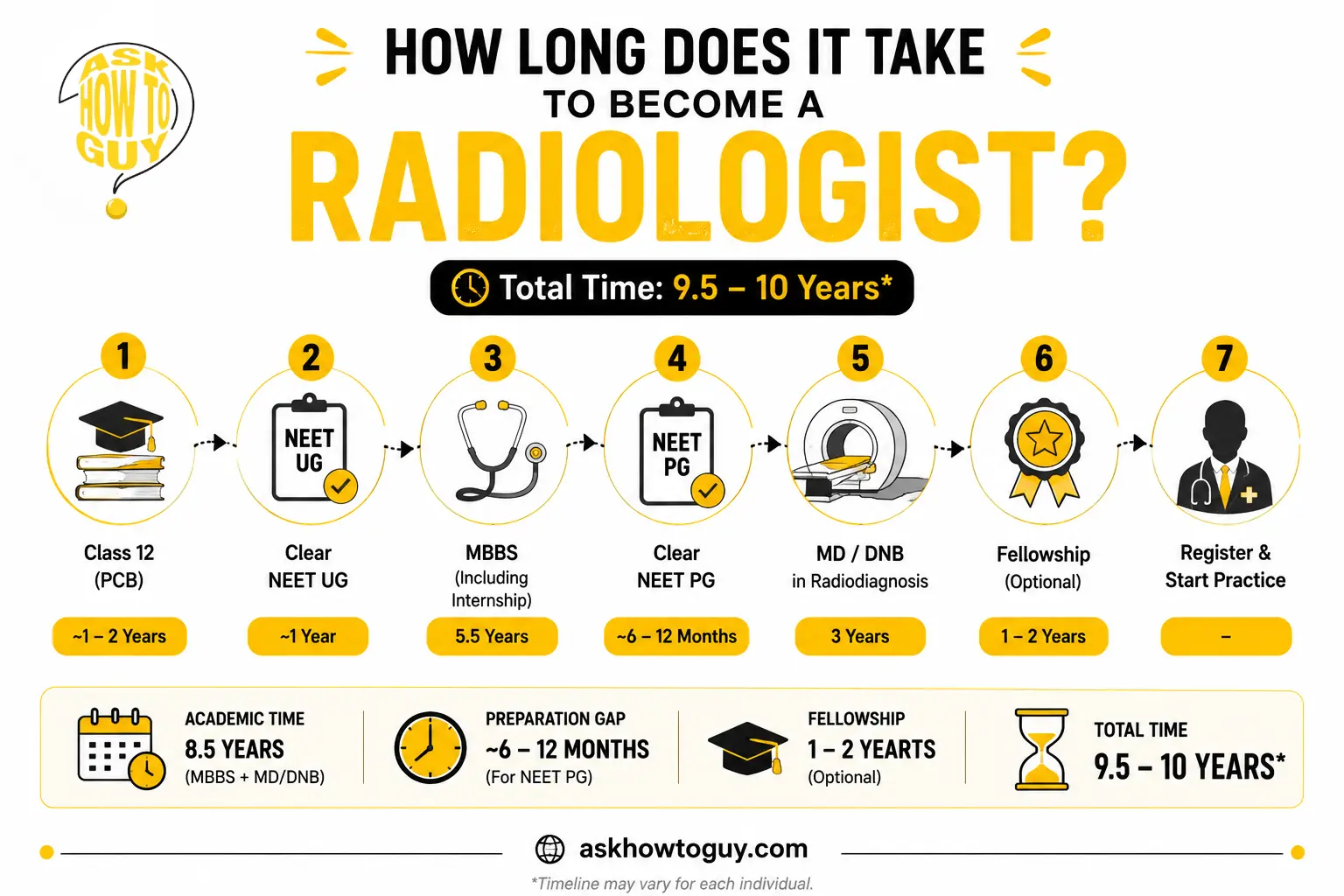
Here’s exactly how to become a radiologist, step by step. Start with NEET UG, the single entrance exam that decides your MBBS seat anywhere in the country. Your rank, category, and state domicile together determine which government or private medical college you can get into -and yes, the college matters less for radiology specifically than your NEET PG rank later does.
MBBS itself is 4.5 years of coursework plus a mandatory 1-year rotating internship where you work across every department, including radiology postings. Pay attention during those postings -they’re often the only real exposure you get before deciding to specialise in this field.
After MBBS, you’ll clear NEET PG, conducted by the National Board of Examinations in Medical Sciences (NBEMS), to get into a postgraduate seat. From here you have two equally valid routes into radiology:
• MD in Radiodiagnosis -a 3-year course run through a medical college, following a university curriculum.
• DNB in Radiodiagnosis -a 3-year course run through NBEMS-accredited hospitals instead of medical colleges. It’s practically identical in recognition and career value, and often has more seats available than MD.
Once you’ve cleared MD or DNB, registration with your State Medical Council or the National Medical Commission is what legally allows you to sign off on scan reports. From there, most radiologists either join a government hospital, work with a private diagnostic chain, or eventually set up independent practice -often after building a reputation through a hospital or chain first. If a stable government posting appeals to you more than years of building a private practice, it’s worth understanding how competitive-exam government careers work more broadly -our guide on how to become an IAS officer breaks down that structure, even though it’s a completely different exam track.
Some radiologists also pursue a fellowship in a sub-specialisation -interventional radiology, neuroradiology, or paediatric imaging -through bodies like the Indian Radiological and Imaging Association. It’s optional, adds 1-2 years, and mainly matters if you want to work in a super-specialty hospital or a metro-city diagnostic chain rather than general practice.
How Long Does It Take to Become a Radiologist?
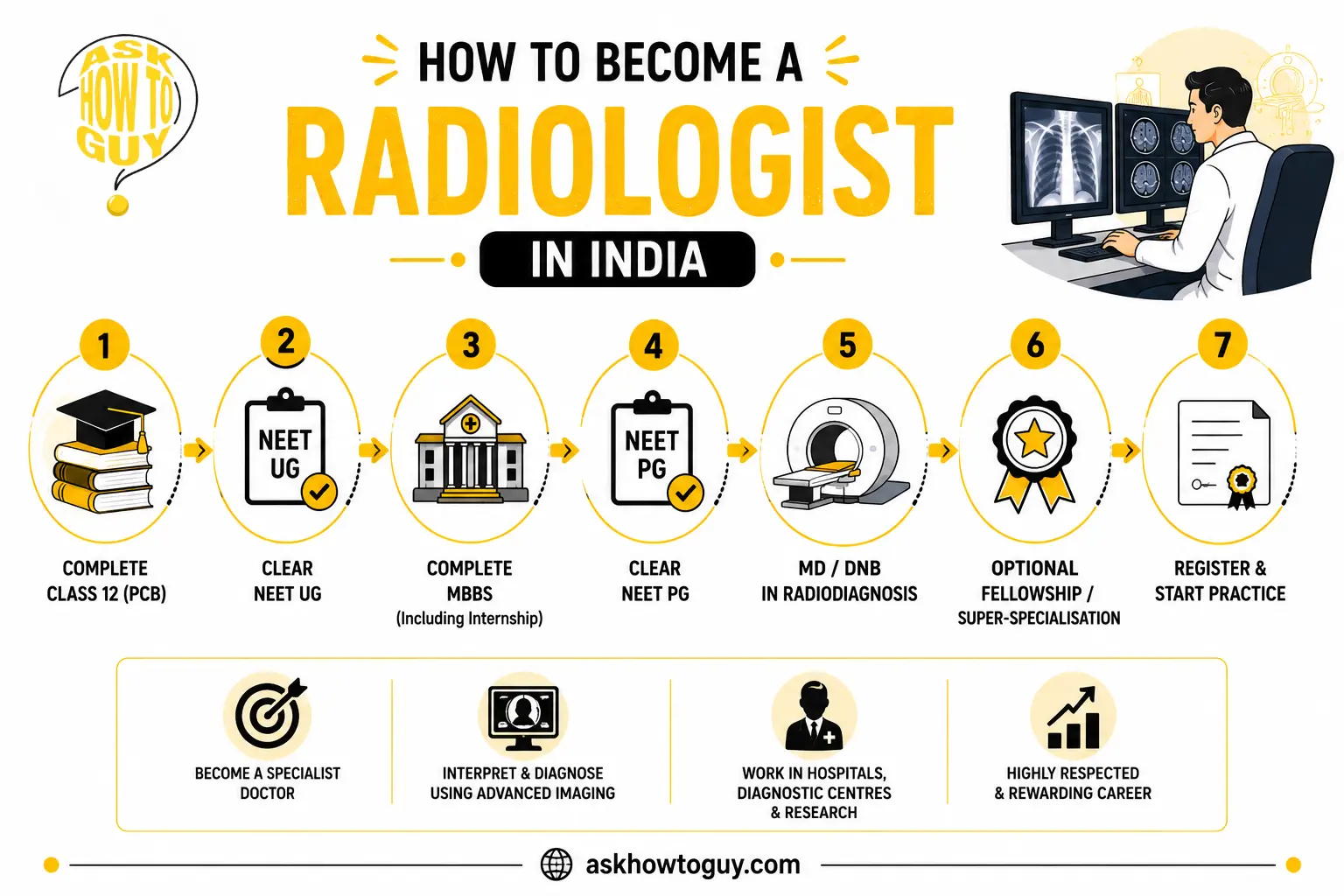
If you’re asking how long does it take to become a radiologist, the honest answer is 9.5 to 10 years from Class 12, and it rarely goes faster. Here’s the actual breakup: 5.5 years for MBBS (including the compulsory 1-year internship), then 3 years for MD or DNB in Radiodiagnosis. That’s 8.5 years on paper -but almost every student takes a preparation gap of 6 months to a year between MBBS and clearing NEET PG, which is why 9-10 years is the realistic number, not the optimistic one.
It’s a longer runway than most professional courses. A law degree, by comparison, takes 5-6 years -you can read our guide on how to become a lawyer if you’re genuinely torn between the two. But radiology’s earning ceiling once you’re established, plus the fact that it’s one of the less physically demanding medical specialisations long-term, is why so many doctors still choose it despite the wait.
How to Become a Radiologist After 12th
If you’re still in Class 12, here’s the part that actually matters right now: you need the PCB combination -Physics, Chemistry, Biology -with Biology being non-negotiable even though radiology feels like a very “physics and machines” specialisation on the surface. NEET UG tests all three, and Biology carries the heaviest weightage.
Register for NEET UG through the National Testing Agency as soon as applications open, usually a few months before the exam. Most colleges ask for a minimum 50% aggregate in PCB (40% for SC/ST/OBC), and there’s no upper age limit that realistically affects a 12th-grade student.
If NEET genuinely isn’t clicking for you after a couple of attempts, it’s worth knowing there’s no shame in the technician route either -a B.Sc in Radiography or Medical Imaging Technology gets you into the same department in a different, non-doctor role, without needing NEET at all. It’s a real career, just not the one this specific search is usually asking about.
And if you’re a PCB student who’s decided medicine’s long timeline isn’t for you but still wants an aspirational, exam-driven career, it’s common for students from the same stream to look at how to become a pilot in India as an alternative -different skill set entirely, but a similarly structured path with clear milestones.
Also Read: How to Become a Pilot in India
| 💬 The Guy’s Take Radiology looks glamorous from the outside -dark rooms, big screens, sharp diagnoses -but almost nobody tells aspirants it’s a 9-10 year commitment before you’re actually earning like a specialist. That’s the part people underestimate. If you’re chasing this because you like the puzzle-solving side of medicine more than the bedside-manner side, you’re probably suited for it. But don’t pick MD Radiodiagnosis just because the seats are less crowded than some other specialisations -that reasoning runs out the day you’re actually reading scans for a living. Talk to a working radiologist before you lock in your NEET PG choices, and don’t skip internships in radiology departments during MBBS if you can help it. The people who do well in this field aren’t the ones who rushed through it -they’re the ones who used the long timeline to actually get good at reading images, not just clearing the next exam. |
Frequently Asked Questions
1. Can I become a radiologist without MBBS?
No. MBBS is compulsory, followed by MD or DNB in Radiodiagnosis. The only imaging-department career that doesn’t need MBBS is becoming a radiology technician or radiographer, which is a completely different, non-doctor role with its own diploma or B.Sc qualification.
2. Is NEET required to become a radiologist?
Yes, twice over. NEET UG gets you into MBBS, and NEET PG later gets you into the MD or DNB Radiodiagnosis seat that actually makes you a radiologist. There’s no way to skip either exam on this path.
3. What is the difference between a radiologist and a radiology technician?
A radiologist is an MBBS doctor with a postgraduate specialisation (MD or DNB) who interprets scans and writes the diagnostic report. A radiology technician, or radiographer, operates the imaging equipment -X-ray, CT, MRI machines -after a diploma or B.Sc, and doesn’t diagnose or sign off on reports.
4. Can a radiologist earn ₹10 lakh a month?
It’s possible, but only at the top end -senior consultants with a strong reputation, or those who own or co-own a diagnostic centre or chain in a major city, after 10-15+ years in the field. A newly qualified radiologist’s income is nowhere close to that; it builds gradually with experience, case volume, and reputation.
5. Is radiology easy to study?
Not easier or harder than any other MD specialisation -it’s just a different kind of hard. It leans heavily on anatomy, pattern recognition, and building the visual memory to spot what’s abnormal in a scan, which suits some students far more naturally than others.
6. Will AI replace radiologists?
Unlikely in the way people fear. AI tools are already used to flag suspicious areas on scans faster, but a licensed radiologist still has to confirm the finding, factor in the patient’s full clinical picture, and take legal responsibility for the report -something radiology bodies globally continue to emphasise as AI tools get adopted. The role is shifting toward working alongside these tools, not disappearing because of them.
Found this useful? Share it with someone still deciding between NEET PG specializations. Got a specific question about MD vs DNB, or which specialization pays better long-term? Drop it in the mail: hello@askhowtoguy.com!