

Somewhere between the third Instagram reel of someone typing on a laptop at a beach cafe and your cousin casually mentioning she got paid in dollars this month, you’ve ended up here, typing “how to become a freelancer” into Google at an hour you probably shouldn’t still be awake.
Here’s what freelancing actually is, minus the reel aesthetic: you’re self-employed, working directly with clients instead of one employer, getting paid per project or per hour instead of a fixed monthly salary. No HR department, no fixed leave policy, no one assigning you work if you don’t go find it yourself. It’s real work – just structured differently.
This guide covers everything about how to become a freelancer – starting from zero experience, doing it while you’re still a student, the specific rules that apply in India, and how platforms like Fiverr and Upwork actually work once you’re ready to find your first client.
Reality Check: Five Myths About Freelancing
| ❌ What People Think | ✅ What’s Actually True |
|---|---|
| Freelancing means working whenever you feel like it | You still have deadlines and clients waiting on you – the flexibility is in when you work, not whether the work happens at all |
| You need years of experience or a fat portfolio to start | Two or three solid sample pieces, even unpaid practice work, are enough to land your first real gig |
| Freelance income isn’t taxable since it’s not a “real job” | It’s very much taxable – as business or professional income under Indian tax law – and GST kicks in once your turnover crosses the threshold |
| You’ll be earning in dollars from international clients within a week | Most freelancers’ first few months are slow. Building trust and reviews takes time before the income actually scales |
| Students can’t freelance, only “qualified professionals” get hired | Plenty of college students freelance in writing, design, and social media alongside classes – clients care about the work, not your degree status |
Also Read: How to Become Customs Officer
| 🗺 VISUAL STEP MAP – How to Become a Freelancer | |
| Step 1 | Pick a skill you can actually sell Writing, graphic design, social media management, video editing, data entry, virtual assistance, coding – pick based on genuine interest and aptitude, not just whatever looks trendy on Instagram. |
| Step 2 | Build a small proof-of-work portfolio Two or three sample pieces are enough. They don’t need to be paid work yet – practice projects, mock briefs, or free work for someone you know all count. |
| Step 3 | Choose your platform and set up a strong profile Fiverr, Upwork, or direct outreach on LinkedIn – whichever you pick, use a clear photo, an honest bio, and a niche-specific pitch instead of a generic “I do everything” profile. |
| Step 4 | Price your first few gigs to actually win them You’re buying reviews and trust right now, not maximising income. Undercut a little at the start; you can raise rates later. |
| Step 5 | Deliver on time and ask for a review This is what actually builds your reputation – clear communication and hitting deadlines matter more than being the most “talented” applicant. |
| Step 6 | Raise your rates as reviews come in Once you’ve got a few solid testimonials and you’re working faster and better, your pricing should reflect that – don’t stay at beginner rates out of habit. |
| Step 7 | Build direct client relationships beyond the platform Repeat clients who contact you directly save you the platform’s commission and protect you from depending on one marketplace’s algorithm. |
| ⏱ Realistic timeline: most freelancers need 3-6 months of consistent effort before income becomes meaningful. Anyone promising overnight results is selling you a course, not a career. | |
How to Become a Freelancer With No Experience
This is the question that stops most people before they even start, and it shouldn’t. Nobody’s first client ever checked their 5-year track record – clients hire based on what you can show them right now, not your resume.
Start by creating 2-3 sample pieces on your own: a mock blog post, a redesigned version of a real brand’s Instagram post, a small coding project, whatever fits your chosen skill. These aren’t paid, but they’re proof you can actually do the work, which is exactly what a portfolio needs to demonstrate at this stage.
From there, take your first one or two real projects at a lower rate than you’ll eventually charge, purely to bank reviews and a testimonial or two. This is the same advice whether someone frames it as how to become a freelancer with no experience or how to become a freelancer for beginners – the underlying fix is identical: trade a bit of income now for proof you can build on later.
If you want structured skill-building before you pitch anyone, platforms like Coursera have short, genuinely useful courses in writing, design, and dozens of other freelance-friendly skills – worth a look before you decide what to specialize in.
How to Become a Freelancer as a Student
Freelancing around college is less about finding time and more about protecting it – treat client work like a fixed timetable slot, not something you squeeze in whenever you’re free, or it’ll eat into both your grades and your sleep.
Skills that fit a student schedule well: content writing, social media management, basic graphic design, transcription, and virtual assistance – all things you can do in a few focused hours without needing expensive equipment or software.
If you’re looking for other ways to earn alongside college, you can also explore these best money-earning apps for students and see which options fit your schedule and skills.
If you’d rather build deep expertise in one recognised profession instead of juggling client work while you study, it’s worth comparing this against a path like how to become a government teacher – a completely different kind of stability, built over years rather than gigs.
Either way, be upfront with clients that you’re a student – most don’t mind, as long as you’re clear about your availability and you actually hit your deadlines.
Also Read: How to Become a Government Teacher
How to Become a Freelancer in India
Becoming a freelancer in India follows the same basic steps as anywhere else, but a few things need sorting out early, specifically because you’re doing this from India.
Start with your PAN card if you don’t already have one – you’ll need it to register on serious platforms, open a payment account, and eventually file taxes on this income. Nothing else on this list really works without it.
Next, decide who you’re actually building toward: Indian clients paying in rupees, or international clients paying in dollars. This shapes almost everything downstream – which platforms make sense, how you receive payments, and even your GST treatment, since work for clients abroad counts as an export of services.
For international clients, most Indian freelancers use Payoneer or a similar service built for cross-border freelance payments, rather than routing everything through a regular savings account. Domestic clients usually just pay via bank transfer or UPI, so there’s no extra setup needed there.
Once money starts coming in regularly, two compliance pieces kick in. Freelance income is taxed as business or professional income, not salary – you’ll report it under the relevant head when filing your ITR with the Income Tax Department. And GST registration through the GST portal becomes mandatory once your annual turnover crosses ₹20 lakh (₹10 lakh in a few special category states), regardless of whether your clients are in India or abroad.
Some freelancers also register on Udyam as a sole proprietor once they’re a bit further along – it mainly matters when a client specifically wants to work with a registered business rather than an individual.
Top 5 Freelancing Platforms in India
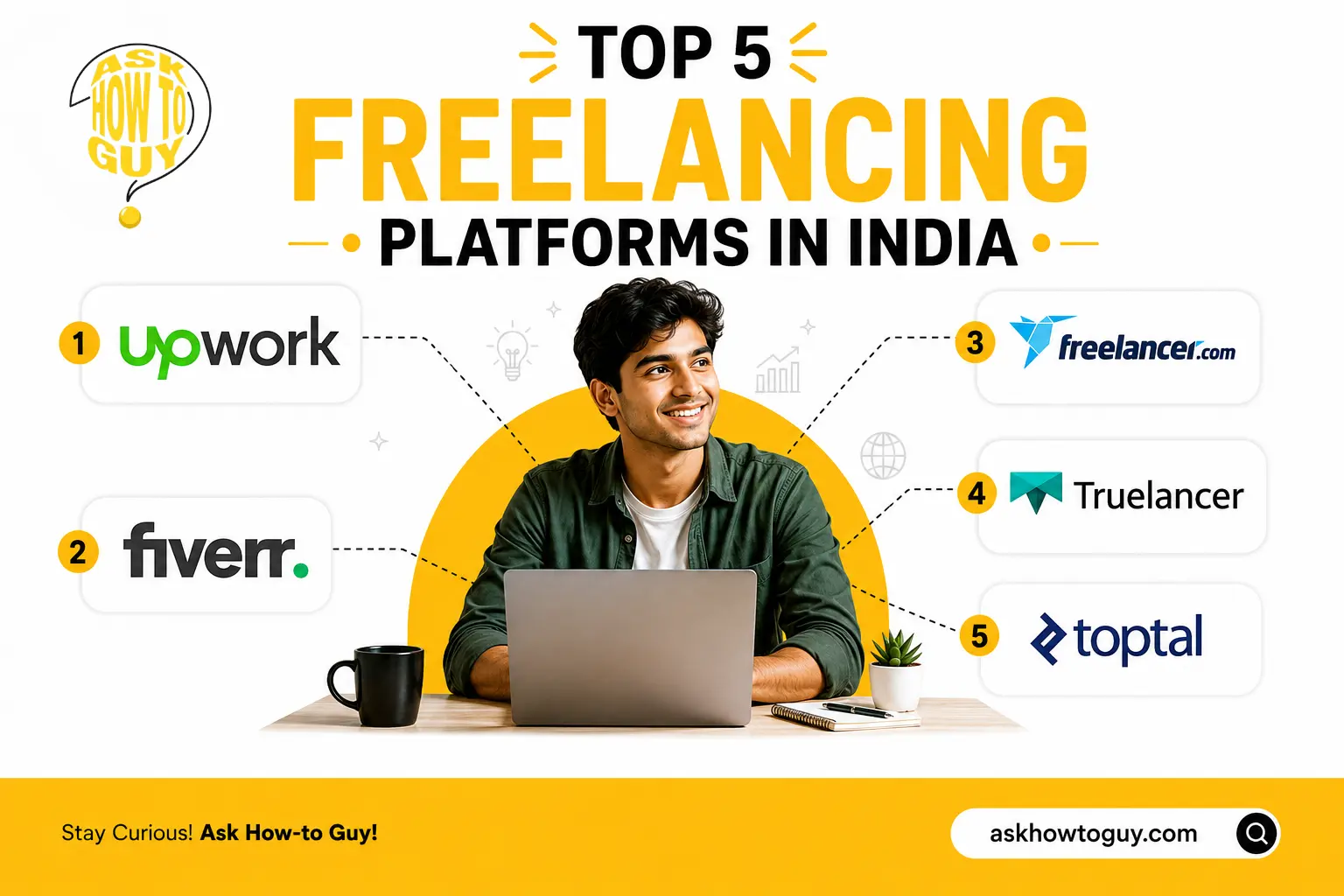
Fiverr and Upwork cover the big two, but they’re not your only options – a few other platforms are worth knowing about, especially if you’re just starting out or want to work more with Indian clients specifically.
• Upwork: upwork.com – proposal-based, best for long-term or higher-ticket projects. You spend limited “Connects” to bid on jobs, so it pays to be selective early on rather than applying to everything.
• Fiverr: fiverr.com – gig-based, best for beginners and productized services. Buyers browse and buy directly, so a well-optimised gig listing does a lot of the selling for you.
• Freelancer.com: freelancer.com – a large global marketplace with both fixed-price bidding and skill-based contests. Wide range of categories, though competition is stiff given how many people worldwide use it.
• Truelancer: truelancer.com – an India-based platform (headquartered in New Delhi), generally with less global competition and easier communication for India-focused clients paying in INR. A solid place to build early confidence before going after international work.
• Toptal: toptal.com – an invite-only network for the “top 3%” of freelance talent, mostly in software development, design, and finance. The screening process is genuinely tough, so this isn’t a beginner platform – it’s more something to aim for once you’ve already built a track record elsewhere.
How to Become a Freelancer on Fiverr
Fiverr and Upwork already showed up in the platform list above, but they work so differently that picking between them deserves a closer look. Fiverr runs on a gig model: you list your services with set packages and prices, and buyers come find you. That’s what makes it a solid starting point – you’re not chasing anyone down or competing in a crowded inbox, so a sharp gig title and description end up doing most of the selling on their own.
Upwork flips that entirely. Clients post the job first, and you’re one of possibly dozens of freelancers submitting a proposal to win it. If you’re specifically trying to figure out how to become a freelancer on upwork, here’s the real answer: your first few proposals matter a lot more than how polished your profile looks. A short pitch that actually responds to the client’s brief will beat a generic copy-paste message nearly every time.
Most freelancers don’t pick one and stick with it – they run both side by side, letting Fiverr bring in steady inbound work while using Upwork to go after the bigger, better-paying projects.
| 💬 The Guy’s Take Every third reel on your phone right now is someone claiming they quit their job and now make lakhs “working from bed.” What they don’t show is the two months before that where they messaged 40 potential clients and heard back from maybe three. Freelancing isn’t passive income – you’re the salesperson, the delivery team, and the accountant, all in one person, especially in month one. The people who actually make it aren’t the most talented; they’re the ones who treated the first few months like an unpaid internship instead of expecting a payday immediately. Pick a skill you can genuinely improve at, not just one that photographs well for LinkedIn. And please, keep your invoices and track your income properly from day one – sorting out a year of messy records right before tax season is a special kind of pain nobody needs. At the end of the day, learning how to become a freelancer is really about proving you can deliver, consistently, not about which tools or platforms you use. |
Frequently Asked Questions
1. How Do I Begin Freelancing?
Pick a skill you can already do reasonably well, build 2-3 sample pieces, set up a profile on Fiverr or Upwork (or reach out to people you know directly), and take your first project even at a lower rate. The full breakdown is in the step map above.
2. How Do I Earn Rs 30,000 Per Month From Home?
Realistically, this needs one or two consistent clients paying reasonably well, or several smaller ones stacked together – most freelancers get there within a few months of steady work, not their first week. It comes down to picking an in-demand skill and actually delivering reliably, not any particular trick.
3. What Is the Best Freelance Job for Beginners?
Content writing, data entry, virtual assistance, basic social media management, and simple graphic design all have a low barrier to entry and steady demand – none need expensive equipment, and all let you build a portfolio quickly.
4. What Is a Freelancer’s Salary?
There’s no fixed number – income depends entirely on your skill, niche, and how consistently you work, which is exactly why it’s so different from a regular paycheck. If a predictable, fixed monthly income matters more to you right now than variable freelance earnings, it’s worth comparing against something like how to become a bank manager, which trades a lower ceiling for a lot more certainty.
5. Do I Pay Tax If I Freelance?
Yes – freelance income is taxable as business or professional income under Indian tax law, regardless of whether it feels like a “real job” or not. You’ll also need GST registration if your turnover crosses ₹20 lakh a year. It’s genuinely worth talking to a CA once your income becomes regular, rather than figuring out compliance retroactively.
6. How to Earn 5000 Rupees Per Day?
That works out to roughly ₹1.5 lakh a month – a solid, established freelancer income, not a beginner-week outcome. It usually takes specialised, higher-value skills (like advanced development, consulting, or high-ticket design and marketing work) plus a consistent client base built up over time, not a shortcut you can apply on day one.
Found this useful? Send it to whoever in your friend group keeps talking about “going freelance” but hasn’t started yet. Got a specific question about pricing your first gig, or which platform to start with? Drop it in the mail: hello@askhowtoguy.com!