
Your uncle thinks psychology means “just talking to people.” Your mom asks if you will become a doctor. Your friend says you need NEET.
All three are off. That is why psychology is one of the most confusing career choices in India right now.
Here is the good news. The path is simple once you know one thing. Psychology in India splits into two tracks: general and clinical.
Pick the wrong track in college and you can lose a year. Pick the right one and you save money, time and a lot of dinner-table arguments.
So, how to become a psychologist without wasting years? That is what this guide covers, from Class 12 to your RCI licence. Whether you live in Nagpur, Jaipur or a town nobody has heard of, the steps stay the same. No heavy jargon. Just the real route.
| ❌ What People Think | ✅ What’s Actually True |
|---|---|
| You need NEET to become a psychologist. | No. NEET is for MBBS. Psychology runs on a psychology degree, not NEET. |
| Psychologists and psychiatrists are the same thing. | Psychiatrists are medical doctors. Psychologists are not. Only psychiatrists prescribe medicines. |
| Any psychology degree makes you a clinical psychologist. | That title needs an RCI-approved course and RCI registration. A normal MA is not enough. |
| Psychology is only for Arts students. | Arts, Commerce and Science students can all enter. The new RCI B.Sc route needs Science. |
| You will earn lakhs from day one. | Early pay is modest. Income grows with your licence, experience and your own practice. |
Also Read: How to Become a Doctor in India
| 🗺️ Visual Step Map: how to become a psychologist | |
| STEP 1 | Finish Class 12. Any stream works for BA Psychology. Science is needed for the RCI B.Sc route. |
| STEP 2 | Do a psychology degree. A four-year Honours course keeps every door open. |
| STEP 3 | Pick your track. Clinical, counselling, child or forensic. Decide before the master’s. |
| STEP 4 | Do your master’s. For clinical work, pick an RCI-approved MA in Clinical Psychology. |
| STEP 5 | Build supervised experience. Internships and clinical hours matter as much as marks. |
| STEP 6 | Register with RCI. Clinical psychologists need a CRR number to practise. |
| STEP 7 | Start working or study further. Jobs, private practice or a PhD. |
| ⏱ Realistic timeline: about 6 years after Class 12 for a licensed clinical psychologist. About 5 years for a general psychologist or counsellor. | |
Psychiatrist vs Psychologist
Start here, because this is where most people get stuck. It is the single biggest confusion around this career.
A psychiatrist is a medical doctor. They finish MBBS, then specialise in psychiatry. They diagnose mental illness and can prescribe medicines.
A psychologist is not a medical doctor. They study psychology. They work through therapy, counselling and psychological tests. They cannot prescribe medicines.
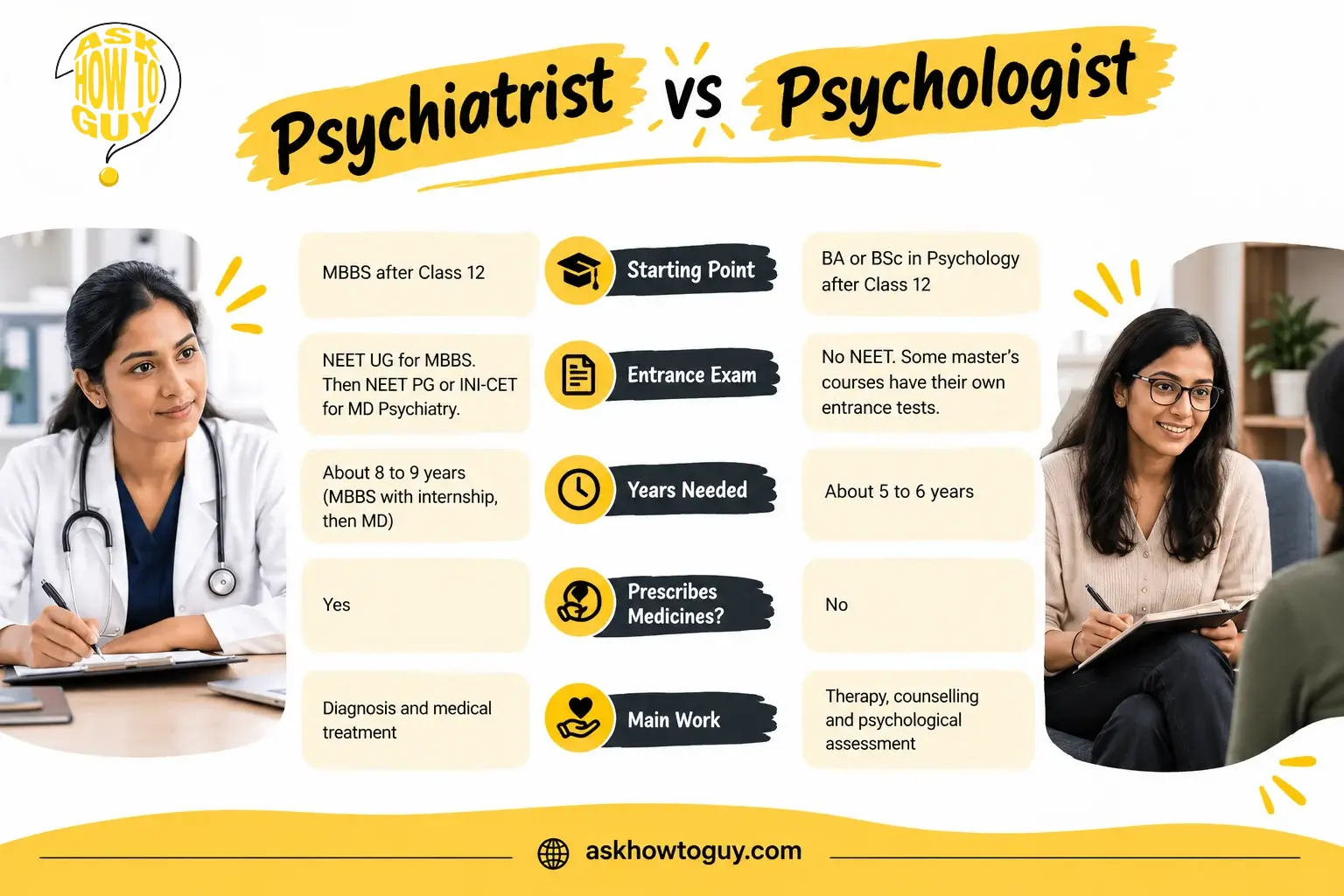
In real life, the two often work as a team. A psychiatrist may handle the medicines while a clinical psychologist runs therapy for the same patient.
Want the doctor route? Read our guide on how to become a doctor in India. The MD stage works the same way for other specialities, as you will see in our radiologist guide. Medical seats and rules come from the National Medical Commission, and entry starts with NEET UG.
If you love people but not the NEET grind, psychology may suit you better. Just know that it has its own tough gates.
How to Become a Psychologist in India
Now the real map. Psychology in India works in two layers.
Layer one is general psychology. Any BA or MA/MSc in Psychology from a UGC-recognised university comes under this. You can move into counselling, HR, research or teaching.
Layer two is clinical psychology. This one is regulated. The title “clinical psychologist” needs registration with the Rehabilitation Council of India, or RCI. Your registration number is called a CRR number, short for Central Rehabilitation Register.
Practising as a clinical psychologist without RCI registration is not allowed under the RCI Act. RCI has published its own guidelines for the MA in Clinical Psychology if you like reading the source.
So the plain answer to how to become a psychologist depends on what you want to do. Want to counsel students or employees? A psychology degree plus a master’s can get you there. Want to diagnose and treat mental illness as a licensed professional? Go clinical, and go through RCI.
One warning. These rules changed a lot in 2025 and 2026. The old M.Phil was replaced by a new master’s. Check RCI’s website before you pay any college fees.
How to Become a Psychologist After 12th
Good news for Class 12 students. You can start right after school. No NEET, no medical exam. You have two main doors.
Door 1: BA or BSc in Psychology. This is the common route. Arts students enter easily, and many Science and Commerce students do too. Many central universities, including Delhi University, take admission through CUET UG.
Check one thing before you join. Is it a full four-year Honours course? For the clinical route, RCI asks for a four-year degree. A three-year degree works only with a bridge course or an MA in Psychology.
Door 2: B.Sc. (Hons.) Clinical Psychology. RCI started this four-year course in 2024-25. It is full-time only, so there is no online or distance version. You need Science in Class 12, and some colleges ask for Biology. Most universities pick students through their own entrance test. Read RCI’s B.Sc. Clinical Psychology guidelines before you apply.
Which door is better? If you are sure about clinical work and have Science, Door 2 is more direct. If you are still unsure, Door 1 lets you explore first.
When people ask how to become a psychologist after school, my advice is simple. Choose the course first and the college second. A famous name does not help if the course has no RCI approval.
How Many Years to Become a Psychologist
Let us do the maths, because everyone asks.
These numbers do not count drop years or gaps. Clinical seats are few, so plan for a possible second attempt at entrance tests. That is normal. It does not mean you failed.
Also Read: How to Become a Radiologist
How to Become a Clinical Psychologist in India
This is the licensed route, so read this part slowly. It has three steps.
- Step one: a four-year BA or BSc in Psychology, usually with 55% marks. Or the three-year route with a bridge course.
- Step two: a two-year MA in Clinical Psychology from an RCI-approved institute.
- Step three: register with RCI and get your CRR number on the RCI registration portal.
The MA replaced the old M.Phil in Clinical Psychology from the 2025-26 session. Students who joined an M.Phil earlier can still register.
Entry is through entrance tests. NIMHANS in Bengaluru is the dream for many students, and it selects through a written entrance test. Others, like Manipal, run their own tests. Seats are limited and the competition is tough. Start preparing in your final year of graduation.
There is also a one-year PG Diploma in Clinical Psychology for people who already hold an MA or MSc in Psychology. It leads to registration as Clinical Psychologist (Associate). That comes with a narrower scope than the full licence.
The system is still settling, and some students have even challenged the new rules in court. Confirm everything with RCI before you commit.
How to Become a Counseling Psychologist
Counselling psychology is the more open route. You do not need Science. Any stream can enter the bachelor’s.
The usual path is a BA or BSc in Psychology. Then comes a two-year MA or MSc in Counselling Psychology, or in Applied Psychology with a counselling focus.
Here is the catch. As far as I know, India has no single national licence for general counsellors. Anyone can print “counsellor” on a visiting card. Your degree and your supervised hours are your real proof.
RCI has also opened a route for B.Sc. (Hons.) Clinical Psychology graduates to register as counselling psychologists. People in the field still argue about it, so check the latest rules.
Pick a course with real internships and supervised practice. Those hours matter more than the college name. You can then work in schools, colleges, companies, NGOs, hospitals or your own practice.
How to Become a Child Psychologist
There is no single degree called “child psychologist” in India. You build this career in two main ways.
The clinical way. Follow the RCI route above, then train and work with children. This suits you if you want to assess and treat problems like ADHD, autism or severe anxiety.
The school and counselling way. Do an MA or MSc in Counselling, Child, Developmental or Educational Psychology. Then work in schools, child guidance centres or NGOs.
Short courses in play therapy or parent coaching help later. They do not replace the main degree. You will also need patience. Kids do not open up like adults, and parents often need as much support as the child.
How to Become a Forensic Psychologist
Forensic psychology sits where psychology meets crime and courts. It sounds like a web series. The real work is quieter: interviews, assessments and reports.
First get a psychology degree. Then do an MSc in Forensic Psychology, or an MA in Criminology with a forensic psychology specialisation. The National Forensic Sciences University runs these, with the MSc offered at Gandhinagar and Delhi.
The intake is small, around 40 seats for the MSc in recent years. Admission goes through the university’s own process, so check the current notice.
Jobs exist with police, prisons, courts, forensic labs, cyber crime units and NGOs. Openings are few, though. A clinical qualification can widen your options. If courtrooms excite you, also read our guide on how to become a lawyer. The two fields often cross paths.
| 💬 The Guy’s Take Here is my honest take on how to become a psychologist. Decide clinical or non-clinical before you pick a college, not after. Most pain in this field comes from joining a course that never leads to the license you wanted. Check RCI approval, ask seniors about internships, and ignore relatives who think this is an easy “talking job”. The start is slow and sometimes lonely. But if you are the friend everyone calls at 2 AM, this career might be made for you. |
People Also Ask
1. how to become a psychologist step by step
Finish Class 12. Join a psychology degree, ideally four-year Honours. Pick your track. Do a master’s, and choose an RCI-approved one for clinical work. Complete supervised training. Register with RCI if you want the clinical title. Then start working or go for a PhD.
2. How many years does it take to become a psychologist?
Around 5 years for a general psychologist or counsellor. Around 6 years for a licensed clinical psychologist. Add 3 to 5 years for a PhD. The timeline box above has the full picture.
3. Do psychologists need NEET?
No. NEET is only for MBBS and other medical courses. Psychiatrists need it. Psychologists do not.
4. What are the qualifications to become a psychologist?
At minimum, you need a bachelor’s and a master’s in psychology. Most master’s programmes ask for around 55% in graduation. For clinical work, you also need an RCI-approved course and a CRR number. Want to teach psychology later? Our guide on how to become a government teacher shows how that world works.
5. Do I need MBBS to become a psychologist?
No. MBBS is the route to becoming a psychiatrist. A psychologist studies psychology, not medicine.
6. Can a psychologist earn 1 lakh per month?
Yes, but rarely in the first few years. Salary sites differ a lot, so treat every number as rough. Freshers in private jobs often report around ₹15,000 to ₹40,000 a month. RCI’s model recruitment rules put government clinical psychologist posts at Pay Level 10, with basic pay starting at ₹56,100. In private practice, sessions often cost ₹1,500 to ₹5,000 in metros and less in smaller cities. Senior professionals and well-established practices can cross ₹1 lakh a month.
7. Will AI replace psychologists?
Nobody can promise either way. AI tools can help with things like journaling or basic screening. Therapy also runs on trust, judgement and accountability, which a trained professional carries. My view is that AI will change parts of the job, like paperwork, more than it replaces the person in the room. Use it as a tool. Do not skip your training because of it.
8. Can I join psychology after 12th?
Yes. BA Psychology is open to most streams. The RCI B.Sc. route needs Science. See the after-12th section above for both doors.
9. Is psychology a high paid job?
Not by default. Pay depends on your level, your city and whether you run a private practice. Licensed clinical roles tend to pay better as experience grows. But there is no guaranteed number.
10. Is psychology hard to study?
It is not hard like engineering maths. Still, expect statistics, research methods and a lot of reading. The tougher part is emotional: listening to heavy stories without carrying them home. For clinical aspirants, the hardest part is the competition for seats.
Found this useful? Send it to the friend in your group who keeps saying “I want to do psychology.” It might save them from a wrong admission.
Got a question this guide missed? Mail us at hello@askhowtoguy.com.