
Someone in your family got into legal trouble, and you saw how the lawyer in the room was the only one who actually understood what was happening. Or maybe you’re just the person who argues every point until everyone else gives up. Either way, you’ve started looking up ‘how to become a lawyer’ – and there’s more to it than watching courtroom dramas.
The legal profession in India isn’t one single track. How to become a lawyer in India depends entirely on which direction you want to go – criminal litigation, corporate advisory, government law, tax practice, or eventually the bench itself. The starting path is the same for all of them; what splits is what you do once the degree is done.
This guide walks through every route – how to become a lawyer after 12th, how to enter after graduation, what the entrance exams are, how BCI enrolment and AIBE work, and what each specialization actually looks like as a career. No fluff, just the actual roadmap.
Reality Check: Five myths that send most aspirants down the wrong track from day one
| ❌ What People Think | ✅ What’s Actually True |
|---|---|
| You need to be a topper to get into law | CLAT is competitive but not impossible – 72,000+ students appeared in 2026; consistent prep matters more than being a ‘genius’ |
| Only Arts students can become lawyers | Science, Commerce, and Arts students all qualify for LLB – your stream doesn’t restrict admission |
| LLB degree alone makes you a lawyer | You also need BCI enrolment and AIBE clearance before you can appear in any Indian court |
| There’s an age limit to study law | BCI removed both the 5-year and 3-year LLB age caps – you can start law at any age |
| You need CLAT to get into any law college | CLAT is only for NLUs. Many top private colleges use LSAT, SLAT, or their own exams; some offer direct admission |
Also Read: How to Become a Judge in India
| 🗺 VISUAL STEP MAP – How to Become a Lawyer | |
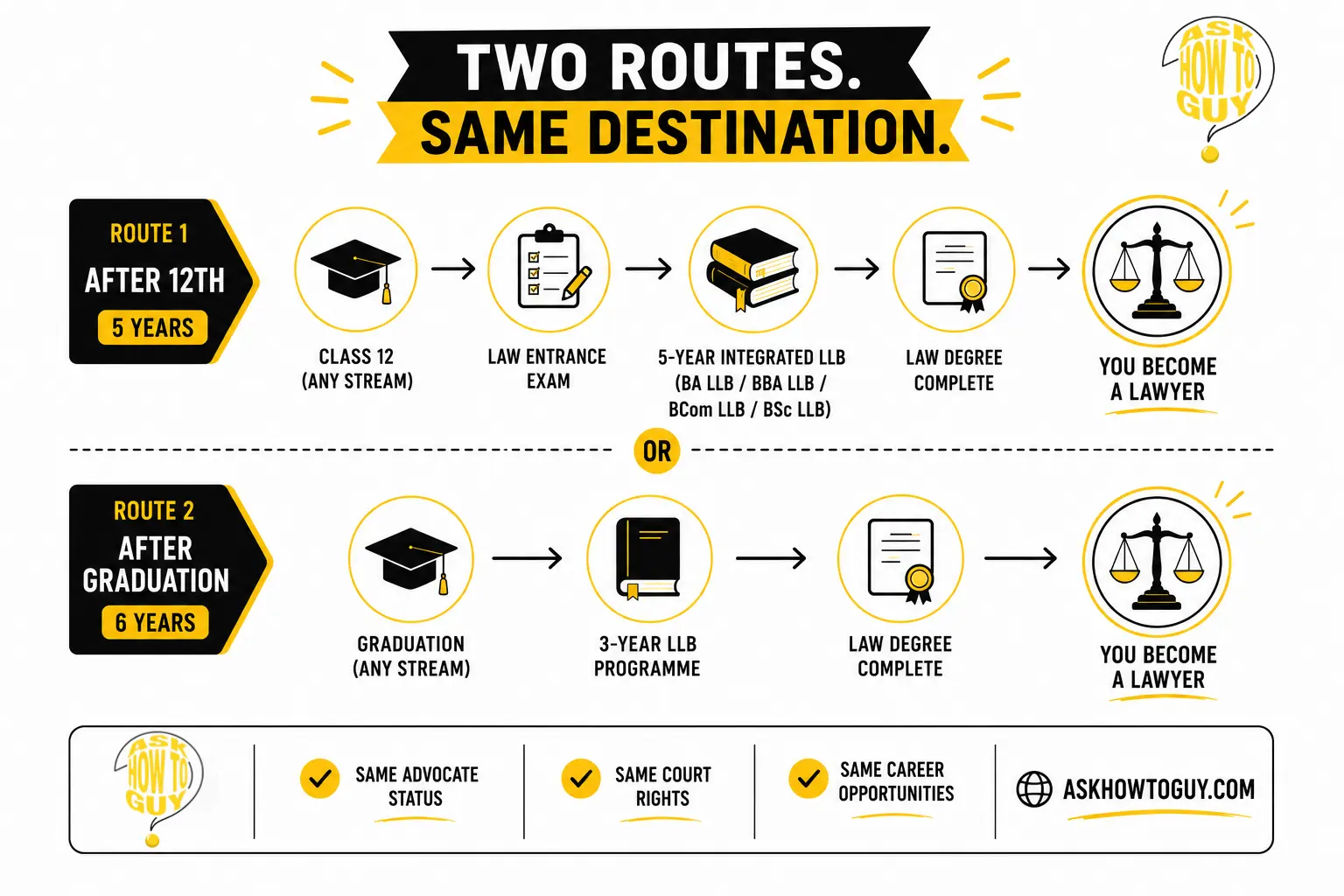
| Step 1 | Complete Class 12 in Any Stream Science, Commerce, or Arts – BCI doesn’t restrict stream. 45% aggregate required (40% for SC/ST). This is where how to become a lawyer after 12th planning begins. |
| Step 2 | Clear a Law Entrance Exam CLAT for NLUs, AILET for NLU Delhi, LSAT for private colleges, or state-level exams like MH CET Law, DU LLB. Not all colleges require an entrance exam. |
| Step 3 | Complete Your Law Degree 5-year integrated BA LLB / BBA LLB / BCom LLB after 12th, or 3-year LLB after any bachelor’s degree. Both are BCI-recognised and career-equivalent. |
| Step 4 | Internships & Moot Courts BCI mandates internship hours during your degree. Start from Year 2 – moot courts, law firm internships, court visits. This is where your real legal instincts develop. |
| Step 5 | Enrol with the State Bar Council After your degree, apply to the Bar Council of the state where you plan to practise. Submit academic documents, ID proof, and enrolment fee. |
| Step 6 | Clear the All India Bar Examination (AIBE) An open-book exam conducted by BCI testing core law subjects. Pass rate is around 60-65% – it’s not trivial even open-book. Clearing it gives you the Certificate of Practice. |
| ⏱ Total timeline: 5 years from Class 12 (integrated LLB), or 6 years if you do graduation first then 3-year LLB. Add 1 year of practice before you find your footing. | |
How to Become a Lawyer After 12th
The cleanest, most direct version of how to become a lawyer after 12th is the 5-year integrated LLB – BA LLB, BBA LLB, BCom LLB, or BSc LLB, depending on your interest. You enter straight after Class 12, and by the time you graduate, you have both a bachelor’s degree and a law degree in one shot.
Getting into a good college requires clearing an entrance exam. CLAT is the national-level test that gets you into 24 National Law Universities – the NLUs that top firms recruit from heavily. NLU Delhi uses its own exam, AILET. Private universities like Symbiosis use SLAT, and many others accept LSAT India. State-level exams like MH CET Law cover Maharashtra colleges. If your CLAT score isn’t where you want it, don’t panic – top private law schools are genuinely strong options and have their own entrance routes.
The 5-year route is especially smart if you already know you want a career in litigation or the judiciary. You’re immersed in legal thinking from Year 1, you get five years of moot court experience, and you graduate with one fewer year spent “figuring it out” compared to someone who did a BA first and then switched to law.
How to Become a Lawyer in India After Graduation
Already have a degree? You don’t need to redo an undergraduate programme. The 3-year LLB course is specifically designed for graduates entering law after another discipline.
Any bachelor’s degree from a recognised university works – B.Com, B.Sc., B.A., B.Tech., even an Engineering degree. The minimum eligibility is 45% aggregate (40% for SC/ST). Some top law schools require their own entrance exam for the 3-year route; others – including many private colleges – offer merit-based admission without CLAT.
This route has one real advantage: you bring something into the law degree. A Commerce graduate who does an LLB ends up with a natural edge in corporate or tax law. An Engineering graduate who switches to IP law is more valuable in a tech firm’s legal team than someone who only ever studied law. Your prior degree isn’t baggage – in the right specialisation, it’s your strongest card.

How to Become a Corporate Lawyer
Corporate law is the most talked-about specialisation, and for good reason – it’s where the highest starting salaries in Indian law sit. Understanding how to become a corporate lawyer is really about three things: getting into the right college, stacking the right internships, and being useful from day one.
A degree from a top NLU – NLSIU Bangalore, NLU Delhi, NALSAR Hyderabad, or Hidayatullah NLU – gives you an easier entry into elite law firms (the “Magic Circle” of Indian legal practice: AZB & Partners, Cyril Amarchand Mangaldas, Shardul Amarchand, Trilegal, etc.). But it’s not the only door. Law firms recruit from strong private schools too, especially students with impressive moot court records or substantive internship experience.
Focus on M&A, contracts, securities law, and corporate governance during your degree. Intern at a law firm – even a small one – from your second year. BBA LLB tends to be the preferred integrated degree if corporate law is the goal, since the business administration foundation gives you the language of corporate clients before you’ve even seen a boardroom. Fresh corporate law associates at top firms currently start at roughly ₹12-18 LPA at NLU placement, with mid-career growth that comfortably crosses ₹30-40 LPA in 5-7 years.
How to Become a Criminal Lawyer
Criminal law is the most visible face of the profession – the courtroom arguments, the cross-examinations, the high-stakes trials. Learning how to become a criminal lawyer is ultimately about building litigation skills and court presence, which takes years of actual courtroom time, not just a degree.
Unlike corporate law, criminal practice doesn’t have a clear “firm recruitment” pipeline. Most criminal lawyers are either junior under an established senior advocate in a district or High Court, or build their own practice gradually. The path is slower and more unpredictable financially in the early years – but it’s also the most operationally independent corner of the profession.
Criminal law doesn’t have a separate specialization degree in most law schools – the core LLB covers it. What matters is what you do outside class: attend as many criminal court hearings as you can during your degree, intern under a criminal lawyer or public prosecutor, and study landmark Supreme Court judgements on criminal procedure. After BCI enrolment, the standard path is to work as a junior under a senior advocate for 2-3 years before taking independent briefs. That apprenticeship phase is where real education happens.
How to Become a Government Lawyer
The term “government lawyer” covers a wide range. It could mean a Public Prosecutor arguing criminal cases on behalf of the state, an Assistant Government Pleader appearing for a state government in civil courts, or a Central Government Standing Counsel representing Union ministries in High Courts. Each has its own recruitment path – understanding how to become a government lawyer means knowing which category you’re aiming for.
Public Prosecutors and Assistant PPs are typically recruited by state governments through public service commissions – most require 3-7 years of standing practice as an advocate before you can apply. Central government law officers are empanelled by the Ministry of Law & Justice through a separate process. If the judiciary appeals to you more than government litigation, our guide on how to become a judge in India covers the Judicial Services exam route – which is the most structured government career path for law graduates.
There’s also the UPSC route: the Indian Legal Service is a Central Service that recruits law graduates directly through a UPSC-conducted exam, placing officers into legislative drafting, international law advisory, and ministry-level legal work. It’s less known than IAS or IPS but gives law graduates a structured government career with defined progression. Our how to become an IAS officer guide covers the broader UPSC CSE structure if you want to understand how government service exams work.
How to Become a Tax Lawyer in India
Tax law is one of the most technically demanding – and consistently well-paid – specializations in Indian legal practice. How to become a tax lawyer in India is a question that comes up most often from Commerce graduates, and for good reason: a CA background or B. Com foundation gives you a natural head start in understanding the tax code before you’ve read a single case law.
The specialization broadly splits into direct tax (income tax, corporate tax, transfer pricing) and indirect tax (GST, customs duties, excise). Direct tax litigation involves appearing before Income Tax Appellate Tribunals, High Courts, and the Supreme Court. Indirect tax has seen an explosion of work since the GST rollout in 2017, and the demand for specialists hasn’t caught up with the supply yet — which makes it a smart area to focus on.
During your LLB, pick taxation law as an elective wherever available. Intern with a CA firm’s direct tax team or with a law firm that has a tax practice. After enrolment, how to become a tax lawyer in india step by step essentially means: LLB degree → BCI enrolment → AIBE certificate → junior under a senior tax advocate or tax law firm → independent practice or in-house tax counsel role. An LLM in Taxation from a recognized university accelerates the trajectory considerably. Our guide on how to become an income tax officer is worth reading alongside this – understanding how the Income Tax department works from the inside makes you a sharper tax advocate.
Also Read: How to Become an Income Tax Officer
How to Become an Advocate in India
If your goal is to practise law and represent clients, becoming an advocate is the next step after completing your LLB. The journey starts with choosing a recognised law programme, but getting a law degree is only one part of building a career in advocacy.
For students planning their career after Class 12, the usual route is a 5-year integrated LLB. If you already have a bachelor’s degree, you can take the 3-year LLB route. During law school, internships, moot courts, legal research, drafting, and exposure to actual court proceedings can help you understand what practising law is really like.
After your LLB, there are a few professional steps you need to complete before you can start practising. These include the required Bar Council formalities and the AIBE. Once you complete the applicable requirements, you can move from being a law graduate to practising as an advocate.
The process may look straightforward on paper, but becoming a good advocate takes time. Many fresh law graduates start by working with a senior advocate or joining a law firm to gain practical experience before taking up independent matters. Strong communication, legal research, drafting, negotiation, and case preparation skills are just as important as your law degree.
If you enjoy dealing with clients, studying legal issues, preparing cases, and representing people in legal matters, advocacy can be a rewarding career option after an LLB.
BCI Enrolment and AIBE – The Two Steps Everyone Underestimates
BCI Enrolment and AIBE – The Two Steps Everyone Underestimates
A lot of law graduates finish their LLB and then put these two steps on the back burner. Don’t! If you want to practise as an advocate, completing your degree is only the beginning.
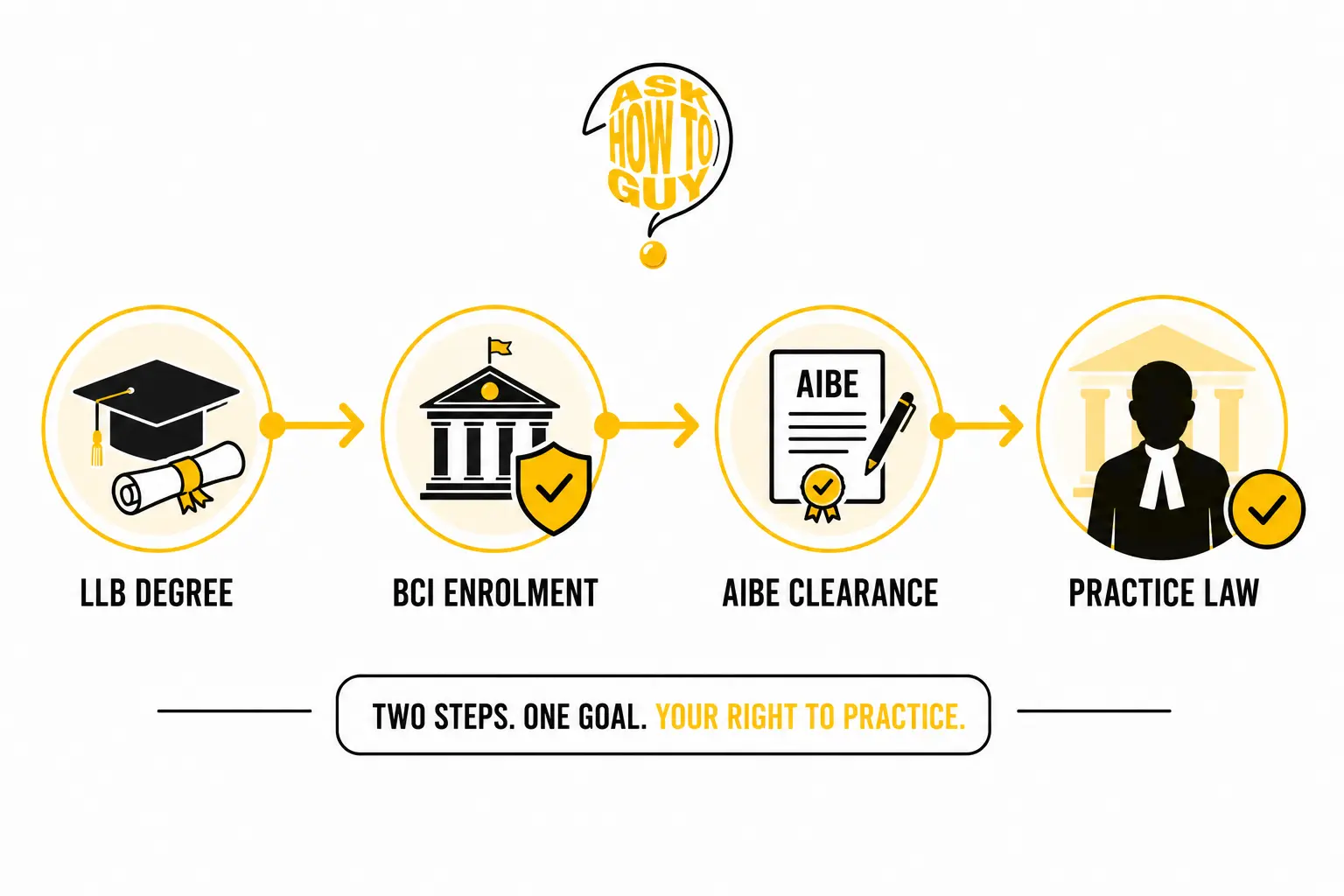
Step 1: Enrol with the State Bar Council
After completing your LLB, you need to apply for enrolment with the State Bar Council in accordance with the applicable rules. The enrolment process generally involves submitting documents such as your law degree, marksheets and identity proof, along with the prescribed fee.
Once your enrolment is completed, you become an enrolled advocate. However, you still need to meet the applicable requirements to obtain the right to practise.
Step 2: Clear the All India Bar Examination (AIBE)
The All India Bar Examination (AIBE) is conducted by the Bar Council of India (BCI) as part of the process for law graduates seeking to practise law. The examination covers important areas of law, including Constitutional Law, the Code of Civil Procedure, criminal law, Contract Law, Evidence and other subjects included in the applicable syllabus.
The AIBE is open-book, but that doesn’t mean it is something you can walk into unprepared. You need to understand the basic concepts and know how to find the relevant provisions quickly during the examination.
Once you meet the applicable AIBE requirements, you can obtain your Certificate of Practice, allowing you to practise as an advocate subject to the applicable rules.
So, think of the journey like this:
[ LLB → State Bar Council Enrolment → AIBE → Certificate of Practice → Legal Practice ]
These steps may sound like paperwork, but they are what take you from having a law degree to being able to practise as an advocate, subject to the applicable rules.
Difference Between Lawyer and Advocate
The terms “lawyer” and “advocate” are often used interchangeably, but they are not exactly the same. A lawyer is generally someone who has completed a law degree, while an advocate is a law graduate who has completed the required enrolment and certification process to practise law.
For example, after completing an LLB, you can explore careers in corporate legal departments, law firms, compliance, legal research, contracts, consulting, and other areas. If you want to practise and represent clients in court, you need to follow the applicable Bar Council requirements and obtain the right to practise.
| Lawyer | Advocate |
|---|---|
| Has completed a law degree | Has completed a law degree and the required Bar Council formalities |
| Can pursue several legal and non-courtroom careers | Can practise law and represent clients in court, subject to applicable rules |
| May work in corporate, compliance, legal research or consulting roles | Often works directly with clients and handles legal proceedings |
| Does not necessarily practise in court | Primarily associated with legal practice and court representation |
In simple terms, an advocate is a lawyer who has completed the requirements to practise law. So, if you’re planning a career in law, first decide what kind of work interests you. You don’t necessarily have to become a courtroom advocate after completing your LLB; corporate law, legal consulting, compliance, government jobs, legal research, and other paths are also available.
| 💬 The Guy’s Take Everyone thinks law is about arguing your way out of a problem. It isn’t. Good lawyers spend far more time reading, researching, drafting, and preparing than they do speaking in a courtroom. If you’re considering law as a career, be honest about what you enjoy. You’ll spend a lot of time with case laws, legal documents, research papers, contracts, and details that most people would happily avoid. Being a confident speaker helps, but being able to understand a complicated issue and explain it clearly matters much more. Also, don’t wait until your final year to think about what you want to do with your law degree. Corporate law, litigation, criminal law, tax, intellectual property, government jobs, and legal compliance all require different skills and offer very different working lives. You don’t need to have your entire career figured out in first year, but getting some exposure to different areas early can help you make better choices later. Your LLB gives you the qualification. What you do with those years determines whether you’re simply a law graduate or someone who is actually prepared for the career you’ve chosen. |
Frequently Asked Questions
1. What is the minimum age to become a lawyer in India?
There is no minimum age as such – but practically, the earliest you can begin a 5-year LLB is right after Class 12, which most students complete around age 17-18. BCI had earlier set a minimum age of 20 for 5-year programs and 21 for 3-year LLB, but both limits have since been removed. You just need to meet the educational eligibility: 12th pass for the integrated program, graduation for the 3-year course.
2. What is the maximum age to become a lawyer in India?
There is no maximum age limit either. BCI removed its earlier age caps (which were 20 for 5-year and 30/45 for 3-year LLB). The Supreme Court also criticized the old age restrictions, and BCI responded by eliminating them entirely. This means you can pursue an LLB and enroll as an advocate at 40, 50, or beyond – there is no cutoff.
3. How many years to become a lawyer in India?
5 years if you start directly after Class 12 with an integrated LLB (BA LLB, BBA LLB, etc.). 6 years if you do a 3-year bachelor’s degree first and then a 3-year LLB after graduation. Add 1-2 years of juniorships and actual practice before you’re functioning independently, and the realistic “becoming a proper lawyer” timeline from Class 12 is 6-8 years for most people, not 5.
4. How to become a lawyer in India after graduation?
Complete a 3-year LLB from a BCI-recognized law college – your stream doesn’t matter, just a 45% aggregate in graduation. Clear whatever entrance exam the college requires (some don’t need one). After your degree, enroll with the State Bar Council of your chosen state, then clear the AIBE to get your Certificate of Practice. From there, find a senior advocate to junior under for 2-3 years before taking independent briefs.
5. How to become a tax lawyer in India step by step?
Step 1: Complete your LLB (5-year after 12th, or 3-year after graduation – a B. Com or CA background helps).
Step 2: During the degree, take taxation law electives and intern with a tax law firm or CA firm’s tax litigation team.
Step 3: Enroll with your State Bar Council.
Step 4: Clear the AIBE.
Step 5: Junior under a senior tax advocate or join a law firm’s tax practice for 2-3 years.
Step 6: Build your own direct/indirect tax practice or move in-house as a tax counsel in a corporate. An LLM in Taxation after your LLB significantly accelerates the specialization.
Found this useful? Share it with someone still deciding between LLB and other options. Got a question about a specific specialisation, entrance exam strategy, or choosing between 5-year and 3-year LLB –
drop it in the mail: hello@askhowtoguy.com !